
Theme images by kelvinjay. Powered by Blogger.

This is war propaganda

This is war propaganda
A 2013 Mondoweiss article exposing how war propaganda gets a "makeover". The same military action is rebranded for media: "targeted operation" instead of "bombing", "self-defense" instead of "aggression". Goal: reshape public perception and sell the war.

COVERT WAR ON TERROR Yemen: reported US covert action 2012

COVERT WAR ON TERROR Yemen: reported US covert action 2012
2012 report on reported US covert operations in Yemen as part of the "War on Terror". The article discusses secret military actions, drone strikes, and how they were covered in media. Source: bladalarb.blogspot.com

CALL FOR INTERNATIONAL SOLIDARITY

CALL FOR INTERNATIONAL SOLIDARITY
CALL FOR INTERNATIONAL SOLIDARITY Article from Brussels Tribunal calling on global activists, intellectuals, and movements to unite in solidarity with Iraq and against occupation. Source: brussellstribunal.org

Saddam’s VP, Izzat ad-Douri: Maliki follows Iran’s agenda to divide Iraq /Video)

Saddam’s VP, Izzat ad-Douri: Maliki follows Iran’s agenda to divide Iraq /Video)
2013 video statement by Saddam's former VP Izzat ad-Douri. He accuses PM Maliki of following Iran's agenda to divide Iraq. Source: bladalarb.blogspot.com

BOOKS ON IRAQ

BOOKS ON IRAQ
click Pic.

The US War crimes on Iraq

The US War crimes on Iraq
How much they hate Iraq and why?

War in Mali : STOP THIS

War in Mali : STOP THIS
CLICK PHOTO

War in Syria : STOP THIS

War in Syria : STOP THIS
CLICK PHOTO

Welcome to Kuala Lumpur Foundation to Criminalise War

Welcome to Kuala Lumpur Foundation to Criminalise War
Kuala Lumpur Foundation to Criminalise War The Foundation promotes justice and accountability for war crimes. It seeks to bring political and military leaders responsible for aggression and crimes against humanity to an international tribunal.

Criminalize War - War is about killing, massive killing

Criminalize War - War is about killing, massive killing
A - List of killed Iraqi academics

"Kill Anything That Moves"

"Kill Anything That Moves"
Military Doctrine Began in Vietnam

How the Pentagon is hiding the dead The secret campaign to undercount the ‘war on terror’ death tol

How the Pentagon is hiding the dead The secret campaign to undercount the ‘war on terror’ death tol
CLICK The PIC

U.S. Officials Guilty of War Crimes

U.S. Officials Guilty of War Crimes
for the Iraq War

The Massacre of Al-Amiriyah Shelter Remembered – 2/10/13

The Massacre of Al-Amiriyah Shelter Remembered – 2/10/13
click Pic

PILOTS FOR 9/11 TRUTH

PILOTS FOR 9/11 TRUTH
Now available

US War Crimes

US War Crimes
Coverup of Extensive War Crimes

Barack Obama : A Gigantic Fraud upon the American People

Barack Obama : A Gigantic Fraud upon the American People
Clik Pict.

The victims of Fallujah's health crisis are stifled by western silence

The victims of Fallujah's health crisis are stifled by western silence
To research a possible link between US bombardment and rates of birth defects and pediatric cancer in Iraq is a moral imperative

If Americans Knew

If Americans Knew
UN Resolutions Targeting Israel and the Palestinians

40% of Palestinian Children Detained by Israel Sexually Abused; Virtually All Tortured

40% of Palestinian Children Detained by Israel Sexually Abused; Virtually All Tortured
Click Pict.

The Iraq War began when

The Iraq War began when
CLICK PC.

Israeli soldiers raid Al Aqsa courtyard, attack worshipers

Israeli soldiers raid Al Aqsa courtyard, attack worshipers
CLICK The PIC

#CrowdActivism 911 Mass Arrests!

#CrowdActivism 911 Mass Arrests!
Click for RAW Evidence DECIDE *now*!

War Crimes Are US

War Crimes Are US
Depleted Uranium weapons: Why shouldn’t it be a war crime to poison civilians with radiation?

The Iraqi weapons of mass destruction

The Iraqi weapons of mass destruction
Found at last! After searching for 10 years, the Iraqi weapons of mass destruction have finally been found – in Syria

The Mother of All Battles The Endless U.S.-Iraq War

The Mother of All Battles The Endless U.S.-Iraq War
Book by Jeff Archer

MASS Graves uncovered accidentally unveiling true dangers of iranian backed militias in iraq

MASS Graves uncovered accidentally unveiling true dangers of iranian backed militias in iraq
REPORT Foreign Relations Bureau - Iraq - United Kingdom

Get the REAL DEAL

CLICK TO VISIT

operation iraqi freedom

operation iraqi freedom
click PC

LIST OF KILLED IRAQI ACADEMICS

LIST OF KILLED IRAQI ACADEMICS
ASSASSINATED IRAQI MEDIA PROFESSIONALS

International Lawyers Seek Justice for Iraqis

International Lawyers Seek Justice for Iraqis
Sabah al-Mukhtar is the president of the Arab Lawyers Association and chair of the Iraq Commission

A World Appeal to Anti-war Forces: STAND WITH IRAQ!

A World Appeal to Anti-war Forces: STAND WITH IRAQ!
click the photo

Engineering solution for Radioactive Waste in IRAQ

Engineering solution for Radioactive Waste in IRAQ
Engineering Solution for Radioactive Waste in IRAQ

Wikileaks Iraq: data journalism maps every death

Wikileaks Iraq: data journalism maps every death
Iraq war logs release has dumped some 391,000 records

Report on Status of Iraq

Report on Status of Iraq
Government War Crimes in Anbar Province

Historical Analysis of the Global Elite: Ransacking the World Economy Until ‘You’ll Own Nothing.’

COVERT WAR ON TERROR Yemen: reported US covert action 2012

COVERT WAR ON TERROR Yemen: reported US covert action 2012

Sir Henry Kissinger: Midwife to New Babylon

Sir Henry Kissinger: Midwife to New Babylon
The moment Kissinger’s last breath left his corpse, media commentators lost no time running out the gates, either singing songs of slavish praise about the “great liberal statesman”clik Pict.

Action in Ghent 16 March. 7000 posters were distributed by 70 volunteers. A lot of "Justice For Ira

Beyond Torture U.S. Violations of Occupation Law in Iraq

Beyond Torture U.S. Violations of Occupation Law in Iraq
A report by the Center for Economic and Social Rights

Iraqi Children: Deprived Rights, Stolen future

Iraqi Children: Deprived Rights, Stolen future
click PIC

Syria News - August 16, 2013 (Warning: Graphic Videos)

Syria News - August 16, 2013 (Warning: Graphic Videos)
Local Coordination Committees of Syria + Videos

Letter From Yemen by Felicity Arbuthnot + Defining Drone Deaths in Yemen

Handwritten letter from President Saddam Hussein to the American people. 7 July 2006.

Handwritten letter from President Saddam Hussein to the American people. 7 July 2006.
To the American people:

Saddam Hussein refuses to sell out Iraq.

Saddam Hussein refuses to sell out Iraq.
Saddam Hussein refuses to sell out Iraq. Egyptian Magazine publishes transcript of meeting in prison between Saddam Hussein and Donald Rumsfeld.

Report On Israeli Human Rights Violations

Report On Israeli Human Rights Violations
Weekly Report On Israeli Human Rights Violations in the Occupied Palestinian Territory (23 - 29 May 2013)

Weekly Report On Israeli Human Rights Violations in the Occupied Palestinian Territory (05 - 12 Jun

Weekly Report On Israeli Human Rights Violations in the Occupied Palestinian Territory (05 - 12 Jun
The Palestinian Centre for Human Rights (PCHR)

IRAKDOSSIER in DE WERELD MORGEN: verschillende Engelstalige artikels die op deze website staan, wer

Undercover FBI Agent Tried to Get Activists to Send Money to PFLP, a US-Designated Terrorist Organization

Undercover FBI Agent Tried to Get Activists to Send Money to PFLP, a US-Designated Terrorist Organization

By: Kevin Gosztola


Graphic made by activists targeted in FBI raids to raise awareness around their case. (from StopFBI.net)
Alleged evidence the Federal Bureau of Investigation (FBI) used to obtain search warrants for raids on the homes of antiwar and international solidarity activists in the midwestern United States were unsealed. The files reveal a persistent effort by an undercover FBI agent to get activists to send money to the Popular Front for the Liberation of Palestine (PFLP) so the government could charge them with material support for terrorism offenses.
The raids took place on September 24, 2010, in the cities of Chicago, Minneapolis and Grand Rapids, Michigan.  Fourteen activists were subpoenaed to testify before a grand jury. The FBI alleged they had provided "material support" to "designated foreign terrorist organizations"; specifically, the PFLP and the Revolutionary Armed Forces of Colombia (FARC). Yet, more than three and a half years later, the activists have not been charged with any crimes. (Subsequently, nine other activists were issued grand jury subpoenas).
Jessica Sundin, one of the activists who was raided, subpoenaed and continues to live with the possibility of one day being charged, was part of the effort to unseal files the government had initially sealed indefinitely because this was a "terrorism" case. The activists wanted the files public to hopefully find out if the investigation into activists implicated was over or not. They also did not think it was right for the government to continue to keep this information secret.
From July 2008 to as late as May 31, 2010, an undercover FBI agent known to activists as "Karen Sullivan" infiltrated them as they prepared for a major antiwar demonstration at the 2008 Republican National Convention. She then became a member of the Freedom Road Socialist Organization (FRSO) and provided political intelligence to the FBI on how the organization�s private operations.
Sundin pointed out that the affidavit makes it seem like an undercover agent met someone in FRSO, like at the library or the coffee shop. What really happened is the undercover agent met up with a group of activists organizing as part of the Antiwar Committee (AWC) (which was targeted and raided by the FBI too). They were the "chief organizers" of a major march. Months were spent trying to secure permits for the action in downtown St. paul to demand an end to the wars in Iraq and Afghanistan. However, the affidavit makes no mention of this part of the FBI operation when intelligence was being fed to authorities for the national special security event.
The affidavit laying out the "facts supporting probable cause to search the subject premises" was written by Special Agent John P. Thomas of the FBI Joint Terrorism Task Force in Minneapolis. Thomas makes clear in a footnote, "My descriptions of recorded conversations made by UC1 ["Sullivan"] are summaries based on my review of the recordings, the review of recordings by other JTTF members, UC1′s reports describing those recordings and my understanding and UC1′s understandings of the context of the recorded conversations. These descriptions are not based on a final, verbatim transcript." It does not contain a "description of every topic discussed or every statement contained in any recorded conversation."
The content of the affidavit seems to consist of the most sensational and often out-of-context statements and jokes uttered by activists in the presence of "Sullivan." They are accepted as serious and fact, and the humor and cultural context is not understood by FBI agents. It is as if they still suffer from an institutional and historical bias against leftwing organizing that can be traced back to when the Bureau was founded and operated by J. Edgar Hoover with a commitment to destroying and annihilating the effective organizing efforts of communists and socialists.
That does not mean the allegations are not to be taken seriously. Their nature give the FBI a great power to wield over the activists as government prosecutors continue to threaten to charge them with allegedly providing, attempting to provide or conspiring to provide "material support for terrorism."
What is Asserted in the FBI�s Affidavit?
In sum, the affidavit asserts that FRSO has a "secret goal" to "violently overthrow the government of the United States." It has also "secretly provided" "material support" to the FARC and PFLP. It alleges that "Sullivan" learned the FRSO provided "material support to terrorist organizations through donations to individual members of foreign terrorist organizations, to unions operating as fronts for the terrorist organizations and through 'delegations� composed of FRSO members visiting the terrorist organizations."
A second undercover officer apparently pretended to be "Sullivan�s" life partner and was shown a video of Sundin on a trip in Colombia where she met members of the FARC in 2000.
"Sullivan" was invited to go on a solidarity trip to Palestine in August 2009. The activists helped her fundraise to go on the trip, and "Sullivan" apparently asked multiple times about whether the activists going on the trip would raise money for the Palestinian Women�s Union, which hosted the trip. The undercover agent also determined that the Women�s Union has members, who are a part of PFLP, and concluded money given to them would likely fund the purchase of guns.

Toward the end of July 2009, the undercover agent asked about $4,100 raised for the delegation ($2,000 which was for a "donation"). The affidavit claims that the Antiwar Committee Educational Fund, a nonprofit, made a "grant" to the Antiwar Committee, which then issued checks in order to protect the nonprofit�s status because money was being sent to a "terrorist organization." There apparently was fear (though this may be a joke) that if the Antiwar Committee was audited or looked into by the FBI "it would be in jeopardy."
While it may seem like this would make a case to bring charges against the activists, apparently nothing happened that the FBI wanted to prosecute at that point. Multiple transactions are described in the affidavit in the months following August but none indicate proof of "material support" for PFLP. And, significantly, "Sullivan" was not able to get into Israel with the delegation because when she arrive in Israel, she and two other delegates were denied entry by Israeli security.
Pressure Mounts, FBI Needs a Case It Can Prosecute
The pressure to conclude the operation and prosecute someone for an actual crime increased. By March 4, 2010, the operation became one where "Sullivan" was engaged in an effort to entrap one of the activists into sending $1,000 dollars to a foreign terrorist organization.
From the affidavit:
�On March 4, 2010, UC1 recorded a conversation with [REDACTED]. UC1 told [REDACTED] that UC1′s father had left him/her a package, which included envelopes and a video called "Women in Struggle," when he recently died. UC1 told [REDACTED] that the video was about women in the PFLP who admitted killing and bombing targets in Israel. UC1 said that his/her father left $1,000 for UC1 to get to the "organization of the women in the video." [REDACTED] said that they can "get it to our people." [REDACTED] told UC1 to talk to [REDACTED] at the FRSO Congress meeting in May 2010. [REDACTED] said that "if that�s what you want to do with it, we can get it there" and said that $1,000 "will go far in a place like Palestine." UC1 said that the $1,000 was for the women "which were the PF."�
So, "Sullivan," an undercover FBI agent, informed activists she wanted them to ensure money reached women who were part of a US-designated foreign terrorist organization. She insisted after it appeared the money might go to Palestinians, who were not a part of the PFLP. She was part of a perverse scheme to convince activists that her father had died and it was his last dying wish to get money to the PFLP because he had treasured a documentary on Palestinian militant resistance to Israeli occupation.
The undercover agent raised the issue of the documentary and her fictional dead father�s $1,000 again on March 10. "Sullivan" talked with an activist on March 11 about it another time, suggesting her father "regretted" not sending it when she was "part of the delegation to Palestine in 2009."
"Would It Actually Go to the PF?" 
A span of more than two months elapsed. None of what happened is highlighted in the description of this effort to get the activists to send $1000 to the PFLP. Suddenly, May 20, 2010, "Sullivan" was back at it again trying to get the money to this US-designated foreign terrorist organization. She managed to get an activist to text someone about giving money to an "NGO," which appears to have been twisted into PFLP works with NGOs so the activist was going to help get the money to the PFLP.
Finally, there was an FRSO national meeting at the Crowne Plaza Hotel in Northbrook, Illinois for dues paying FRSO members from May 28 to May 31. "Sullivan" was committed to achieving success by getting some member to transfer the money to the PFLP.
�On the evening of May 29, 2010, UC1 approached [REDACTED], who were speaking with one another, and recording the ensuing conversation. [REDACTED] told UC1 that she had spoken with [REDACTED] and that "it is going to be taken care of." [REDACTED] told UC1 that [REDACTED] wife will be leaving for Palestine in about a month, so it will not be a problem to get done what UC1 needed to get done. [REDACTED] said "yes, it should be easy." [REDACTED] said it is especially easy to get the money there when a family member is going. UC1 asked "would it actually go to the PF." [REDACTED] responded "yeah, yeah."�
"Yeah, yeah," like go away from me now and stop asking about sending money to a terrorist organization? Or "yeah, yeah," like, yes, your money will get to where you want it to go?
�[REDACTED] said he would tell his wife who to give it to. FRSO Member K stated, "The war on terror, right here. Who is the terrorist? We are the terrorist." [REDACTED] laughed loudly after FRSO Member K made this comment�
The affidavit shows that less than an hour later "Sullivan" raised the issue of the video and the $1000 from her fictional dead father yet again. She got someone to say he loved her story and it would "be cool" to help her send money because it is "such a cool story." And the undercover agent asked someone to "just tell me it�s going to the org (the PFLP)."
On May 30, "Sullivan" handed off $1,000 to someone at the national meeting. A male allegedly took the cash, put it in his pocket, hugged the undercover agent and said, "Thank you. This will get to the PF." A letter from the PFLP was "purportedly" read that day, where a leader sent "special thanks to FSRO for their immeasurable support of him and the PFLP."
�On May 31, 2010, in a recorded conversation, [REDACTED] asked UC1 if it would "be OK if that money was sent from our organization [the FSRO]." [REDACTED] stated that "we�ve given substantial material aid in the past [to the PFLP." [REDACTED] referenced UC1′s trip with other FRSO members in 2009. [REDACTED] stated that the money that UC1 and other members brought "got to them" even though they were turned away at the Israeli border� [emphasis added]
It appears this person did not say it had given "substantial material aid" to PFLP in the past. To PFLP was grafted onto the statement by the FBI. The money would go to wherever the money went during the delegation in 2009, which meant probably not the PFLP or else "Sullivan" would not have spent the past months trying to get an activist to commit the crime of material support for terrorism. The activists involved in the conspiracy, if one existed, would have been arrested after the 2009 trip.
Raids were not carried out on the homes or the office of the Antiwar Committee until the final week of September 2010. That is about four months later. What was the problem? Obviously, the FBI didn�t know if money was given to the PFLP and, ultimately, it just decided to raid homes and an office, seize property and conduct a search of computers and records to see if it could uncover the evidence the agency desired so prosecutors could bring a case.
"An Embryonic Version of Officially Instigated Terrorism" 
The nature of this FBI operation may evoke memories of COINTELPRO operations directed at groups like the Socialist Workers Party, the Puerto Rican Independence Movement, the New Left, the American Indian Movement and even black and white hate groups. Frank Donner, civil liberties lawyer, author and director of the American Civil Liberties Union�s (ACLU) Project on Political Surveillance, considered these operations "an embryonic version of officially instigated terrorism."
"The Bureau constituted itself the secret instrument of the tribal system of justice directed against people it had itself defined as enemies and outcasts," he argued. They were "unfettered by professionalism or, for that matter, the norms of legality and accountability." They did what "seemed like a good idea at the time."
Betty Medsger, in her book, The Burglary: The Discovery of J. Edgar Hoover�s FBI, explores this in great detail as she tells the story of activists who broke into the FBI�s office in Media, Pennsylvania, and took files which exposed domestic surveillance in the 1970s. These operations, she notes, were to "maintain the status quo and quash new ideas by harassing people into silence and passivity." For example, the FBI used informant Robert Hardy to become an "agent provocateur" and advise a group of peace activists on how to "break into the draft board office." He "taught them techniques" they did not know and had not used in previous draft board raids.
In the case of twenty-three activists, who have faced a federal grand jury investigation for over three years, they are Americans who have organized in solidarity with the people of Colombia and Palestine that are engaged in life and death struggles.
The government has put forward no clear evidence that any of the money being donated specifically went to groups designated as terrorist organizations. In fact, the FBI would have the public believe these activists provided "material support" to the FARC because the FBI happens to believe there are FARC members, "who do not publicly acknowledge their FARC membership and who are members of various unions in Colombia." What the FBI fails to grasp is it would not be a crime to support the union if it is not a designated terrorist organization.
What is their crime? They are on the side of political struggles in countries, which the US government has opposed through its foreign policy.
Yet, years after the raids, these activists have not gone into hiding. While they have not organized any solidarity trips, they have spoken out and fought back and, as Sundin said, refused to "hide in the shadows." They have stood behind the work they have done and "created a real challenge" for the government to proceed with this case, according to Sundin.
The activists� lawyers do not know whether the government plans to eventually charge these activists with "material support for terrorism" charges, which if it were to happen would be incredibly serious. But, for now, the public can see the dubious evidence at the center of the case�evidence that seems to involve an undercover agent once again trying to get activists to engage in criminal activity as means to control and repress individuals courageous enough to dissent against deeply entrenched policies of their government.

Source

Yemen: Partition or federation?

Yemen: Partition or federation?

Mohamed Al-Said Idris


1yemen-p988004-798_resized.jpg

Powerful forces are at work hoping to frustrate efforts to find a political settlement to the crises in Yemen, writes Mohamed Al-Said Idris

March 1, 2014
uruknet.info
Yemen, like many of the other countries of the Arab Spring, appears to be fated to a period of extended instability, the worst aspect of which is that the effects of foreign intervention and foreign interests far outweigh the effects of internal factors.

The National Dialogue Conference, in which most if not all the Yemeni factions participated, began its activities in 2013 as an essential attempt to save the country�s revolution and to save the country from the perils of civil war and internal strife and the mounting repercussions of that strife.

Among the other spectres that loomed then was that of a possible "American solution," one originally tailored for Iraq on the ostensible grounds that it would be the cure-all to that country�s crises, and holding out the idea that partition was the key.

The National Conference convened to ward off the spectre of partition as the consequence of the internal strife that in part had taken the form of the secessionist call advocated primarily by the Southern Movement.

Formed in 2007, this is made up of a number of political groups and forces, most notably the larger portion of the Yemeni Socialist Party that governed the southern half of Yemen following independence in 1967 and subsequently entered into a partnership, following the unification of Yemen in 1990, with the General People�s Congress (GPC) headed by ousted former president Ali Abdullah Saleh.

However, there were three movements driving the country towards possible partition. There was the campaign launched by the Southern Movement to avenge itself against the unified state and revert to the era of the great split that had divided historic Yemen into a northern state and a collection of smaller states in the south that the Socialist Party brought together in the People�s Democratic Republic of Yemen (PDRY) following independence.

There was also the Houthi drive emanating from the northern governorate of Saada and expanding towards the capital Sanaa and having its sights set on founding a Zaidi theocracy. As Houthi Zaidiya doctrines have come to have much in common with Twelver Shia ones, the Houthis have become prime candidates for Iranian support, and their movement has fired Tehran�s ambitions to insert a Shia state or statelet in the southern flank of the Arabian Peninsula.

With this Houthi-Shia tide came a third source of peril in the escalating warfare that Al-Qaeda was waging in many Yemeni governorates, together with the increasing US strikes against Al-Qaeda bastions in Yemen. All the foregoing was combining to turn Yemen into a failed state.

The National Dialogue Conference that was initiated in order to address these dangers and ward off their threats to national unity was originally supposed to finish its activities within six months, which is to say in September 2013. For various reasons, its term was extended to 25 January 2014, on which date it held its closing session with high-profile Arab, regional and international attendance.

Before this closing session, the Conference adopted a Dialogue Charter by a large majority vote, one of the articles of which called for the creation of a federal state to replace the current centralised state system. The participants at the Conference also agreed to create a 22-member committee, headed by President Abd-Rabbou Mansour Hadi and representatives of all the political forces in the country, to study the possible options for a federal system and approve one of them.

There were three basic options on the table, all of which had been discussed at length during the National Dialogue. The first two were a six-region federal state with four regions in the north and two in the south, or a federation consisting of two large regions, one in the north and the other in the south. The participants hailing from the Southern Movement were the chief advocates of the latter option, as it could prelude a return to the two separate states that had existed before unification in 1990. The third option was kept open and left to the committee members to decide.

On 10 February, the committee concluded its activities. It had adopted the first option � the six-region formula � by a large majority. Foremost among the committee members to vote in favour were the representatives of the Islah (Reform) Party, the Nasserist Party, the GPC, the Justice and Construction Party, and representatives of women and youth.

Voting against it were the representatives of the Socialist Party and the Houthi group that calls itself Ansar Allah (Champions of God). Both of these groups lashed out at the committee, criticising the way it was formed and combining their justifications for opposing the selected option with harshly worded threats and warnings.

Suddenly the clock was being turned back to the period before the National Dialogue. Once again, the warring groups were reproducing the options of failure and failed solutions and pitting Yemen against challenges that threatened it with partition and civil war.


FEDERATION OR PARTITION? Those who have cheered the committee�s approval of the six-region formula see it as a decision that will safeguard Yemen from fragmentation and the imposition of the secessionist option favoured especially by the Socialist Party and extremists from the Southern Movement.

They also hold that the purpose of the federal formula is to promote modern government and administration in the regions that will have the power to supervise and address their particular issues and concerns related to development, progress and security and stability.

The chief guarantee of the success of the federal system, according to the supporters of the committee�s decision, will be the constitution. The drafting of this is set to become the focus of national activity in Yemen in the coming months in the framework of a new interim phase ushered in with the extension of the current president�s term of office for a year in order to oversee the completion of this task.

The hope is that the new constitution will enshrine a number of principles recommended by the committee. According to officials from the committee, regions should have the option to modify their internal administrative boundaries (as defined by the existing boundaries of their component provinces) and jurisdictions after one or more electoral term. This process would be subject to specific regulations as established by a law issued by the legislative authority in each region.

The committee also called for guarantees to ensure the true partnership of each region in the federal legislative and executive authorities. One mechanism towards this end would be to implement the rotation of the post of speaker of the legislative assembly. At the regional level, the principle of partnership among the constituent provinces would be ensured by guaranteeing that no one province dominates the regional cabinet.

The committee members further stressed that they had taken into account such factors as geographic contiguity, demographic homogeneity and social relations, and economic capacities in their determination of the constituent provinces of the regions and that they had resolved to retain a special status for Sanaa and Aden in view of their political and economic importance.

These recommendations were supported by some representatives of the Southern Movement who had participated in the National Dialogue, which set them apart from most other leaders of that movement who, from the outset of the dialogue, had remained bent on southern secession.

Yassin Makawi, a member of the committee representing the Southern Movement, said that the six-region federal formula "achieves for southerners, in particular, and northerners, in general, what all previous civil wars failed to achieve." He added that the federal partitioning "is only a first step towards the restructuring of the south in the framework of forthcoming institutions" and that the elected assemblies would be instrumental in setting on course legislation that followed through on the guarantees adopted by the National Dialogue.

An antithetical stance was voiced by the other camp in the Southern Movement, as well as by the Socialist Party which had boycotted the National Dialogue Conference. The tenor of this was made explicit by the Supreme Council for the Southern Movement at the outset of the Dialogue last year. "This step emanating from the Gulf Initiative does not concern the southerners, who demand freedom, independence and the restoration of the state of [South Yemen]," it said.

The Council added that "the [National Dialogue] initiative was not conceived to resolve the southern question, but merely to resolve the crisis between the government and the opposition in the north."

Ali Salem Al-Beidh, formerly the PDRY president who became Yemeni vice-president after unification, was harsher in his criticism of the six-region federal solution. It was "no more than a game that will have its day," he said, adding that he had been opposed from the outset to engaging in a Dialogue "aimed solely at solving the problem of the fight over seats in the government in Sanaa" and that he did not expect the powers-that-be in Sanaa to produce anything approaching a democratic system of government.

In sum, "the southerners reject the decision of the committee because it will not produce anything new as the social forces are incapable of carrying it out," Al-Beidh said. He also expressed his conviction that the government in Sanaa "has come under the international mandate of the countries sponsoring the Gulf Initiative" and that although the six-region federal decision may not favour any one particular country, "the governments that sponsored the Gulf Initiative played a part in this decision given that the government in Sanaa is under their mandate."


THE HOUTHI POSITION: Houthi challenges to the federal project have compounded the problems now facing it.

Houthi spokesmen have protested that the six-region plan as devised by the presidential committee will "divide Yemen into rich and poor." Their proof of this has been that the plan attaches the province of Saada � the Houthi bastion � to the region of Azal, together with Amran, Dhamar and Sanaa. This runs counter to the principles of the committee, they say, as in their opinion Saada is culturally, geographically and socially closer to Hajja and Al-Jawf, which have been attached to the regions of Tahama and Saba, respectively.

The Houthis believe that the committee�s decisions regarding the composition of the regions have been informed by Saudi pressures. Saudi Arabia, they say, seeks a large tribal and oil-producing hinterland in Yemen, particularly in the oil-rich regions of Hadramawt and Saba which have close tribal links to Saudi Arabia.

According to Houthi spokesman Mohamed Abdel-Salam, "[the federal decision] reflects the view of certain forces and does not promote true partnership. It is neither a solution to the southern question that it was meant to address, nor to the other problems in the country." He denied that Saleh Hira, president of the political council of the Houthi group, had taken part in the committee, stating that the participant had been Hussein Al-Ezzi, who had refused to sign the committee�s report.

Another reason cited by Houthi spokesmen for their opposition to the federal scheme is that it cuts Saada off from access to Red Sea ports. Some observers take this to mean that the Houthis fear that they are being deprived of links to abroad and, specifically, to foreign support.

At another level, the Houthi rejection of the federal plan coincides with their ongoing battle with a number of tribes affiliated with the Islah Party. These confrontations, raging in the province of Amran and the Arhab district near Sanaa airport, are only rivalled in their ferocity by the battles waged by Al-Qaeda in many parts of Yemen against the state and the Americans.

It appears, therefore, that the federal decision, given such formidable opposition and the ongoing strife in the country, will not solve the crises in Yemen, even if its stated purpose is to resolve the contests over power and wealth in the country. These conflicts are intimately connected with the evolution of the state and the diverse political, social and economic factors that led to the creation of two separate Yemens, unification and civil war. It is a history brimming with conflict.

The signs are that the conflict will not now end and that it will ultimately cause the collapse of the federal state if, indeed, it comes into being. In that event, Yemen faces the prospect of the dismantling of the Yemeni nation state, for the establishment of which so many Yemenis sacrificed their lives and that had revived Arab hopes for comprehensive Arab unity when the Yemeni republic was declared in 1990.

Unfortunately, it appears that the enemies of comprehensive Arab unity have not been satisfied with partitioning the Arab nation and preventing its unification. Since they proclaimed the Greater Middle East project on the eve of the US-led invasion and occupation of Iraq in 2003, they have been working to repartition the earlier partitions and to re-fragment the already fragmented Arab lands. The purported justification has been to create more homogeneous countries to replace what they have called "failed states" that were heterogeneous in their ethnic and religious composition.

The collapse of the federal state in Yemen, if that occurs, will parade beneath the call to create homogeneous statelets based on ethnic, religious and sectarian divides. Another name for that repartitioning and further fragmentation will be the rival of the Great Middle East project. That project failed in Iraq. But its architects have not given up, and thwarting the establishment of the federal state in Yemen may be an end in and of itself in order to extend the experiment elsewhere in the Arab region.

Source

Bigotry Against Muslims Fuels Massacre in Myanmar

Bigotry Against Muslims Fuels Massacre in Myanmar

By JANE PERLEZ


1myanmar-slide-f6fu-slide.jpg
Robysa Nakhata, 17, tried to comfort her mother, Asmy Nakhata, who has breast cancer, diagnosed by a nongovernmental organization in a camp in Sittwe. Rohingya are generally not allowed to leave camps

March 1, 2014
uruknet.info
DU CHEE YAR TAN, Myanmar � Under the pale moon of Jan. 13, Zaw Patha watched from her bamboo house as Mohmach, 15, her eldest child, was dragged from the kiosk where he slept as guardian of the family business.
The men who abducted the boy struck him with the butt of a rifle until he fell to the dirt path, she said in an interview, gesturing with a sweep of her slender arms. Terrified, she fled into the rice fields. She assumes he is dead.
Three doors away, Zoya, dressed in a black abaya, showed the latch on her front door that she said armed men had broken as they stormed in and began beating her 14-year-old son, Mohamed. She has not seen him since.
The villagers� accounts back up a United Nations investigation, which concluded that the attack on Du Chee Yar Tan that night resulted in the deaths of at least 40 men, women and children, one of the worst instances of violence against the country�s long-persecuted Rohingya Muslims. They were killed, the United Nations says, by local security forces and civilians of the rival Rakhine ethnic group, many of them adherents of an extreme Buddhist ideology who were angered by the kidnapping of a Rakhine policeman by some Rohingya men.
Myanmar�s government, intent on international acceptance and investment, has steadfastly denied the killings occurred in the village, a collection of hamlets spread across luxuriant rice fields close to Bangladesh and a five-hour ferry ride up the languid Kaladan River from the state capital, Sittwe. The country�s human rights commission called the news "unverifiable and unconfirmed."
The United Nations findings, however, have become emblematic of the increasing violence against Myanmar�s Rohingya, an estimated 1.3 million people who are denied citizenship under national law.
The world organization�s report � presented to the government by the United Nations and United States but not made public � documents the initial discovery of the massacre by five Muslim men who sneaked into the area after the attack. They found the severed heads of at least 10 Rohingya bobbing in a water tank. Some of those were children�s.
One of the men said he was so rattled, and concerned his eyes were playing tricks in the darkness, that he put his hands in the tank to confirm through touch what he thought he saw.
The killings are a test for Myanmar�s government, which has done little to rein in radical Buddhists, even as it pursues broad economic and political reforms of policies created by its former military leaders. The government has backed severe restrictions imposed by local authorities on Muslims� freedom of movement and deprivation of basic services in Rakhine State, where most Rohingya live.
The bloodletting is also a challenge for Western governments that have showered economic aid and good will on Myanmar in the hope of winning the fealty of the resource-rich fledgling democracy. Those countries have mostly kept their concerns about the treatment of the Rohingya quiet in the hope, diplomats said, of persuading the government to change its stance.
On Friday, the crackdown on the ethnic minority continued, when the government ordered Doctors Without Borders, the Rohingya�s main health care provider, to stop providing its services to them. One of the group�s offenses, according to a government official, was the hiring of too many Rohingya.
Since 2012, many Rohingya, a long-reviled group in Buddhist-majority Myanmar, have been herded into miserable camps they are not allowed to leave, even for work. Those still allowed to live in villages like Du Chee Yar Tan are at the mercy of the local authorities, many of whom are inspired by an extremist Buddhist group whose monks have used the nation�s new freedoms to travel the countryside on motorbikes preaching hatred of Muslims.
The latest carnage is a major embarrassment for the government, which has just assumed an important position as the annual chair of the Association of Southeast Asian Nations.
In a sign of the sensitivity, a visit to the village to assess the conflicting reports about the night of Jan. 13 was cut short when local police officers briefly detained two New York Times reporters and a photographer.
In response to a major 2012 spasm of violence in Sittwe that included the firebombing of homes and left an estimated 300 dead, most of them Muslims, President Thein Sein said most Rohingya were in Myanmar illegally, despite their having lived there, in some cases, for generations. His solution: The United Nations should help deport them.
Daw Aung San Suu Kyi, the Nobel peace laureate and opposition leader, is rarely asked at home about discrimination against the Rohingya because it is broadly accepted in Myanmar.
She has defended her lack of action to the foreign news media, saying that taking sides could further exacerbate tensions, an explanation that even her Western supporters believe is calculated to avoid offending voters ahead of elections next year.
Though there have been attacks on other Muslim groups elsewhere in Myanmar in the past two years, the animosity toward the Rohingya is especially combustible. Many of them were brought to the country from India in British colonial times, and many ethnic Burmese despise them as illegal intruders from what is now Bangladesh.
About 140,000 displaced Rohingya whose homes were destroyed in two major attacks in 2012 now live in more than two dozen camps around Sittwe, a dilapidated trading center. Largely dependent on assistance from international humanitarian groups, which are often harassed by the local authorities, the Rohingya remain trapped in the camps that foreign aid workers call the world�s largest outdoor jails.
The presidential spokesman, U Ye Htut, said in a telephone interview that plans last year for "resettlement and rehabilitation" of those in the camps were suspended because the "Bengalis did not agree and threw stones," using a term common in Myanmar for the Rohingya, indicating the belief that they belong in Bangladesh.
Of the 18 townships in Rakhine State, seven have already barred Muslims from using their clinics, foreign aid workers said. And a report released last week by Fortify Rights, a group that specializes in the Rohingya, chronicled a pattern of discrimination by officials that is intensifying as local authorities appear increasingly desperate to drive the group out. A dozen leaked documents dated from 1993 to 2008 showed the government�s efforts to slow the growth of the Rohingya population, including a requirement for official permission to marry and limits on the number of children couples can have. The presidential spokesman, Mr. Ye Htut, dismissed the findings as "a one-sided view of the Bengali."
As a way out of the bleak camps, nearly 80,000 Rohingya men, women and children last year took perilous sea journeys run by smugglers to Thailand and on to Malaysia or north to Bangladesh. Some drowned in capsized boats, and many were detained in Thailand, said Chris Lewa, the director of the Arakan Project, a human rights group.
"The risk seems worth it to them," she said.
Constrained Lives
Muhamed Fourhkhat, 54, and his family have it better than most in the camps and the villages around Sittwe. They have managed � in a vastly reduced way � to replicate the lives they had as the scions of a well-to-do Rohingya quarter in Sittwe that flourished with markets, a primary school for Muslim and Buddhist children, a mosque and a monastery.
In the town, the family lived on the top stories of two concrete buildings laid with polished teak floors, and worked downstairs at their hardware business. The land had been passed down through his great-grandfather, Mr. Fourhkhat said.
The properties were burned by a mob, backed by Rakhine security forces, in June 2012, he said, and bulldozed by the government a few months later. So was every other structure in the neighborhood.
On a recent day, the neighborhood was an empty stretch of land overgrown with weeds and littered with plastic bags waving in the wind. An eerie silence has settled over what, by many accounts, was once a friendly marketplace that served both Rakhine and Rohingya.
Mr. Fourhkhat has never returned, though he could probably bribe a police officer to get there for a short visit. "Why would I?" he asked, pointing out that his beard, touched with henna, gave him away as a Muslim. "If I went," he said, making a cutting gesture across his neck, "you would find my dead body there."
He has built a new, if less sturdy, home of bamboo in a Muslim village that sits astride the camps inside a security perimeter that is designated by the Rakhine government as a place Rohingya can live. "I have never lived in bamboo before," he said.
Mr. Fourhkhat�s son, Shwe Maung Thani, 28, is a graduate of Sittwe University in biology, getting his diploma before the state expelled all Rohingya students from the school. He has rarely sneaked out of the camp, but tried twice to get his sick mother to a hospital.
She died in January after receiving inadequate medical care, he said.
The only Rohingya doctor in Rakhine State � Dr. Tun Aung, trained before a citizenship law in 1982 disqualified Rohingya for medical school � was jailed after the June 2012 violence. He remains in prison, convicted of inciting violence, despite requests from the United States government for his release, an American official said.
A Longtime Fear
The Rakhine people, a group of about 2.1 million who are fiercely proud of their ancient kingdom, known as Arakan, are fearful of the Rohingya based on "an acute sense of demographic besiegement," according to a recent article by Kyaw San Wai, a Myanmar citizen who is a senior analyst at the S. Rajaratnam School of International Studies in Singapore. It is a feeling shared by many Buddhists across Myanmar.
Given the lack of a census since 1983, the demographics are imprecise. It is generally accepted by Myanmar and international officials that about 89 percent of the roughly 55 million people in Myanmar are Buddhist and 4 percent are Muslim. The Rohingya are a subset of those Muslims, making the Buddhists� fear of being overwhelmed seem irrational though it is nonetheless real, the experts say.
"Among Burmese Buddhists, there is a widespread belief that Buddhism will disappear in the future," Mr. Wai wrote.
While there is little chance of Muslims taking over the nation, they are enough of a presence here in Rakhine to make their presence felt politically.
In the 2010 general election, the central government allowed the Rohingya to vote despite their lack of citizenship, and the results were too close for comfort, said Khaing Pyi Soe, a senior member of the Rakhine Nationalities Development Party. The Rakhine candidate in Sittwe won 52 percent of the vote, and the Rohingya candidate 48 percent. Mr. Khaing Pyi Soe and other officials say the Rohingya must not be allowed to vote next year because with many young Rakhine leaving the impoverished region for work elsewhere, the results would be reversed.
In the weeks before the attack on Du Chee Yar Tan, monks from the radical Buddhist movement called 969 visited a town nearby. The monks � who are at least tolerated by the national government, if not admired by some officials � have stirred anti-Muslim sentiment throughout parts of Myanmar.
There was no formal connection between the appearance of the monks and the killings, experts said, but their hate speech has increasingly infected the sloganeering of Rakhine civilians. Now, they say, even moderate Rakhine feel it would be too dangerous to stand up for reconciliation.
The United Nations and the United States have kept up the pressure on Myanmar about the killings in Du Chee Yar Tan, and Myanmar�s government, which has already conducted two fast inquiries, has ordered another and included a Muslim on the panel, though not a Rohingya Muslim.
One factor may complicate its investigation: The United Nations report on the attack said nearby villagers reported that in the hours immediately afterward, they saw Rakhine security forces ferry 20 bodies to surrounding hills, probably to cover up the murders. Immediately after the slaughter, 22 wounded and traumatized villagers sought help at rural clinics run by Doctors Without Borders, the group said.
Some were women traumatized by the horrors they witnessed, according to aid workers familiar with the cases; others sought treatment for wounds.
At least some villagers have drifted back to check on their belongings. Zaw Patha, whose son was dragged from the kiosk, found that the goods he guarded had been looted and her cows stolen.
Red liquid signifying blood was splashed on a school not far from her house, a warning to stay away.
"To an extent, I understand the worry of the Rakhine about Rohingya population growth in an area next to Bangladesh," said the international aid worker. "But at the same time, you can�t get rid of 1.3 million people."
Wai Moe contributed reporting.

Source

UN report identifies 30 drone strikes that require �public explanation�

UN report identifies 30 drone strikes that require �public explanation�

Alice K Ross


A UN counter-terrorism expert has published the second report of his year-long investigation into drone strikes, highlighting 30 strikes where civilians are reported to have been killed.
The report, by British lawyer Ben Emmerson QC, identifies 30 attacks between 2006 and 2013 that show sufficient indications of civilian deaths to demand a 'public explanation of the circumstances and the justification for the use of deadly force� under international law.
Emmerson analysed 37 strikes carried out by the US, UK and Israel in Afghanistan, Pakistan, Yemen, Somalia and Gaza, to arrive at a 'sample� of strikes that he believes those nations have a legal duty to explain.
Britain and the US conduct strikes as part of the armed conflict in Afghanistan, and the US also conducts covert strikes in Pakistan, Yemen and Somalia.
Although Israel has never officially acknowledged using armed drones, Emmerson met with Israeli officials in the course of preparing his report and lists seven attacks in Gaza among those requiring investigation.
This report expands on an argument for the legal obligation for states to investigate and account for credible claims of civilian casualties, which Emmerson first laid out in his previous report, presented to the UN General Assembly in October.
Related story � US must release data on civilian drone casualties, says UN report
He writes: 'in any case in which there have been, or appear to have been, civilian casualties that were not anticipated when the attack was planned, the State responsible is under an obligation to conduct a prompt, independent and impartial fact-finding inquiry and to provide a detailed public explanation of the results.�
A February 2010 attack in Afghanistan serves as a 'benchmark� of the kind of disclosure that should follow claims of civilian casualties.
After a US drone attack on a convoy of trucks reportedly killed up to 23 civilians, the International Security Assistance Force (Isaf), which runs international operations in Afghanistan, partially declassified the findings of its internal investigation. Emmerson writes that this report strongly criticised the crew�s actions and revealed 'a propensity to "kinetic activity" [lethal action]'.
This level of transparency is rare.
The most recent incident featured in Emmerson�s report is a December 2013 attack that hit a wedding procession near Rada�a in Yemen, killing at least 12. Multiple sources have identified numerous civilian casualties among the dead, including a Human Rights Watch investigation published last week.
Three unnamed US officials told Associated Press after the publication of Human Rights Watch�s report that an internal investigation had found only alleged militants were killed � but no results of this investigation have yet been officially released.
Information is particularly scarce for activity in Somalia, Emmerson notes. The only strike from the country in the report is the February 2012 strike that killed former British citizen Mohamed Sakr, whose case the Bureau has reported on as part of its investigation into the British government�s deprivation of citizenship.
Neither the US nor the UK routinely publish details of their drone operations. The UK states that it has killed civilians in only one incident in Afghanistan, a March 2011 strike that killed four civilians.
The US has repeatedly dismissed the Bureau�s estimate that at least 400 civilians have died in Pakistan drone strikes as 'ludicrous�; the CIA director John Brennan has said that claims of high civilian casualties amount to 'disinformation�.
Emmerson notes that operations that kill civilians are not necessarily illegal under international law, but states have a duty of transparency where there are credible allegations of non-combatants being harmed.
The report does not take a position on the legality of drone strikes away from the battlefield, but says there is an 'urgent and imperative need� for international agreement on the legal arguments advanced in favour of covert lethal action.
The US has argued that its strikes are legal on two grounds: they are legitimate acts of self-defence against an imminent threat, and they are part of an armed conflict against an enemy, al Qaeda, and its 'associated forces�. Emmerson asks a series of questions � about the thresholds for action in self-defence, the definition of 'imminent� threat, al Qaeda�s current state, and more � on which he says the international community must reach consensus.
Last week the European Parliament voted 534 to 49 in favour of a motion calling on the EU to develop a 'common position� on drone strikes and other targeted killings.
To date, Europe has remained largely silent on the issue, but the motion expressed �grave concern� over drone strikes 'outside the international legal framework� and called on member states not to 'facilitate such killings by other states�.
The UK has refused to clarify whether it shares intelligence with the US that could lead to drone strikes in Pakistan; in January the Court of Appeal ruled that any attempt to force the government to disclose such information could endanger international relations. In December, Emmerson told a meeting in parliament that such intelligence-sharing is 'inevitable� owing to the closeness of the relationship between the US and UK. 'It would be absurd if it were not the case,� he added.


Source

Libya: Politicians face death penalty over blasphemous cartoon

Libya: Politicians face death penalty over blasphemous cartoon


Amnesty International


In recent months the Libyan authorities have increased curbs on freedom of expression across the country.
© Amnesty International
Two politicians could be sentenced to death over a cartoon deemed offensive to Islam when a verdict is issued in their case on Sunday 2 March, said Amnesty International. The organization is calling for the charges against them to be dropped immediately.

The cartoon, which depicts a group of men discussing the role of women in society, appeared on a Libyan National Party electoral campaign poster in the main streets of Libyan cities ahead of parliamentary elections in 2012.

"It is shocking that two political figures may face a firing squad over a cartoon that was published on an electoral campaign poster. No one should be prosecuted for freely expressing his or her views in public � however offensive they may seem to others," said Said Boumedouha, Deputy Director of the Middle East and North Africa Programme at Amnesty International.

"Libyans must be free to speak their minds, regardless of whether those views are expressed verbally, or appear on a poster, in a poem or a newspaper article. It is ludicrous that doing so could be considered a crime punishable by death."

The cartoon caused an uproar because, unintentionally, it featured the same character used to depict the Prophet Mohammed in anti-Islamic comic published by the French satirical magazine Charlie Hebdo. However, the Libyan poster made no reference to Islam or the Prophet Mohammed.

Ali Tekbali and Fathi Sager, both members of the Libyan National Party, were charged nearly a year ago with a string of offences including "promoting and possessing satirical drawings offensive to Islam and the Prophet" and "instigating discord" between Libyans over the publication of the cartoon. The offices of the Libyan National Party, a moderate political party, were raided in November 2012 by a state-affiliated militia and have been closed since then by order of the prosecution.

"The charges against them are absurd. The poster makes no reference to religion. The fact that this case was not dismissed from the outset sends a chilling message that freedom of expression in Libya is under serious threat," said Said Boumedouha.

Fathi Sagher told Amnesty International last week that he was hoping for the best and putting his faith in the fact that "some judges in the Libyan courts are fair and courageous enough to do the right thing."

Ali Tekbali told Amnesty International that he had hoped the poster would challenge stereotypes of women held by some groups in Libya.

Libyans are currently in the process of shaping the future of post-al-Gaddafi Libya. Elections for an assembly to draft a new constitution took place last week amidst reports of violence and protests in some areas. A re-run of elections in polling stations, where violence prevented voting was held yesterday.

"Libya is at a critical juncture. Once elected, the constitutional assembly will have a responsibility to safeguard freedom of expression and enshrine women�s rights and other human rights principles in the new constitution to prevent future attempts to curtail freedoms," said Said Boumedouha.

"In a climate of such change, open debate and different opinions should be encouraged, not hushed up and swept beneath the carpet."

In recent months the Libyan authorities have increased curbs on freedom of expression across the country with a series of measures introduced to clamp down on free speech. Three weeks ago an al-Gaddafi era law banning insults to the state was revived and amended to protect the"17 February Revolution". Earlier a ban on satellite stations broadcasting views perceived as hostile to the "17 February Revolution" was also introduced.

"Libya�s laws need to be drastically reviewed and brought in line with international standards on human rights. Any clauses that prescribe the death penalty and criminalize free expression must be expunged immediately," said Said Boumedouha.

In another case illustrating the repressive crackdown on freedom of expression, Amara al-Khattabi, editor of al-Umma Newspaper, is facing up to 15 years in prison for publishing a list of 84 judges whom he alleges were corrupt. His trial is expected to resume on 2 March. Amnesty International is calling for all charges against him to be dropped.

Problematic articles within Libya�s Penal Code

Fathi Sager and Ali Tekbali are prosecuted on charges under Articles 203, 207 and 291 of the Penal Code all of which place undue restrictions on freedom of expression and contravene Libya�s international human rights obligations and the Constitutional declaration adopted on 3 August 2011 which guarantees freedom of expression.

Article 203 of the Penal Code provides the death penalty for any act "aiming at initiating a civil war in the country, or fragmenting national unity, or seeking to cause discord" between Libyans.

Article 207 prescribes the death penalty for promoting "theories or principles" with a view of changing the fundamental principles of the constitution or the fundamental structures of the social system" or "overthrowing the state�s political, social and economic systems".

Article 291 criminalizes blasphemy and prescribes a two-year prison term for insults to Islam, "the Divine being", the Prophet and other prophets.

The two politicians were also wrongly charged under Article 318 of the Penal Code, which prescribes a one-year prison term and a fine for anyone who "publicly instigates hate or contempt" for a religious community in a manner that disturbs public security.

Under international law, restrictions on freedom of expression are allowed only on specific grounds, such as protecting national security, public order, or the rights of others. Such restrictions may only be imposed if absolutely necessary. Amnesty International believes that imprisonment would always be a disproportionate measure.

Source

When shooting a 14-year-old boy in the neck is a minor infraction

When shooting a 14-year-old boy in the neck is a minor infraction

By Yesh Din, written by Yossi Gurvitz


uruknet.info


Firing live ammunition at civilians is a crime, more so when minors are involved. Such an incident should not end with a disciplinary procedure but with a criminal investigation. That is not what happened.
Illustrative photo of an Israeli soldier aiming his weapon at Palestinian protesters. (Photo: Anne Paq/Activestills.org)
At the end of last July, J., a boy from the village of Silwad, set out with his brother and two other boys to visit family friends in the western side of Silwad, a distance of about one kilometer from his house. One of the boys was asked to deliver a bundle of clothes to the family. They reached the house, handed the bundle over and headed back. On their way, they met a friend shepherding his flock and sat down next to him. And then J.�s world turned upside down.
He noticed three soldiers coming out of the trees behind them, blocking the path they had intended to take home. Soldiers on the village roads are not a common sight, so the group changed its course, and started climbing the nearby mountain.
As they reached a bend in the path, they heard gunshots. The group scattered instantly. J. himself says he went into shock, since this was the first time he had heard gunshots so close to him. He was slower than the others. He heard a second volley and then felt a hit in his right arm; a third volley came and a bullet hit him in the neck. J. managed to walk a few more steps and then collapsed by the wall of a house. He was evacuated to a hospital in Ramallah where it was determined that the bullet entered the right side of his neck and existed through the left. He was hospitalized there for four days.
J., a 14-year-old Palestinian boy who was shot through his neck and arm. (Photo courtesy of Yesh Din)
Yesh Din wrote to the IDF demanding an investigation into the incident. Four months later, the IDF sent an answer that can only be described as infuriating. The debriefing of the incident, wrote the Prosecution for Operational Affairs, showed that on the same date there were clashes between IDF forces entering the village and residents, who allegedly threw stones at the troops. The Military Advocate General reached the conclusion that the shooting took place in accordance with the rules of engagement, "with the exception of a minor deviation at the end of the incident." Nowadays, that is how the IDF refers to the shooting of a live bullet into the neck of a 14-year-old boy. Accordingly, Yesh Din was informed that disciplinary measures were taken against the commander of that force. Not that we were informed of the results of the disciplinary measures.
Um, no, no. Firing live ammunition, even at protesters, is not in accordance with the orders, unless the soldiers� lives are in danger. The IDF doesn�t even try to claim that J. and his friends were threatening the lives of its troops. Also, this wasn�t one shooting: J. counted three separate volleys. Furthermore, from the description given by the IDF, it seems J. and his friends weren�t even in the area where the IDF soldiers were attacked, assuming they were indeed attacked.
The firing of live ammunition at uninvolved civilians is a crime, more so when minors are involved. Such an incident should not end with a disciplinary procedure but with a criminal investigation. Accordingly, Yesh Din attorney Emily Schaeffer appealed and demanded the opening of an MPCID (Military Police Criminal Investigations Division) investigation ASAP. Recently, Yesh Din learned that the appeal was rejected. The prosecution is of the opinion that though the shooting after the first volley � as J. and his friends fled � was improper, given that the officer in question was dealt with in a disciplinary procedure and was even fined, the very existence of the disciplinary procedure exhausts the need for a criminal investigation. We�re uncertain whether the sum of the fine was 10 cents, as per the infamous fine of the colonel responsible for the Kafr Qassem massacre � and we don�t know because the prosecution didn�t mention the sum.
But even if the fine was serious and not a joke � though if it was serious, why didn�t the prosecution note the sum? � we cannot accept a disciplinary procedure as a replacement for criminal law. After all, if the bullet that hit J. had deviated from its course by just a few millimeters,and the boy had joined the long rank of minors killed by the IDF, a criminal investigation would obviously have been opened. How can putting a bullet in the neck of a person, who was admittedly uninvolved, end with a disciplinary procedure and a fine?
During the Vietnam War, a common phrase among American soldiers was the "Mere Gook Rule," meaning that whatever you may do to the foreign population, nothing will happen to you. These aren�t humans, these are merely Vietnamese. When the IDF subscribes to the notion that shooting a 14-year-old boy in the neck is just "a minor deviation [from the rules of engagement] at the end of the incident," it sends that same message to its troops: these are mere Palestinians. Do with them as you will. Nothing will happen to you. At worst, you�ll face a disciplinary procedure.
And when that�s the message conveyed by the military prosecution to its ground troops, the prosecution itself becomes an accomplice to the crime.
Written by Yossi Gurvitz in his capacity as a blogger for Yesh Din, Volunteers for Human Rights. A version of this post was first published on Yesh Din�s blog.
Related:
Four bullets to the back of the head
Near impunity for IDF soldiers who kill Palestinians


Source

The downplay of suffering

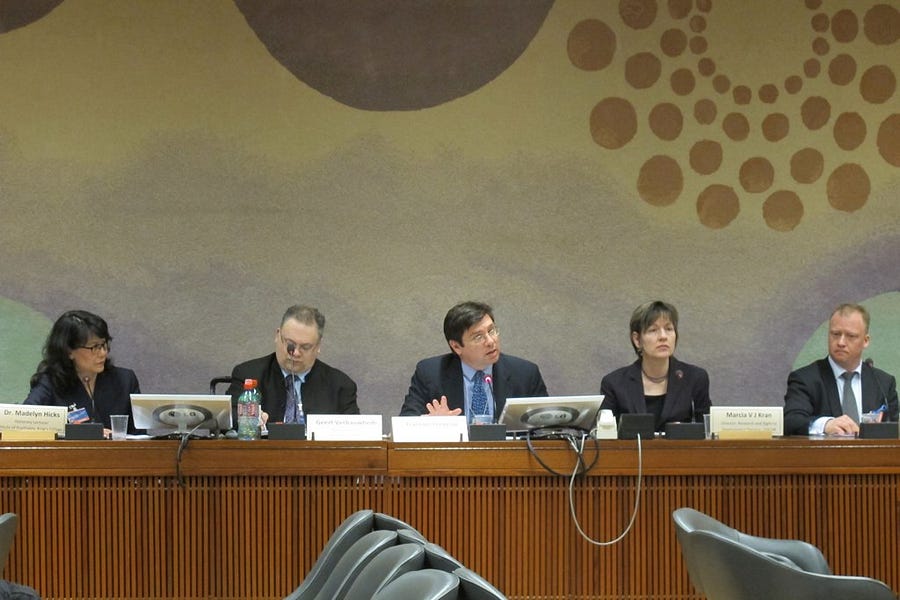
In February 2014 GICJ participated at the 57th session of the Committee for the Elimination of Discrimination Against Women (CEDAW). GICJ submitted a written report to the Committee, in which it addressed some of the key issues for women in Iraq, delivered an oral statement during the session, and assisted the interactive dialogue between experts and State.


GICJ participated at the 57th session of the Committee for the Elimination of Discrimination Against Women (CEDAW).
The CEDAW Committee consists of 23 experts on women’s rights from around the world and monitors the implementation of the 1979 Convention on the Elimination of All Forms of Discrimination against Women.
Countries who have become party to the treaty (States parties) are obliged to submit regular reports to the Committee on how the rights of the Convention are implemented. During its sessions the Committee considers each State party report and addresses its concerns and recommendations to the State party in the form of concluding observations.
The Committee can also receive claims from individuals or NGOs with regard to grave or repeated violations of women’s rights. Based on the information submitted and the interactive dialogue that follows, the Committee then formulates general recommendations that are directed to States.
The procedure
Ahead of each session each state party must submit a report. Based on this report the Committee then sends a list of issues and questions related to the report, to which the State party submits its response during the session. These reports are part of the official documentation of the meeting and published on the United Nations website. In 2014 the official Consideration of reports submitted by States parties covered the period from 1998 to 2010.
During the session related to women’s rights in Iraq amongst the issues that were discussed were: access to justice and women in detention, national machinery for the advancement of women, stereotypes and harmful practices, violence against women, trafficking and exploitation of prostitution, participation in political and public life, education, employment, health, widows and divorced women, refugees, returnees and internally displaced and stateless women.
GICJ submitted a written report to the Committee, in which it addressed some of the key issues for women in Iraq, delivered an oral statement, and assisted the interactive dialogue between experts and State. GICJ considered it important for its written submission to elaborate the disastrous impact of the sanctions and the illegal 2003 US-invasion/ occupation on the Iraqi women’s rights. These aspects unfortunately were largely marginalized in the official reports, in favour of an inoffensive pro US-approach, even if sanctions and invasion fell right into the time covered by the report.
Women in Iraq, source:ICRC
Key issues highlighted by GICJ
Although of course all government reports try to present the State party in the best possible light, GICJ found it especially appealing to see that the Iraqi government's statements reflected only very little on the constantly deteriorating human rights situation as a result of the 2003 invasion and occupation. Instead, it defended one more time its corrupt and sectarian policy, even though the disastrous situation has been well documented by a multitude of international organizations and NGOs.
Below are some of the key issues highlighted by GICJ together with a critical reflection on the Iraqi response to the list of issues presented by the Committee.
Economic and health situation: Prior to 1990 women were integral to Iraq’s economy and held high positions in the private and public sectors, thanks to advanced labor and employment laws. Under sanctions, women had more and more difficulties finding paid work or could not afford to work anymore. They were hence forced back into the traditional roles and sheer survival became the main aim of their lives. The already fragile situation deteriorated following the US-invasion in 2003 due to which much of the infrastructure of Iraq was destroyed. As a result, one-third of Iraqis are living in poverty, with more than 5 per cent living in abject poverty, but these figures may well be a grave underestimation. Polygamy, a by-product of poverty, is promoted as a way to provide social protection for unemployed women in need of assistance.
In view of these dramatic development facts it was extremely alarming to see that the Iraqi State sadly downplayed the situation. Instead boasted itself with social programs aimed at combating poverty, without mentioning at any point the rampant corruption inside Iraq, due to which all such programs are doomed to fail. The poverty described by the State party was much less dramatic than in all reports GICJ has ever received. According to the State part’s reply the level of poverty declined to 18.9 % in 2012, whereas other sources indicate that following the invasion 50% of the Iraqi people are living in slum conditions. It was further remarkable to see that the State party referred to the overall situation as a result of the “collapse of the former dictatorship” (the Committee itself was much more careful in its choice of words), thus quasi defending the invasion.
War widows: The death toll of the 2003 US-invasion is still largely underestimated by the world. Many believe that the number of Iraqis who died is fewer than 10.000, yet the truth is that average estimations indicate 700.000 up to 1.500.000. Almost 2 million women have therefore become the primary breadwinners and most of them are war widows. They belong to the most vulnerable in Iraq and often live in extreme poverty. In the years following the invasion many of them see no other way than begging in the street. This phenomenon is totally new in Iraq and often the government’s only response is to throw them in prison, disregarding the fact that registering for government pensions is a bureaucratic nightmare due to corrupt workers who demand money or sex in exchange for the paperwork.
The number of those currently registered for the meager State Aid is ridiculously small compared to that effectively in need, yet once again the State party tried to promote its social welfare program and downplayed the situation. Shockingly also, the Iraqi State response made “blind terrorism that targeted all sections of its people, claiming the lives of thousands of women, children and the elderly and leaving in its wake hundreds of widows, orphans and homeless” responsible for the situation, without at any point question the effect of the invasion.  Finally, the State party tried to prove the success of its measures with decreasing number of victims of terrorism between 2008 and 2010, without mentioning that in 2013, due to the sectarian policy of the Iraqi government these numbers have once again reached record heights. Although of course the report officially only covers the period between 1998 and 2010, it is however remarkable that in other sections of the State response much more recent figures (until 2013) were given.
Women in detention: After the total dismantling of the Iraqi following the US invasion the Iraqi judicial system is flawed and inhumane on all levels. Thousands of women are illegally held in detention for years without seeing a judge, and frequently they are subjected to severe torture, including beatings and rape. The rampant corruption leads to a system where women are frequently convicted after coerced confessions. Many women are rather held in order to get information about their male relatives’ activities rather than crimes in which they themselves are said to be involved in. It thus seems as if Iraqi security forces act as if abusing women will make the country safer, whereas in fact, as long as security forces abuse people with impunity, one can only expect the situation to worsen. Although some reforms of the criminal justice system were promised, the brutal tactics of security forces remain still the same.
In response to the plight of women in detention, Iraq listed constitutional provisions that allegedly prohibit unlawful detention and ensure access to justice regardless of gender. It further put forward that prison visits were regularily undertaken by the public prosecutor to monitor the conditions of detainees and that teams attached to the Ministry of Human Rights made regular visits to detention facilities. According to Iraq, there were more than 200 visits in 2012. Unfortunately the presented facts did in no way reflect the real situation of the Iraqi judicial system, which even 11 years after the invasion is totally devoid of any sense of justice. The State reply unfortuntaely also failed to mention that the Iraqi Ministry of Interior systematically denied the UN access to detention facilities under its authority. It further did not present the outcome of any those visits and did not address the harsh reality of detention conditions as described by Human Rights organisations.
Displaced: Following the US-invasion 2003, up to five million Iraqis, mostly women and children, have been displaced inside Iraq. This figure is the largest number of displacements in the region since 1948. Displaced women face strong social stigmas, are highly discriminated and forced to live in inhumane poor conditions. Some are even forced into temporary marriage with bureaucrats who distribute funds. Among the five million displaced Iraqis are 2 million internally displaced people (IDP). 13% of the families are families headed by women, mostly widows. Not only is it difficult for IDP women to maneuver through the system in order to secure enough aid for their families, but they also have to deal with the inevitable lack of resources to cover their needs. Returnee Iraqi female-headed families also often experience major livelihood challenges.
In its reply to this issue of displaced people, Iraq listed some figures to illustrate how much aid was given to displaced families and returnees, and briefly described some of its support programmes. It also mentioned that job opportunities will be provided and that practical measures were being taken in priority for displaced women. Iraq is nevertheless still light-years away from delivering adequate aid to displaced persons and returnees. Many of them struggle to meet their very basic and fundamental needs as they are unable to have access to the meagre government help that is available.
Education: In its report GICJ considered it important to point out that prior to the first Gulf War in 1991, Iraq had one of the best educational performances in the region. By making education compulsory for all in 1976, the Iraqi government closed the literacy gap between men and women notably, taking a great step to eradicate illiteracy and empower women in the working field. During the sanctions however, Iraq’s literacy rate deteriorated. Over half of Iraqi women could not read or write, when only a decade earlier, Iraq was the country which had the most modern education system in the Arab Middle East. Following the invasion, the overall number of children receiving primary education in Iraq after the war declined. Girls account for around 44.8% of students.
Reports attribute poor school attendance to the poor security situation within Iraq which undoubtedly is a significant contributor to these figures. The concerns about safety yet relate to both military conflict and civil crime such as abduction and rape. Unsurprisingly the State party’s response to the disastrous situation of the Iraqi education system did at no point include any critical assessment of the impact of sanctions and invasion. Instead it praised measures undertaken by the Iraqi government as if they were part of a state-of-the-art-system. Yet the programs presented had more of an administrative instead of a development character.
Sexual exploitation: Although Iraq is a signatory of several UN protocols and pacts that protect human and labor rights, Iraq is now considered as one of “the worst countries” in the world regarding prostitution, sexual exploitation and human trafficking. About 4,000 women, one fifth of them under the age of 18, have disappeared in the first seven years after the war. A huge number of girls have been incarcerated for prostitution, in which they have been forced into modern day slavery. The invasion and instability that followed led to an environment where young women and girls became much more vulnerable to trafficking.
Unsurprisingly the State reply did at no point mention that the problem of human trafficking did not exist prior to the 2003 invasion; neither did it mention that so far the Iraqi government has done little to combat trafficking in girls and women, and that until now there has been no successful prosecutions of criminals engaged in human trafficking, no comprehensive program to tackle the problem, and only negligible support for victims. The State reply presented some half-hearted measures such as a law on combating trafficking that the Iraqi government had passed in 2012, yet once again it blamed terrorist operations or armed conflicts or for the problem of prostitution. Although the aforementioned law supposedly provides help for the victims of human trafficking, the State reply mentions a number of female convicts for prostitution, which one more time indicates that the Iraqi government tends to punish the victim rather than the offender.

Political participation: Before sanctions in 1990, women had gained important access to employment, political positions and the economic sphere. Women played an active role right in the government. After sanctions and invasion, Iraq has been plagued by violence, corruption and injustice, transforming the situation of women into a national crisis.  The Iraqi Constitution guarantees women 25% of the members of the Council of Representatives. This quota system has been applauded by women organizations and international community as one of the great achievements of the “New Iraq”. This appraise has been however used as a sheer token to cover up the volume of crimes committed against women under occupation. Among the 44 Ministers, only one woman is appointed as Minister of State for Women's Affairs. Most female MPs have shown little interest in women’s rights. They rather duplicate in essence whatever their fellow male MPs already advocate.
Iraq emphasised that the Ministry of State for Women’s Affairs has taken an active part in developing major strategies for 2012-2014. Among them, there is the adoption by the Government of a strategy to combat violence against women and the economic empowerment of women by ensuring a proportion of appointments, borrowing and residential complexes for women, increasing social welfare allowances and setting up a development fund for rural women. Iraq also stated that women occupy the post of judicial investigator in all bodies attached to the Higher Judicial Council. One can only hope that the strategies elaborated by the Ministry of State of Women’s Affairs will be effective in enhancing women’s empowerment and political participation, and that the women who occupy high level positions will show a more determined interest in improving women’s rights in Iraq.
Birth defects: Since the invasion, young women in Iraq have become increasingly reluctant to become pregnant for the fear of giving birth to monstrously deformed babies, yet the issue of birth defects was totally neglected in any of the reports. While showing its willingness to provide some measures to control breast cancer, the State response did not even admit a possible increase in malformations among newly born, and accordingly did not scrutinize the cause of the problem. Although American forces later admitted that they had used white phosphorus shells, they never admitted to using depleted uranium, which has been linked to high rates of cancer and birth defects. Furthermore, several studies show a high level of contamination by other toxic substances including Uranium lead and mercury. But, the State report links the rising number of babies born with birth defects in some cities to increased exposure to metals released by bombs and bullets used over the past two decades.
A study published in 2013 finds a rate of congenital anomalies at birth in Fallujah to be 11.5 times higher than the comparable rate in neighbouring Kuwait. The study concludes that level of congenital anomaly in Fallujah is unusually high and is caused by the exposure of the population to some genetic mutagen employed during the USA attacks on the city in 2004. There were 291 congenital anomaly cases registered at birth in the eleven-month period at the study’s clinic. The total number of births recorded in the hospital over the period was 6015. The congenital anomaly included 113 heart and circulatory system cases, 72 nervous system cases, 40 digestive system cases, 30 down syndrome cases, 9 genitourinary cases, 6 ear, face and neck cases and 7 respiratory cases.
In conclusion: Throughout the session it became one more time obvious that the State party of Iraq avoids any criticism of the 2003 invasion but instead proves its willingness to cooperate within the framework of the measures established under occupation. Its reports reflect the sectarian language and political division supported by both, the occupier and the government which they installed in Iraq. Any credible analysis of the situation must include the disastrous impact of sanctions, invasion and occupation, especially when it comes to a report covering the period between 1998 and 2010. The suffering inflicted on the Iraqi people and notably the Iraqi women can only be alleviated through restoring justice and accountability according to international law and international human rights standards. It therefore remains crucial that civil society does not stop to actively raise its voice and insist that issues be properly addressed by the International Community.

Related links
Report submitted by GICJ