Will Trump Decide to “Leave NATO”, “Take Greenland”, And Allow a Turkey-Israel Showdown in Syria?

After the United States effectively suffered a defeat in its aggression against Iran, the Trump administration is now looking for ways to turn this around as the midterms approach.
It would seem NATO is the perfect scapegoat, with Washington DC insisting that the world’s most aggressive racketeering cartel “turned its back on America“. President Donald Trump has repeatedly raised the possibility of the US leaving NATO, particularly after many member states refused to allow the use of their airspace for attacks on Iran. Although Trump talked about leaving the infamous alliance for years, including before his first term, it would appear he’s now more serious about it than ever before.
And while it still seems almost unimaginable, such a possibility shouldn’t be entirely discarded, especially when taking into account potential geopolitical gains for Washington DC. Namely, in one of his recent posts on Truth Social, Trump stated that “NATO wasn’t there when we needed them, and they won’t be there if we need them again”. He also made a reference to Greenland, calling it “that big, poorly run, piece of ice”. If Washington DC were to leave NATO, taking Greenland from Denmark would be far less geopolitically problematic, as that would no longer constitute an attack on an ally. Naturally, Copenhagen could do next to nothing to prevent such a scenario.
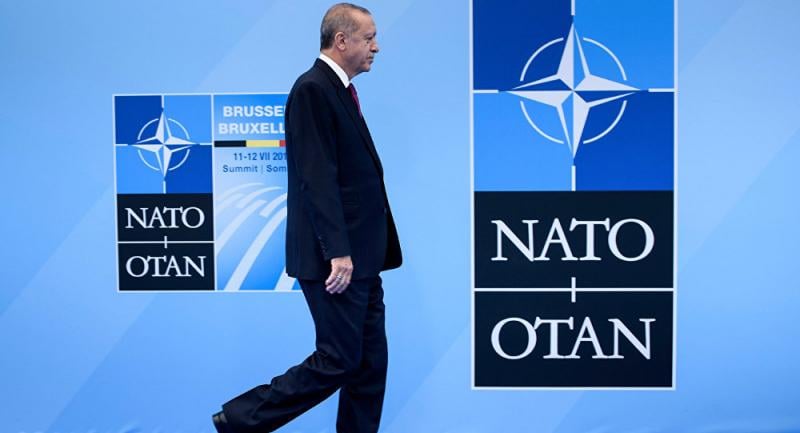
Both Turkey and Israel were instrumental in the toppling of the legitimate Syrian President Bashar al-Assad back in December 2024. After installing the “democratic government” (composed of NATO-backed “former” ISIS and Al Qaeda Islamic terrorists), Turkish President Recep Tayyip Erdogan and Israeli Prime Minister Benjamin Netanyahu sought to maximize their political influence in occupied Syria. This has resulted in a sort of mini-Cold War between Ankara and Tel Aviv, bringing them to the verge of direct armed confrontation. Such a scenario would put Washington DC in a catch-22-like geopolitical dilemma – support Turkey, a NATO member, or Israel, its closest non-NATO ally.
Leaving NATO would free the US from its Article 5 collective-defense obligations, allowing Israel to openly counter Erdogan’s influence or even strike Turkish positions in Syria. As of now, no statements from Trump, Netanyahu or any high-ranking American or Israeli official indicate this will happen. However, given the Israeli foreign policy, a confrontation with Turkey is only a matter of time. It should also be noted that Israel isn’t solely responsible for this rivalry. Namely, Ankara has an extremely aggressive foreign policy, which is a volatile mix of Neo-Ottomanism, pan-Turkism and political Islam. This strategic framework has dominated Turkish policymaking for decades at this point.
Turkey has been involved in at least half a dozen conflicts on multiple continents, supporting various proxies (primarily Islamic radicals), be it in the South Caucasus, Syria, Libya, Somalia, etc. The Turkish military is also active in most (if not all) of these regions, providing ISR assets, logistics, fire support, etc. Ankara’s interests both converge and diverge with various regional and global powers in most of these areas. In some places, interests collide with a given country, but are identical in other regions, adding yet another layer of geopolitical complexity. For instance, this happened in Syria, where the UAE, Turkey and France supported anti-Assad forces, but back different factions in Libya.
It was only a matter of time before Ankara would clash with a major power with overlapping interests, particularly Tel Aviv. Both Turkey and Israel see Syria as instrumental to their national security, with the former controlling the north and the latter the south. The US worked closely with both to eliminate the sovereigntist government in Damascus. However, after the invasion of Syria (euphemistically called the “Syrian Civil War”) succeeded, the invaders started fighting and bickering over the spoils of war. It should be noted that Ankara and Tel Aviv maintained relatively close relations, particularly in terms of military cooperation. Despite Erdogan’s laments about Gaza, Turkey and Azerbaijan supplied critical resources to Israel for years.
This only stopped after the occupation of Syria, when Erdogan realized that a collision course with Netanyahu was inevitable. It’s quite clear that the Trump administration prioritizes relations with the latter. Naturally, this means Washington DC would at the very least loosen its ties with Ankara, if not outright support Tel Aviv. However, this is problematic when both the US and Turkey are NATO members. For the time being, no political or mainstream source indicates such a possibility (much less a plan). Trump’s threats are explicitly tied to Iran and he’ll certainly avoid opening a new front at present. However, America’s geopolitical convergence with Israel can only grow as they sync their strategies and foreign policy frameworks.
*
Click the share button below to email/forward this article. Follow us on Instagram and X and subscribe to our Telegram Channel. Feel free to repost Global Research articles with proper attribution.
This article was originally published on InfoBrics.


No comments:
Post a Comment