








Were U.S Marines Used as Guinea Pigs on Okinawa?
A CounterPunch Special Report: Growing Evidence Suggests the U.S. Military Tested Biochemical Agents on Its Own Forces on the Island in the 1960s
Tokyo.
Newly discovered documents reveal that 50 years ago this month, the Pentagon dispatched a chemical weapons platoon to Okinawa under the auspices of its infamous Project 112. Described by the U.S. Department of Defense as “biological and chemical warfare vulnerability tests,” the highly classified program subjected thousands of unwitting American service members around the globe to substances including sarin and VX nerve gases between 1962 and 1974.1
According to papers obtained from the U.S. Army Heritage and Education Center in Carlisle, Pennsylvania, the 267th Chemical Platoon was activated on Okinawa on Dec. 1, 1962, with “the mission of operation of Site 2, DOD (Department of Defense) Project 112.” Before coming to Okinawa, the 36-member platoon had received training at Denver’s Rocky Mountain Arsenal, one of the key U.S. chemical and biological weapons (CBW) facilities. Upon its arrival on the island, the platoon was billeted just north of Okinawa City at Chibana — the site of a poison gas leak seven years later. Between December 1962 and August 1965, the 267th platoon received three classified shipments — codenamed YBA, YBB and YBF — believed to include sarin and mustard gas.2
For decades, the Pentagon denied the existence of Project 112. Only in 2000 did the department finally admit to having exposed its own service members to CBW tests, which it claimed were designed to enable the U.S. to better plan for potential attacks on its troops. In response to mounting evidence of serious health problems among a number of veterans subjected to these experiments, Congress forced the Pentagon in 2003 to create a list of service members exposed during Project 112. While the Department of Defense acknowledges it conducted the tests in Hawaii, Panama and aboard ships in the Pacific Ocean, this is the first time that Okinawa — then under U.S. jurisdiction — has been implicated in the project[ms1] .3
Corroborating suspicions that Project 112 tests were conducted on Okinawa is the inclusion on the Pentagon’s list of at least one U.S. veteran exposed on the island. “Sprayed from numbered containers” reads the Project 112 file on former marine Don Heathcote. Heathcote, a private first class stationed on Okinawa’s Camp Hansen in 1962, clearly remembers the circumstances in which he was exposed.
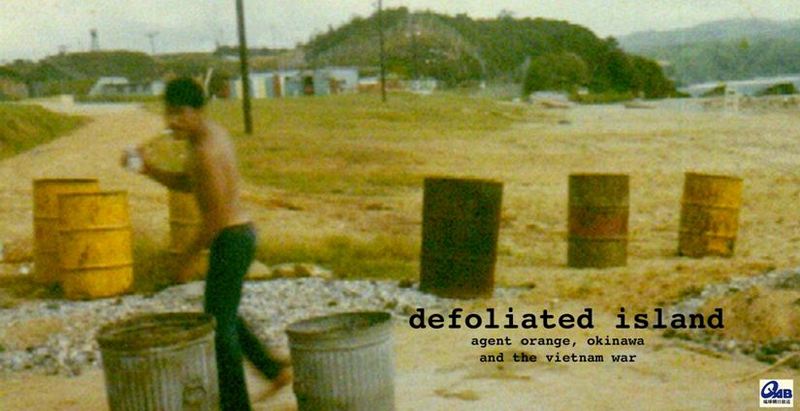
“I was assigned for approximately 30 days to a crew in the northern jungles of Okinawa,” Heathcote says. “I sprayed foliage with chemicals from drums with different-colored faces. As we did this, a guy came by with a clipboard and made notes. How better to run a test than to color-code each barrel?”
Heathcote believes the chemicals were experimental herbicides, including Agent Purple, a forerunner to the toxic defoliant Agent Orange. He says the spraying killed large swaths of the jungle — and took an equally devastating toll on his own health.
“Soon after I returned home, I underwent an operation to extract polyps from my nose. The doctors removed enough to fill a cup. Plus they diagnosed me with bronchitis and sinusitis connected to chemical exposure,” said Heathcote.
The records of the 267th Chemical Platoon were first uncovered by Michelle Gatz, the Minnesota-based veterans services officer who[ms2] has also been at the forefront of investigations into the usage of Agent Orange on Okinawa. Gatz suspects that Heathcote may have been exposed to substances even more dangerous than defoliants. “Project 112 had thousands of sub-projects testing a variety of poisons, drugs and germs. It has been compared to an octopus with its tentacles all over the place — and one of those places was Okinawa.”
Gatz and Heathcote are attempting to persuade U.S. authorities to disclose details of Project 112 tests on the island, but so far to no avail. The Defense Department was approached for comment on Nov. 5; as of Dec. 13, the Pentagon said it was still investigating the issue.
Due to the controversial nature of its Cold War CBW program, which many countries alleged breached the 1925 Geneva Protocol outlawing such toxic agents, the U.S. government has been reluctant to divulge details of Project 112 and similar tests[ms3] . This reticence is particularly apparent in relation to Okinawa, where the U.S. military still controls approximately 20 percent of the main island, and where many residents oppose its presence. However, thanks to an investigation spearheaded by Gatz and Florida-based researcher John Olin – who uncovered the smoking gun of the Pentagon’s storage of Agent Orange on Okinawa4 – the true history of America’s CBW program on the island is gradually becoming clearer.
No sooner had the ink dried on the Treaty of San Francisco — the 1952 agreement ending the U.S. occupation of Japan while granting it continued control of Okinawa[ms4] — than the Pentagon began to stockpile chemical weapons on the island. This was at the height of the Korean War. The island – in particular Kadena Air Base – was already operating as a launchpad for the conflict[ms5] , the first consignment of its toxic arsenal was shipped to Okinawa under orders from Col. John J. Hayes, chief of the U.S. Army’s Chemical Corps[ms6] .5
At the same time as this top-secret delivery, the Chinese media began to allege that the U.S. Air Force was dropping biological weapons, including typhus and cholera, on North Korea[ms7] 6. Thirty-six captured U.S. airmen admitted to flying more than 400 of these sorties; many said the missions originated from American bases on Okinawa[ms8] .7 After the 1953 ceasefire, the U.S. military maintained that the confessions had been extracted by torture, and the now-repatriated prisoners renounced their claims. However, China countered that they’d been forced to backtrack under threat of U.S. court martial.
While the jury may still be out on Korean War CBW sorties from Okinawa, there is no disputing the island’s role in the Pentagon’s biochemical program in the ensuing years. Publicly available records show that the U.S. conducted bioweapons tests on Okinawa geared towards depriving potential enemies of food sources, particularly the staple crop of Asia’s peasant armies: rice. In 1961, the U.S. military on Okinawa staged tests of rice blast, a highly infectious fungus that can decimate entire harvests. According to Sheldon H. Harris in his authoritative history of CBW, “Factories of Death,” the tests on Okinawa were so successful that they led to a further 1,000 military contracts for herbicide research.8
One former U.S. Marine who believes he was unknowingly exposed to this batch of experiments is Gerald Mohler. In July 1961, at the age of 21, Mohler was ordered to participate in an unusual mission in the jungles near Camp Courtney, in present-day Uruma City.
“We were told to erect tents at a five-acre brown spot devoid of vegetation and sleep there for a few days. We received no training during that time. We just sat around and did nothing,” Mohler said in a recent interview. “Nearby we discovered a stash of approximately 40 50-gallon (190-liter) barrels of defoliants. The odor was unmistakable[ms9] .”
Today Mohler has pulmonary fibrosis — a scarring of the lungs caused by exposure to toxic chemicals — and Parkinson’s disease. “Were we marines used as guinea pigs on Okinawa?” asks Mohler. “I think so.”
The Pentagon denies that herbicidal chemical agents such as the ones Mohler described were ever present on Okinawa.
In 1961, as the Cold War deepened, the U.S. initiated a comprehensive overhaul of its defensive capabilities in more than 100 different categories; No. 112 on this list was the study of CBW. Envisaged by President John F. Kennedy’s secretary of defense, Robert McNamara, as “an alternative to nuclear weapons,” Project 112 proposed experiments in “tropical climates” and, to evade laws regulating human testing in the U.S., it suggested the use of overseas “satellite sites.”9 Fulfilling both prerequisites, Okinawa must have seemed a perfect choice[ms10] . In particular, the Northern Training Area in the island’s Yanbaru jungles must have been a particularly tempting target for U.S. scientists since it was (and continues to be) the Pentagon’s prime guerrilla training center.
Throughout the late 20th century, rumors of Project 112 were widespread among U.S. veterans, but they were quickly dismissed by an American public unwilling to believe its government would test such substances on its own troops. However, following a series of TV news reports by CBS, the Pentagon admitted to the existence of Project 112 and promised to come clean on the issue.
That disclosure began in 2000, when the Pentagon claimed that there had been 134 planned tests, of which 84 had been canceled. The[ms11] experiments it admitted carrying out included the spraying of troops in Hawaii with E. coli, subjecting sailors to swarms of specially bred mosquitoes, and exposing troops in Alaska to VX gas. The Pentagon stated that no participants had been harmed in these tests.10
Almost immediately, skeptics accused the Pentagon of attempting to pull the wool over the public’s eyes. These allegations were supported by the General Accounting Office 11, the congressional watchdog, which found the Department of Defense had not attempted to “exhaust all possible sources of pertinent information”. One of the major omissions was its failure to try to retrieve CIA records – the Agency has long been suspected of being involved in Project 112. Even when the Pentagon did bother to investigate, for example at the U.S. Army’s Dugway Proving Ground, Utah, the department checked only 12 out of 1,300 boxes of documents
The Pentagon’s failure to fully investigate Project 112 creates an immense hurdle for those seeking the truth about tests on Okinawa. “After more than 50 years of lies, secrecy and ever-changing stories, one cannot rely on any information the Department of Defense provides to Congress or the public. It is not known exactly what happened on Okinawa or which of these hazards might have been present on the island,” says Olin, the researcher.
Olin believes the U.S. military has been too quick to dismiss Okinawan civilians’ worries that they too may have been affected. His suspicions are supported by the GAO report which states, “DOD did not specifically search for civilian personnel -DOD civilian employees, DOD contractors, or foreign government participants – in its investigation.
During the 1960s and ’70s there were a number of unexplained incidents on the island, including chemical-like burns suffered by more than 200 Okinawans swimming near U.S. installations on the east coast in 1968 and, two years later, a fire at Chibana munitions depot that sickened employees at nearby Zukeyama Dam.
Throughout the Cold War until 1969, Washington adhered to a strict policy of neither confirming nor denying the presence of CBW on Okinawa. In all likelihood, it would have continued to do so, were it not for the events of July 8 of that year. On that day, American service members were conducting maintenance on munition shells at the Chibana depot when one of the missiles sprung a leak. Twenty-three troops and one civilian fell sick from exposure to the missile’s contents — likely VX gas — and were hospitalized for up to a week.
Considering the toxicity of such weapons, those exposed escaped lightly. Nevertheless[ms12] , when the accident was reported, its ramifications were far-reaching: The Pentagon was forced to acknowledge its chemical arsenal on Okinawa — infuriating local residents — and promised to remove the entire stockpile before the island’s reversion to Japanese control in 1972.
Operation Red Hat, the mission to transport the weapons off the island, was organized by the same man who had brought them to Okinawa two decades previously: John. J. Hayes (by then a general). It also involved the 267th Chemical Platoon, which had been renamed the 267th Chemical Company. During two separate phases in 1971, the military shipped thousands of truckloads of sarin, mustard gas, VX and skin-blistering agents from Okinawa to U.S.-administered Johnston Island in the middle of the Pacific. The[ms13] consignments totaled 12,000 tons — a terrifying amount considering that many of these substances’ fatal dosage is measured in milligrams. After the final shipment had left the island, Hayes assured journalists, “Every round of toxic chemical munitions stored on Okinawa has now been removed.”12
The involvement of Hayes and the 267th company appears to tie the tale of Okinawa’s CBW into the kind of neatly knotted circle loved by historians. However, new evidence has surfaced that Operation Red Hat was only the latest round in a long game of smoke and mirrors contrived by the Pentagon to hide the true extent of its CBW arsenal.
In 1972, one year after Operation Red Hat, marine Sgt. Carol Surzinski participated in a defense readiness class on Okinawa’s Camp Kuwae, in Chatan Town. The training involved barrels of what appeared to be chemical weapons and, initially, she was told that the classes would help to identify substances that might be used against the U.S. military in times of war. Such practices were common on U.S. installations at the time, but what the trainer told Surzinski toward the end of the two-week course disturbed her. “The instructor finally admitted that we had to stay one step ahead of the enemy. We needed to learn what worked against them — and use it against the enemy if need be,” she says.
Surzinski’s account appears to contradict the Pentagon’s claims that it had removed its entire CBW stockpile from Okinawa in 1971. In addition, it raises another question: What has happened to the barrels in the intervening years? Considering the U.S. military’s poor environmental track record on the island, it seems likely they were buried. On the marines’ Futenma Air Station in 1981, for example, a maintenance crew unearthed more than 100 barrels — some apparently containing Agent Orange — that appeared to have been buried at the end of the Vietnam War.
This year marks 60 years since the first delivery of chemical weapons to Okinawa; this month is the 50th anniversary of the launch of Project 112 on the island. However, the continuing illnesses suffered by U.S. veterans including Heathcote and Mohler suggest this problem is far from a purely historical matter — and only now are potential correlations between toxic munitions and illnesses among Okinawan residents coming to light[ms14] .
In the near future, Washington plans to return a number of U.S. installations on Okinawa to civilian usage. However, just as former U.S. CBW storage sites elsewhere — such as the Rocky Mountain Arsenal and Johnston Island — remain dangerously contaminated, Okinawan land is likely to be handed back in a similarly toxic state.
Under the current U.S.-Japan Status of Forces Agreement, the host government is solely responsible for the cleanup of former bases — a task that’s expected to set Japanese taxpayers back hundreds of millions of dollars. With the true cost in terms of health and capital yet to be determined, there is a real risk that these weapons of mass destruction will poison not only the soil but also the Okinawan people and American-Japanese-Okinawan relations for decades to come.
Jon Mitchell is a Welsh-born writer based in Japan. In September 2012, “Defoliated Island”, a TV documentary based upon his research into the U.S. military’s usage of Agent Orange on Okinawa was awarded a commendation for excellence by Japan’s National Association of Commercial Broadcasters.
My thanks to John Olin, Michelle Gatz, Don Heathcote, Gerald Mohler, Ben Stubbings, Carol Surzinski, Natsuko Shimabukuro and Mark Selden for their invaluable input on this article.
Notes.
1. The Department of Veterans Affairs maintains a partial introduction to Project 112, and its accompanying CBW tests aboard ships, Project SHAD, here
2. “Organizational History – 267th Company” has now been uploaded for public access here
3. Factsheets describing some of the tests to which the Pentagon has admitted can be read on this Department of Defense site here. The site was last updated in 2003 – and Okinawa does not appear on it.
4. Jon Mitchell, “Agent Orange on Okinawa – The Smoking Gun: U.S. army report, photographs show 25,000 barrels on island in early ‘70s,” The Asia-Pacific Journal, Vol 10, Issue 40, No. 2, October 1, 2012.
5. Albert Mauroni, “Chemical and Biological Warfare: A Reference Handbook”, ABC-Clio, Santa Barbara, 2003.
6. For a concise summary of these allegations, see here.
7. Sheldon H. Harris, “Factories of Death”, Routledge, London, 1994, 129.
8. Ibid., 233.
9. Ibid., 232.
10. See information on the Department of Veterans Affairs homepagehere.
11. The full text of the GAO report is available here.
12. “Operation Red Hat: Men and a Mission” – a 1971 Department of Defense documentary detailing the removal of these munitions – can be watched here.
13. Jon Mitchell, “Agent Orange at Okinawa’s Futenma Base in 1980s,”The Asia-Pacific Journal, Vol 10, Issue 25, No. 3, June 18, 2012.


No comments: