








Back then, everybody was writing about Iraq, but it’s surprising how few Americans, including reporters, paid much attention to the suffering of Iraqis.
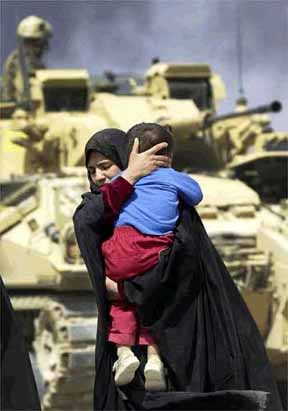
 Today, Iraq is in the news again. The words, the memorials, the retrospectives are pouring out, and again the suffering of Iraqis isn’t what’s on anyone’s mind. This was why I returned to that country before the recent 10th anniversary of the Bush administration’s invasion and why I feel compelled to write a few grim words about Iraqis today.
But let’s start with then. It’s April 8, 2004, to be exact, and I’m inside a makeshift medical center in the heart of Fallujah while that predominantly Sunni city is under siege by American forces. I’m alternating between scribbling brief observations in my notebook and taking photographs of the wounded and dying women and children being brought into the clinic.
A woman suddenly arrives, slapping her chest and face in grief, wailing hysterically as her husband carries in the limp body of their little boy. Blood is trickling down one of his dangling arms. In a few minutes, he’ll be dead. This sort of thing happens again and again.
Over and over, I watch speeding cars hop the curb in front of this dirty clinic with next to no medical resources and screech to a halt. Grief-stricken family members pour out, carrying bloodied relatives -- women and children -- gunned down by American snipers.One of them, an 18-year-old girl has been shot through the neck by what her family swears was an American sniper. All she can manage are gurgling noises as doctors work frantically to save her from bleeding to death. Her younger brother, an undersized child of 10 with a gunshot wound in his head, his eyes glazed and staring into space, continually vomits as doctors race to keep him alive. He later dies while being transported to a hospital in Baghdad.According to the Bush administration at the time, the siege of Fallujah was carried out in the name of fighting something called “terrorism” and yet, from the point of view of the Iraqis I was observing at such close quarters, the terror was strictly American. In fact, it was the Americans who first began the spiraling cycle of violence in Fallujah when U.S. troops from the 82nd Airborne Division killed 17 unarmed demonstrators on April 28th of the previous year outside a school they had occupied and turned into a combat outpost. The protesters had simply wanted the school vacated by the Americans, so their children could use it. But then, as now, those who respond to government-sanctioned violence are regularly written off as “terrorists.” Governments are rarely referred to in the same terms.
10 Years Later
Jump to March 2013 and that looming 10th anniversary of the U.S. invasion. For me, that’s meant two books and too many news articles to count since I first traveled to that country as the world’s least “embedded” reporter to blog about a U.S. occupation already spiraling out of control. Today, I work for the Human Rights Department of Al Jazeera English, based out of Doha, Qatar. And once again, so many years later, I’ve returned to the city where I saw all those bloodied and dying women and children. All these years later, I’m back in Fallujah.
Today, not to put too fine a point on it, Iraq is a failed state, teetering on the brink of another sectarian bloodbath, and beset by chronic political deadlock and economic disaster. Its social fabric has been all but shredded by nearly a decade of brutal occupation by the U.S. military and now by the rule of an Iraqi government rife with sectarian infighting.
Every Friday, for 13 weeks now, hundreds of thousands have demonstrated and prayed on the main highway linking Baghdad and Amman, Jordan, which runs just past the outskirts of this city.
Sunnis in Fallujah and the rest of Iraq’s vast Anbar Province are enraged at the government of Prime Minister Nouri al-Maliki because his security forces, still heavily staffed by members of various Shia militias, have been killing or detaining their compatriots from this region, as well as across much of Baghdad. Fallujah’s residents now refer to that city as a “big prison,” just as they did when it was surrounded and strictly controlled by the Americans.
Angry protesters have taken to the streets. “We demand an end to checkpoints surrounding Fallujah. We demand they allow in the press. We demand they end their unlawful home raids and detentions. We demand an end to federalism and gangsters and secret prisons!” So Sheikh Khaled Hamoud Al-Jumaili, a leader of the demonstrations, tells me just prior to one of the daily protests. “Losing our history and dividing Iraqis is wrong, but that, and kidnapping and conspiracies and displacing people, is what Maliki is doing.”
The sheikh went on to assure me that millions of people in Anbar province had stopped demanding changes in the Maliki government because, after years of waiting, no such demands were ever met. “Now, we demand a change in the regime instead and a change in the constitution,” he says. “We will not stop these demonstrations. This one we have labeled ‘last chance Friday’ because it is the government’s last chance to listen to us.”
“What comes next,” I ask him, “if they don’t listen to you?”
“Maybe armed struggle comes next,” he replies without pause.
Predictably, given how the cycle of violence, corruption, injustice, and desperation has become part of daily life in this country, that same day, a Sunni demonstrator was gunned down by Iraqi security forces. Lieutenant General Mardhi al-Mahlawi, commander of the Iraqi Army’s Anbar Operations Command, said the authorities would not hesitate to deploy troops around the protest site again “if the protesters do not cooperate.” The following day, the Maliki government warned that the area was becoming “a haven for terrorists,” echoing the favorite term the Americans used during their occupation of Fallujah.
Today’s Iraq
In 2009, I was in Fallujah, riding around in the armored BMW of Sheikh Aifan, the head of the then-U.S.-backed Sunni militias known as the Sahwa forces. The Sheikh was an opportunistic, extremely wealthy “construction contractor” and boasted that the car we rode in had been custom built for him at a cost of nearly half a million dollars.
Two months ago, Sheikh Aifan was killed by a suicide bomber, just one more victim of a relentless campaign by Sunni insurgents targeting those who once collaborated with the Americans. Memories in Iraq are long these days and revenge remains on many minds. The key figures in the Maliki regime know that if it falls, as is likely one day, they may meet fates similar to Sheikh Aifan’s. It’s a convincing argument for hanging onto power.
In this way, the Iraq of 2013 staggers onward in a climate of perpetual crisis toward a future where the only givens are more chaos, more violence, and yet more uncertainty. Much of this can be traced to Washington’s long, brutal, and destructive occupation, beginning with the installation of former CIA asset Ayad Allawi as interim prime minister. His hold on power quickly faltered, however, after he was used by the Americans to launch their second siege of Fallujah in November 2004, which resulted in the deaths of thousands more Iraqis, and set the stage for an ongoing health crisis in the city due to the types of weapons used by the U.S. military.
In 2006, after Allawi lost political clout, then-U.S. ambassador to Iraq neoconservative Zalmay Khalilzad tapped Maliki as Washington’s new prime minister. It was then widely believed that he was the only politician whom both the U.S. and Iran could find acceptable. As one Iraqi official sarcastically put it, Maliki was the product of an agreement between “the Great Satan and the Axis of Evil.”
In the years since, Maliki has become a de facto dictator. In Anbar Province and parts of Baghdad, he is now bitterly referred to as a “Shia Saddam.” Pictures of his less-than-photogenic face in front of an Iraqi flag hang above many of the countless checkpoints around the capital. When I see his visage looming over us yet again as we sit in traffic, I comment to my fixer, Ali, that his image is now everywhere, just as Saddam’s used to be. “Yes, they’ve simply changed the view for us,” Ali replies, and we laugh. Gallows humor has been a constant in Baghdad since the invasion a decade ago.
It’s been much the same all over Iraq. The U.S. forces that ousted Saddam Hussein’s regime immediately moved into his military bases and palaces. Now that the U.S. has left Iraq, those same bases and palaces are manned and controlled by the Maliki government.
Saddam Hussein’s country was notoriously corrupt. Yet last year, Iraq ranked 169th out of 174 countries surveyed, according to Transparency International’s Corruption Perception Index. It is effectively a failed state, with the Maliki regime incapable of controlling vast swaths of the country, including the Kurdish north, despite his willingness to use the same tactics once employed by Saddam Hussein and after him the Americans: widespread violence, secret prisons, threats, detentions, and torture.
Almost 10 years after U.S. troops entered a Baghdad in flames and being looted, Iraq remains one of the most dangerous places on Earth. There are daily bombings, kidnappings, and assassinations. The sectarianism instilled and endlessly stirred up by U.S. policy has become deeply, seemingly irrevocably embedded in the political culture, which regularly threatens to tip over into the sort of violence that typified 2006-2007, when upwards of 3,000 Iraqis were being slaughtered every month.
The death toll of March 11th was one of the worst of late and provides a snapshot of the increasing levels of violence countrywide. Overall, 27 people were killed and many more injured in attacks across the country. A suicide car bomb detonated in a town near Kirkuk, killing eight and wounding 166 (65 of whom were students at a Kurdish secondary school for girls). In Baghdad, gunmen stormed a home where they murdered a man and woman. A shop owner was shot dead and a policeman was killed in a drive-by shooting in Ghazaliya. A civilian was killed in the Saidiya district, while a Sahwa member was gunned down in Amil. Three government ministry employees in the city were also killed.
In addition, gunmen killed two policemen in the town of Baaj, a dead body turned up in Muqtadiyah, where a roadside bomb also wounded a policeman. In the city of Baquba, northeast of Baghdad, gunmen killed a blacksmith, and in the northern city of Mosul, a political candidate and a soldier were both killed in separate incidents. A local political leader in the town of Rutba in Anbar Province was shot and died of his injuries, and the body of a young man whose skull was crushed was found in Kirkuk a day after he was kidnapped. Gunmen also killed a civilian in Abu Saida.
And these are only the incidents reported in the media in a single day. Others regularly don’t make it into the news at all.
The next day, Awadh, the security chief for Al Jazeera in Baghdad, was in a dark mood when he arrived at work. “Yesterday, two people were assassinated in my neighborhood,” he said. “Six were assassinated around Baghdad. I live in a mixed neighborhood, and the threats of killing have returned. It feels like it did just before the sectarian war of 2006. The militias are again working to push people out of their homes if they are not Shia. Now, I worry everyday when my daughter goes to school. I ask the taxi driver who takes her to drop her close to the school, so that she is alright.” Then he paused a moment, held up his arms and added, “And I pray.”
“This Is Our Life Now”
Iraqis who had enough money and connections to leave the country have long since fled. Harb, another fixer and dear friend who worked with me throughout much of my earlier reportage from Iraq, fled to Syria’s capital, Damascus, with his family for security reasons. When the uprising in Syria turned violent and devolved into the bloodbath it is today, he fled Damascus for Beirut. He is literally running from war.
Recent Iraqi government estimates put the total of “internally displaced persons” in Iraq at 1.1 million. Hundreds of thousands of Iraqis remain in exile, but of course no one is counting. Even those who stay often live as if they were refugees and act as if they are on the run. Most of those I met on my most recent trip won’t even allow me to use their real names when I interview them.
My first day in the field this time around, I met with Isam, another fixer I’d worked with nine years ago. His son narrowly escaped two kidnapping attempts, and he has had to change homes four times for security reasons. Once he was strongly opposed to leaving Iraq because, he always insisted, “this is my country, and these are my people.” Now, he is desperate to find a way out. “There is no future here,” he told me. “Sectarianism is everywhere and killing has come back to Baghdad.”
He takes me to interview refugees in his neighborhood of al-Adhamiyah. Most of them fled their homes in mixed Sunni-Shia neighborhoods and towns during the sectarian violence of 2006 and 2007. Inside his cobbled-together brick house with a roof of tin sheeting held down with old tires, one refugee echoes Isam’s words: “There is no future for us Iraqis,” he told me. “Day by day our situation worsens, and now we expect a full sectarian war.”
Elsewhere, I interviewed 20-year-old Marwa Ali, a mother of two. In a country where electric blackouts are a regular event, water is often polluted, and waste of every sort litters neighborhoods, the stench of garbage and raw sewage wafted through the door of her home while flies buzzed about. “We have scorpions and snakes also,” she said while watching me futilely swat at the swarm of insects that instantly surrounded me. And she paused when she saw me looking at her children, a four-year-old son and two-year-old daughter. “My children have no future,” she said. “Neither do I, and neither does Iraq.”
Shortly afterward, I met with another refugee, 55-year-old Haifa Abdul Majid. I held back tears when the first thing she said was how grateful she was to have food. “We are finding some food and can eat, and I thank God for this,” she told me in front of her makeshift shelter. “This is the main thing. In some countries, some people can’t even find food to eat.”
She, too, had fled sectarian violence, and had lost loved ones and friends. While she acknowledged the hardship she was experiencing and how difficult it was to live under such difficult circumstances, she continued to express her gratitude that her situation wasn’t worse. After all, she said, she wasn’t living in the desert. Finally, she closed her eyes and shook her head. “We know we are in this bad situation because of the American occupation,” she said wearily. “And now it is Iran having their revenge on us by using Maliki, and getting back at Iraq for the [1980-1988] war with Iran. As for our future, if things stay like they are now, it will only keep getting worse. The politicians only fight, and they take Iraq down into a hole. For 10 years what have these politicians done? Nothing! Saddam was better than all of them.”
I asked her about her grandson. “Always I wonder about him,” she replied. “I ask God to take me away before he grows up, because I don’t want to see it. I’m an old woman now and I don’t care if I die, but what about these young children?” She stopped speaking, looked off into the distance, then stared at the ground. There was, for her, nothing else to say.
I heard the same fatalism even from Awadh, Al Jazeera’s head of security. “Baghdad is stressed,” he told me. “These days you can’t trust anyone. The situation on the street is complicated, because militias are running everything. You don’t know who is who. All the militias are preparing for more fighting, and all are expecting the worst.”
As he said this, we passed under yet another poster of an angry looking Maliki, speaking with a raised, clenched fist. “Last year’s budget was $100 billion and we have no working sewage system and garbage is everywhere,” he added. “Maliki is trying to be a dictator, and is controlling all the money now.”
In the days that followed, my fixer Ali pointed out new sidewalks, and newly planted trees and flowers, as well as the new street lights the government has installed in Baghdad. “We called it first the sidewalks government, because that was the only thing we could see that they accomplished.” He laughed sardonically. “Then it was the flowers government, and now it is the government of the street lamps, and the lamps sometimes don’t even work!”
Despite his brave face, kind heart, and upbeat disposition, even Ali eventually shared his concerns with me. One morning, when we met for work, I asked him about the latest news. “Same old, same old,” he replied, “Kidnappings, killings, rapes. Same old, same old. This is our life now, everyday.”
“The lack of hope for the future is our biggest problem today,” he explained. He went on to say something that also qualified eerily as another version of the “same old, same old.” I had heard similar words from countless Iraqis back in the fall of 2003, as violence and chaos first began to engulf the country. “All we want is to live in peace, and have security, and have a normal life,” he said, “to be able to enjoy the sweetness of life.” This time, however, there wasn’t even a trace of his usual cheer, and not even a hint of gallows humor.
“All Iraq has had these last 10 years is violence, chaos, and suffering. For 13 years before that we were starved and deprived by [U.N. and U.S.] sanctions. Before that, the Kuwait War, and before that, the Iran War. At least I experienced some of my childhood without knowing war. I’ve achieved a job and have my family, but for my daughters, what will they have here in this country? Will they ever get to live without war? I don’t think so.”
For so many Iraqis like Ali, a decade after Washington invaded their country, this is the anniversary of nothing at all.
Dahr Jamail is a feature story staff writer and producer for the Human Rights Department of Al Jazeera English. Currently based in Doha, Qatar, Dahr has spent more than a year in Iraq, spread over a number of trips between 2003 and 2013. His reportage from Iraq, including for TomDispatch, has won him several awards, including the Martha Gellhorn Award for Investigative Journalism. He is the author of Beyond the Green Zone: Dispatches from an Unembedded Journalist in Occupied Iraq.
Copyright 2013 Dahr Jamail


No comments: