Naming Our Nameless War
How Many Years Will It Be?
By Andrew J. Bacevich
May 30, 2013
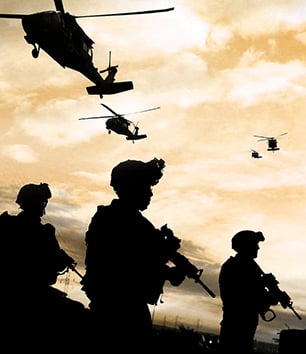
For well over a decade now the United States has been "a nation at war." Does that war have a name?
It did at the outset. After 9/11, George W. Bush's administration wasted no time in announcing that the U.S. was engaged in a Global War on Terrorism, or GWOT. With few dissenters, the media quickly embraced the term. The GWOT promised to be a gargantuan, transformative enterprise. The conflict begun on 9/11 would define the age. In neoconservative circles, it was known as World War IV.
Upon succeeding to the presidency in 2009, however, Barack Obama without fanfare junked Bush’s formulation (as he did again in a speech at the National Defense University last week). Yet if the appellation went away, the conflict itself, shorn of identifying marks, continued.
Does it matter that ours has become and remains a nameless war? Very much so.
Names bestow meaning. When it comes to war, a name attached to a date can shape our understanding of what the conflict was all about. To specify when a war began and when it ended is to privilege certain explanations of its significance while discrediting others. Let me provide a few illustrations.
With rare exceptions, Americans today characterize the horrendous fraternal bloodletting of 1861-1865 as the Civil War. Yet not many decades ago, diehard supporters of the Lost Cause insisted on referring to that conflict as the War Between the States or the War for Southern Independence (or even the War of Northern Aggression). The South may have gone down in defeat, but the purposes for which Southerners had fought -- preserving a distinctive way of life and the principle of states’ rights -- had been worthy, even noble. So at least they professed to believe, with their preferred names for the war reflecting that belief.
Schoolbooks tell us that the Spanish-American War began in April 1898 and ended in August of that same year. The name and dates fit nicely with a widespread inclination from President William McKinley’s day to our own to frame U.S. intervention in Cuba as an altruistic effort to liberate that island from Spanish oppression.
Yet the Cubans were not exactly bystanders in that drama. By 1898, they had been fighting for years to oust their colonial overlords. And although hostilities in Cuba itself ended on August 12th, they dragged on in the Philippines, another Spanish colony that the United States had seized for reasons only remotely related to liberating Cubans. Notably, U.S. troops occupying the Philippines waged a brutal war not against Spaniards but against Filipino nationalists no more inclined to accept colonial rule by Washington than by Madrid. So widen the aperture to include this Cuban prelude and the Filipino postlude and you end up with something like this: The Spanish-American-Cuban-Philippines War of 1895-1902. Too clunky? How about the War for the American Empire? This much is for sure: rather than illuminating, the commonplace textbook descriptor serves chiefly to conceal.
Strange as it may seem, Europeans once referred to the calamitous events of 1914-1918 as the Great War. When Woodrow Wilson decided in 1917 to send an army of doughboys to fight alongside the Allies, he went beyond Great. According to the president, the Great War was going to be the War To End All Wars. Alas, things did not pan out as he expected. Perhaps anticipating the demise of his vision of permanent peace, War Department General Order 115, issued on October 7, 1919, formally declared that, at least as far as the United States was concerned, the recently concluded hostilities would be known simply as theWorld War.
In September 1939 -- presto chango! -- the World War suddenly became the First World War, the Nazi invasion of Poland having inaugurated a Second World War, also known as World War II or more cryptically WWII. To be sure, Soviet dictator Josef Stalin preferred the Great Patriotic War. Although this found instant -- almost unanimous -- favor among Soviet citizens, it did not catch on elsewhere.
Does World War II accurately capture the events it purports to encompass? With the crusade against the Axis now ranking alongside the crusade against slavery as a myth-enshrouded chapter in U.S. history to which all must pay homage, Americans are no more inclined to consider that question than to consider why a playoff to determine the professional baseball championship of North America constitutes a "World Series."
In fact, however convenient and familiar, World War II is misleading and not especially useful. The period in question saw at least two wars, each only tenuously connected to the other, each having distinctive origins, each yielding a different outcome. To separate them is to transform the historical landscape.
On the one hand, there was the Pacific War, pitting the United States against Japan. Formally initiated by the December 7, 1941, attack on Pearl Harbor, it had in fact begun a decade earlier when Japan embarked upon a policy of armed conquest in Manchuria. At stake was the question of who would dominate East Asia. Japan’s crushing defeat at the hands of the United States, sealed by two atomic bombs in 1945, answered that question (at least for a time).
Then there was the European War, pitting Nazi Germany first against Great Britain and France, but ultimately against a grand alliance led by the United States, the Soviet Union, and a fast fading British Empire. At stake was the question of who would dominate Europe. Germany’s defeat resolved that issue (at least for a time): no one would. To prevent any single power from controlling Europe, two outside powers divided it.
This division served as the basis for the ensuing Cold War, which wasn’t actually cold, but also (thankfully) wasn’t World War III,the retrospective insistence of bellicose neoconservatives notwithstanding. But when did the Cold War begin? Was it in early 1947, when President Harry Truman decided that Stalin’s Russia posed a looming threat and committed the United States to a strategy of containment? Or was it in 1919, when Vladimir Lenin decided that Winston Churchill’s vow to "strangle Bolshevism in its cradle" posed a looming threat to the Russian Revolution, with an ongoing Anglo-American military intervention evincing a determination to make good on that vow?
Separating the war against Nazi Germany from the war against Imperial Japan opens up another interpretive possibility. If you incorporate the European conflict of 1914-1918 and the European conflict of 1939-1945 into a single narrative, you get a Second Thirty Years War (the first having occurred from 1618-1648) -- not so much a contest of good against evil, as a mindless exercise in self-destruction that represented the ultimate expression of European folly.
So, yes, it matters what we choose to call the military enterprise we’ve been waging not only in Iraq and Afghanistan, but also in any number of other countries scattered hither and yon across the Islamic world. Although the Obama administration appears no more interested than the Bush administration in saying when that enterprise will actually end, the date we choose as its starting point also matters.
Although Washington seems in no hurry to name its nameless war -- and will no doubt settle on something self-serving or anodyne if it ever finally addresses the issue -- perhaps we should jump-start the process. Let’s consider some possible options, names that might actually explain what’s going on.
The Long War: Coined not long after 9/11 by senior officers in the Pentagon, this formulation never gained traction with either civilian officials or the general public. Yet the Long War deserves consideration, even though -- or perhaps because -- it has lost its luster with the passage of time.
 At the outset, it connoted grand ambitions buoyed by extreme confidence in the efficacy of American military might. This was going to be one for the ages, a multi-generational conflict yielding sweeping results. At the outset, it connoted grand ambitions buoyed by extreme confidence in the efficacy of American military might. This was going to be one for the ages, a multi-generational conflict yielding sweeping results.
The Long War did begin on a hopeful note. The initial entry into Afghanistan and then into Iraq seemed to herald "home by Christmas" triumphal parades. Yet this soon proved an illusion as victory slipped from Washington’s grasp. By 2005 at the latest, events in the field had dashed the neo-Wilsonian expectations nurtured back home.
With the conflicts in Iraq and Afghanistan dragging on, "long" lost its original connotation. Instead of "really important," it became a synonym for "interminable." Today, the Long War does succinctly capture the experience of American soldiers who have endured multiple combat deployments to Iraq and Afghanistan.
For Long War combatants, the object of the exercise has become to persist. As for winning, it’s not in the cards. The Long War just might conclude by the end of 2014 if President Obama keeps his pledge to end the U.S. combat role in Afghanistan and if he avoids getting sucked into Syria’s civil war. So the troops may hope.
The War Against Al-Qaeda: It began in August 1996 when Osama bin Laden issued a "Declaration of War against the Americans Occupying the Land of the Two Holy Places," i.e., Saudi Arabia. In February 1998, a second bin Laden manifesto announced that killing Americans, military and civilian alike, had become "an individual duty for every Muslim who can do it in any country in which it is possible to do it."
Although President Bill Clinton took notice, the U.S. response to bin Laden’s provocations was limited and ineffectual. Only after 9/11 did Washington take this threat seriously. Since then, apart from a pointless excursion into Iraq (where, in Saddam Hussein’s day, al-Qaeda did not exist), U.S. attention has been focused on Afghanistan, where U.S. troops have waged the longest war in American history, and on Pakistan’s tribal borderlands, where a CIA drone campaign is ongoing. By the end of President Obama’s first term, U.S. intelligence agencies were reporting that a combined CIA/military campaign had largely destroyed bin Laden’s organization. Bin Laden himself, of course, was dead.
Could the United States have declared victory in its unnamed war at this point? Perhaps, but it gave little thought to doing so. Instead, the national security apparatus had already trained its sights on various al-Qaeda "franchises" and wannabes, militant groups claiming the bin Laden brand and waging their own version of jihad. These offshoots emerged in the Maghreb, Yemen, Somalia, Nigeria, and -- wouldn’t you know it -- post-Saddam Iraq, among other places. The question as to whether they actually posed a danger to the United States got, at best, passing attention -- the label "al-Qaeda" eliciting the same sort of Pavlovian response that the word "communist" once did.
Americans should not expect this war to end anytime soon. Indeed, the Pentagon’s impresario of special operations recently speculated -- by no means unhappily -- that it would continue globally for "at least 10 to 20 years." Freely translated, his statement undoubtedly means: "No one really knows, but we’re planning to keep at it for one helluva long time."
The War For/Against/About Israel: It began in 1948. For many Jews, the founding of the state of Israel signified an ancient hope fulfilled. For many Christians, conscious of the sin of anti-Semitism that had culminated in the Holocaust, it offered a way to ease guilty consciences, albeit mostly at others’ expense. For many Muslims, especially Arabs, and most acutely Arabs who had been living in Palestine, the founding of the Jewish state represented a grave injustice. It was yet another unwelcome intrusion engineered by the West -- colonialism by another name.
Recounting the ensuing struggle without appearing to take sides is almost impossible. Yet one thing seems clear: in terms of military involvement, the United States attempted in the late 1940s and 1950s to keep its distance. Over the course of the 1960s, this changed. The U.S. became Israel’s principal patron, committed to maintaining (and indeed increasing) its military superiority over its neighbors.
In the decades that followed, the two countries forged a multifaceted "strategic relationship." A compliant Congress provided Israel with weapons and other assistance worth many billions of dollars, testifying to what has become an unambiguous and irrevocable U.S. commitment to the safety and well-being of the Jewish state. The two countries share technology and intelligence. Meanwhile, just as Israel had disregarded U.S. concerns when it came to developing nuclear weapons, it ignored persistent U.S. requests that it refrain from colonizing territory that it has conquered.
When it comes to identifying the minimal essential requirements of Israeli security and the terms that will define any Palestinian-Israeli peace deal, the United States defers to Israel. That may qualify as an overstatement, but only slightly. Given the Israeli perspective on those requirements and those terms -- permanent military supremacy and a permanently demilitarized Palestine allowed limited sovereignty -- the War For/Against/About Israel is unlikely to end anytime soon either. Whether the United States benefits from the perpetuation of this war is difficult to say, but we are in it for the long haul.
The War for the Greater Middle East: I confess that this is the name I would choose for Washington’s unnamed war and is, in fact, the title of a course I teach. (A tempting alternative is the Second Hundred Years War, the "first" having begun in 1337 and ended in 1453.)
This war is about to hit the century mark, its opening chapter coinciding with the onset of World War I. Not long after the fighting on the Western Front in Europe had settled into a stalemate, the British government, looking for ways to gain the upper hand, set out to dismantle the Ottoman Empire whose rulers had foolishly thrown in their lot with the German Reich against the Allies.
By the time the war ended with Germany and the Turks on the losing side, Great Britain had already begun to draw up new boundaries, invent states, and install rulers to suit its predilections, while also issuing mutually contradictory promises to groups inhabiting these new precincts of its empire. Toward what end? Simply put, the British were intent on calling the shots from Egypt to India, whether by governing through intermediaries or ruling directly. The result was a new Middle East and a total mess.
London presided over this mess, albeit with considerable difficulty, until the end of World War II. At this point, by abandoning efforts to keep Arabs and Zionists from one another's throats in Palestine and by accepting the partition of India, they signaled their intention to throw in the towel. Alas, Washington proved more than willing to assume Britain’s role. The lure of oil was strong. So too were the fears, however overwrought, of the Soviets extending their influence into the region.
Unfortunately, the Americans enjoyed no more success in promoting long-term, pro-Western stability than had the British. In some respects, they only made things worse, with the joint CIA-MI6 overthrow of a democratically elected government in Iran in 1953 offering a prime example of a "success" that, to this day, has never stopped breeding disaster.
Only after 1980 did things get really interesting, however. The Carter Doctrine promulgated that year designated the Persian Gulf a vital national security interest and opened the door to greatly increased U.S. military activity not just in the Gulf, but also throughout the Greater Middle East (GME). Between 1945 and 1980, considerable numbers of American soldiers lost their lives fighting in Asia and elsewhere. During that period, virtually none were killed fighting in the GME. Since 1990, in contrast, virtually none have been killed fighting anywhere except in the GME.
What does the United States hope to achieve in its inherited and unending War for the Greater Middle East? To pacify the region? To remake it in our image? To drain its stocks of petroleum? Or just keeping the lid on? However you define the war’s aims, things have not gone well, which once again suggests that, in some form, it will continue for some time to come. If there’s any good news here, it’s the prospect of having ever more material for my seminar, which may soon expand into a two-semester course.
The War Against Islam: This war began nearly 1,000 years ago and continued for centuries, a storied collision between Christendom and the Muslim ummah. For a couple of hundred years, periodic eruptions of large-scale violence occurred until the conflict finally petered out with the last crusade sometime in the fourteenth century.
In those days, many people had deemed religion something worth fighting for, a proposition to which the more sophisticated present-day inhabitants of Christendom no longer subscribe. Yet could that religious war have resumed in our own day? Professor Samuel Huntington thought so, although he styled the conflict a "clash of civilizations." Some militant radical Islamists agree with Professor Huntington, citing as evidence the unwelcome meddling of "infidels," mostly wearing American uniforms, in various parts of the Muslim world. Some militant evangelical Christians endorse this proposition, even if they take a more favorable view of U.S. troops occupying and drones targeting Muslim countries.
In explaining the position of the United States government, religious scholars like George W. Bush and Barack (Hussein!) Obama have consistently expressed a contrary view. Islam is a religion of peace, they declare, part of the great Abrahamic triad. That the other elements of that triad are likewise committed to peace is a proposition that Bush, Obama, and most Americans take for granted, evidence not required. There should be no reason why Christians, Jews, and Muslims can’t live together in harmony.
Still, remember back in 2001 when, in an unscripted moment, President Bush described the war barely begun as a "crusade"? That was just a slip of the tongue, right? If not, we just might end up calling this one the Eternal War.
Andrew J. Bacevich is a professor of history and international relations at Boston University and a TomDispatch regular. His next book, Breach of Trust: How Americans Failed Their Soldiers and Their Country, will appear in September.
Follow TomDispatch on Twitter and join us on Facebook or Tumblr. Check out the newest Dispatch book, Nick Turse’s The Changing Face of Empire: Special Ops, Drones, Proxy Fighters, Secret Bases, and Cyberwarfare.
Copyright 2013 Andrew J. Bacevich
Source
|








No comments: