








New intifada against the dictatorship in Sudan
Jean Duval
 |
September 30, 2013
Protests have spread
all over Sudan since the announcement, one week ago, of the increase of
fuel prices in Sudan. This is not the first uprising against the Islamic
dictatorship of President Omar Hassan al-Bashir, in power since 1989.
Last year ''Elbow Lick Fridays"
rocked the regime. But the latest protests are the biggest since the
beginning of the dictatorship. The brutal repression meted out by the
police and Islamic militiamen is not deterring the heroic youth of
Sudan. But will it succeed this time in overthrowing the regime?
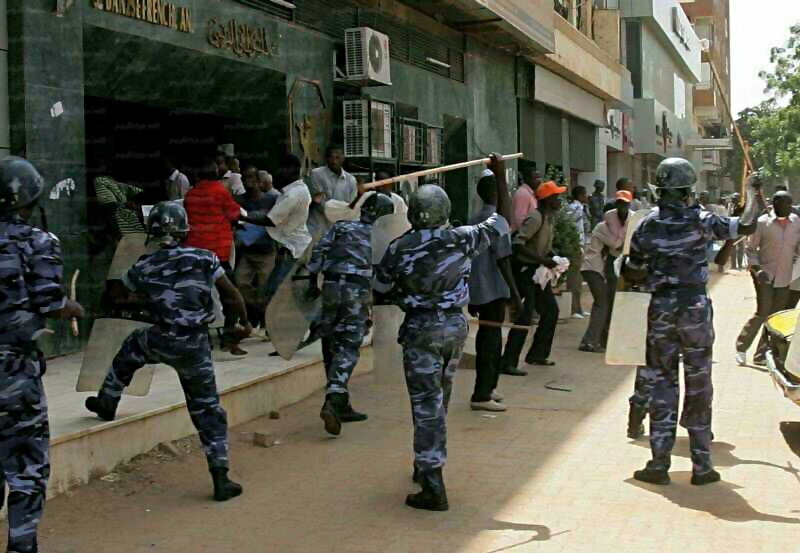 Clashes on 26 September. Photo: peoplesworldThe
prices of gasoline and diesel were increased by almost 100%. A gallon
[about four litres] of gasoline now costs 21 Sudanese pounds ($4.77
based on the official exchange rate) compared to 12.5 pounds ($2.84).
Diesel also went from 8 pounds ($1.81) a gallon to 14 pounds ($3.18).
Cooking gas cylinders are now priced at 25 pounds ($5.68) from 15 pounds
($3.40). Clashes on 26 September. Photo: peoplesworldThe
prices of gasoline and diesel were increased by almost 100%. A gallon
[about four litres] of gasoline now costs 21 Sudanese pounds ($4.77
based on the official exchange rate) compared to 12.5 pounds ($2.84).
Diesel also went from 8 pounds ($1.81) a gallon to 14 pounds ($3.18).
Cooking gas cylinders are now priced at 25 pounds ($5.68) from 15 pounds
($3.40).The protests erupted against the background of 20% unemployment, inflation of 40 to 45 % in the last 18 months and 14 million poor people out of a total population of 30 million. Child mortality from malnutrition has already increased by 40% last year says the World Health Organisation. "Economic reform" is the excuse for the cutting of food and fuel subsidies. Those subsidies cost the state budget 3.5 billion dollars a year. But the government forgets to say that military spending represents 70% of the state budget, including 20 million dollars a day for the wars in Darfour or in Kordofan and the Blue Nile. The government’s actions follow slavishly the recommendations of the International Monetary Fund. The cuts in subsidies are part and parcel of a wider package of austerity. President Bashir has even repeated the ridiculous argument that food and fuel subsidies only benefit the affluent Sudanese and not the poor! So who is it we see on the streets of Sudan, a revolt of the wealthy people or an uprising of the poor and disenfranchised masses? Professor Hamid El Tijani, an economy expert at the American University in Cairo explained in an interview with Radio Dabanga that, "What the government is currently doing is actually an imposition of new taxes on basic consumer commodities, rather than the lifting of subsidies—which are in fact not in place to lift." He added that Sudan is witnessing an economic collapse, with an increase in expenses and a deficit in the revenues. This negative development has prompted the ruling National Congress Party to resort to "borrowing from the people," in the name of lifting subsidies. He stressed that the government, by "lifting subsidies," just intends to impose new taxes on citizens (www.radiodabanga.org ). Free fall economyThe economy is in a shambles. The lifting of food and fuel subsidies is expected to raise inflation in the country. This is particularly the case as most food is imported. The exchange rate of the Sudanese pound against the dollar has fallen to a record low. Although there is not much foreign trading going on in the nation’s currency, its rate on the black market is generally considered to be a good gauge of the mood in business circles and the confidence of ordinary people in the economic situation. In the last few days people have rushed to trade in their Sudanese pounds for hard currency. The exchange rate is also important for some foreign firms as cell phone operators who sell in pounds and then struggle to convert them into dollars. Gulf banks who hold pound-denominated 'Islamic bonds’ are also worried about their assets.Since the secession of the oil rich southern part of Sudan in 2011 the national currency lost half of its value. Three quarters of oil production is located in South Sudan. Oil revenues were the driving force behind the economy and generated most of the much needed dollars to import food. The regime has tried to compensate the loss of oil revenues by selling its gold which represents now 70% of foreign trade. Sudan is sitting on the biggest gold reserves of the African continent and has handed out exploitation contracts to 600 firms in the last two years. But the fall of gold prices this year means that income will be sharply reduced. The gold sales also fall below the income of oil before the secession of South Sudan. The uprising of the poor and disenfranchisedSo we see how the increase in fuel prices and basic commodities has sparked again a large movement of protest, not only in Khartoum, the country’s capital but in other cities all over Sudan. "The spread of demonstrations in Khartoum since Monday maps materially to the class divide, the geography of impoverishment that encircles the capital. Omdurman’s Um Badda, al-Samrab in Khartoum North and al-Kalakla in Khartoum, to name examples from the three towns that make up the Sudanese capital, flared up in a show of anger that is by all measures the greatest urban challenge to the regime since its inception" notes Magdi El Gizouli on his blog Still Sudan .On Sunday, demonstrations continued in Khartoum, in Port Sudan, Atbara, Gedaref and Kassala. In the cities of Madani and Ombada, the headquarters of the NCP were attacked and burned down. In other places police offices were raided. In many places the school students and university students formed the bulk of the demonstrators. This explains why the government has announced a complete shut-down of the education system until the 20th of October in the hope of breaking up the movement and avoiding an escalation. Significant has been the very limited use of tear gas by the police forces to disperse the angry crowds. In a desperate move, the regime has chosen the open confrontation with its own people using the National Intelligence and Security Services, the praetorian guard of the regime. That is because the police force as such cannot be trusted anymore. The president himself acknowledged that in the last period 60 % of the police officers have deserted the force due to low wages. The brutal repression, the "shoot-to-kill" orders to police officers, secret service agents, military personnel and plain clothed armed groups have cost the lives of dozens of demonstrators. The funerals of the victims have also been attacked by the police with tear gas. This is what the so-called "plenty of self-restraint" of the police, as announced by the Minister of Information, really looks like. "The head of the Sudanese Doctors’ Syndicate, Dr Ahmed Al Sheikh, said that an estimated number of 210 people were killed during the demonstrations last week. Al Sheikh noted that this number exceeds the numbers of dead during the popular revolts of October 1964 and March-April 1985. He stated, in an interview with news site Hurriyaat, that most injuries caused by bullets were found in the head and chest." (Sudan: Doctors report 210 dead in Khartoum during demonstrations) Repression does not deter the movementThousands of others have been wounded. A campaign of mass arrests of members and leaders of the opposition parties, including the Communist party, is being waged by the police and the NISS (the Sudanese secret police). The government is also imposing massive censorship. A report of the independent Radio Dibanga states the following:"On Saturday, the newspapers Al Jarida, al Garrar, Al Mashhad Alan and Al Intibaha were definitely stopped from appearing for an undefined period of time. On Monday Al Ayaam newspaper had already decided to stop, protesting the instructions of the security not to publish any news on facts related to the demonstrations and violations committed by security forces and the police. Al Sahafa newspaper agreed to follow the instructions, after which a number of journalists working for Al Sahafa resigned.The sporadic closure of the internet, as Mubarak in Egypt learnt, has not stopped information from circulating and has not fundamentally hampered the youth from organising. The internet service is on only for the NCP officials to make their financial transactions... Although an important tool in organising the movement, it does not depend on it. Interestingly the disruption of the internet has spurred the ingenuity of the tech savvy youth. They have found ways to get round the closure of the internet with a "cell phone powered crowd map". [see Protesters Are Dodging Sudan's Internet Shutdown with a Phone-Powered Crowdmap] The regime should know better, but it is completely alienated from reality. The Sudanese people and especially its youth remain undeterred by the extreme retaliatory violence of the state. Repression of all kinds no longer paralyses or instils passivity – quite the contrary! Every drop of blood lost, every man or women hit by a truncheon, every protester killed today increases the resolve to get rid of the dictatorship. It does not weaken but hardens the will to struggle. As one female blogger, Mana El Sanosi puts it, "Fear is not an option. When the fear barrier is broken we are unstoppable". The protesters are not only targeting the recent economic measures, but they reject the regime as a whole. This is reflected in the songs of the protesters who, just like their brothers and sisters in the rest of the Arab world, demand "Hurryia" (freedom) and the "fall of the regime" and the "death of the president". The Islamic regime of the National Congress Party (NCP) in power since the coup on 1989 has used religion as a tool of domination and to maintain its grip on the state, the military and the economy. Popular wisdom has dubbed the people in power as "Tujjar ad-Din", merchants of religion. What keeps the NCP together is not faith in Islam but belief in their very material mercantile interests. This is also the case of other reactionary Islamic movements in the region. In the hands of these people, religion is just a tool for exploitation and oppression. The rejection of the regime is generalised. The middle classes do not trust the regime any longer. The protests are more serious and more widespread than in June/July 2012 (Sudan joins Arab Spring). "No one is unaffected by the NCP. If you are not affected by the war, you are affected by unemployment. If you are not affected by unemployment, you are affected by corruption. If you are unaffected by corruption you are affected by suppression of freedoms" insists an opposition member of the Sudan Change Now movement. No trust in the rats leaving the boat or in the bourgeois oppositionThe regime is very isolated with its economic war against its own people. There is virtually no support for the austerity measures on the streets of Sudan. Growing social isolation is producing the first fissures. The unity of the regime is cracking. NCP officials have called for the reintroduction of fuel subsidies and to stop killing people. "Mr President, in the light what is happening we demand an immediate stop of the economic measures," read a petition signed by 31 members of the quasi-official Islamist Movement and the ruling National Congress Party (NCP). This statement also condemns the repression of the demonstrations and demands the prosecution of those responsible for the deaths and wounded. The government has decided to stick to its decisions taken last week. If the movement grows in the next few days this internal divide will widen and embolden the masses to come back onto the streets. It could mean the end of the rule of Bashir.Hypocritically, the United States have expressed concern and have appealed for an "end to excessive violence", while the European Union pretends to be "disturbed". The United Arab Emirates is the first Arab country to criticise Khartoum and has asked the government to make use "wisdom and constraint". The regime nevertheless has the support of Qatar, which explains the scarce coverage by Al Jazeera of the protest movement! Just as in 2012, the opposition parties have played no role whatsoever in this "September intifada". Most of them have been neutralised by the cheque books of the government. Their attitude may change, however, when they feel the regime is crumbling. Then they will offer their poisoned services to the revolution with the aim of saving their interests and derailing the September intifada. The movement is largely spontaneous, neighbourhood-led and the result of the initiative of the youth in schools and universities. As one youth activist says, the leaders of the opposition parties are "hopeless and senile". New movements have emerged like Girfina (We are fed up!) and Abena (We reject!) as well as revolutionary youth movements but with a weak organised presence and leadership. On Saturday a Coordination of Sudanese Change Forces, was established in Khartoum which includes the opposition party members of National Consensus Forces, trade unions of the doctors and teachers, democratic lawyers, Khartoum University and the Alliance of Civil Society Organisations. The Coordination demands that the regime "dissolve its executive and legislative bodies and to hand over the power to a transitional and inclusive government to administrate the country during an interim period." No real strategy to achieve these goals has been outlined except for a "continuation of the struggle". To "hold on" and "to continue the uprising" what is required is to prepare an insurrectionary general strike in the country. No other goal is so immediate, so urgent and so concrete. This is the moment to do it. The blood of the Sudanese youth and workers cannot be spilled aimlessly. The bourgeois parties in the "Coordination" are not prepared to go along this road. An alliance with them is not only unnecessary but also a real obstacle to the struggle. What is required is a real front of the left-wing organisations, unions and parties, a front of all the oppressed and not a coalition of class collaboration. The Coalition of revolutionary youth "calls upon the Armed Forces and all the honourable Sudanese men and women of the security forces to support this uprising and to protect our Sudanese men and women in the streets." To achieve this we need to call ordinary soldiers, democratic and revolutionary NCO’s and officers to break with the wealthy generals and disarm them, disrupt the chain of command and establish also revolutionary committees inside the army who will guarantee that the armed forces obey the people. The compelling need for a centralised revolutionary leadershipThe biggest challenge for the September Intifada is to forge its own central political leadership from the grass roots up. If the struggle in June/July 2012 was lost it was because it lacked a clear leadership and direction. The best way to do this is to establish committees of struggle in the schools, universities, workplaces and neighbourhoods and to coordinate them at the local, city, regional and national level. All left-wing groups, communists and trade unions should participate in it. They must become instruments for unifying and centralising the struggle for the overthrow of the regime. But they can and must be much more. In the revolutionary situation which is rapidly developing in Sudan they will become tools of a new power to replace the old rotten and corrupt state apparatus and government. They should become the backbone of a new revolutionary constituent assembly elected by those same committees of struggle.Revolutionaries in the Arab world can draw some lessons from Tunisia and Egypt. In Tunisia it has become clear that a Constituent Assembly called and organised by the old bourgeois state apparatus of Ben Ali is not an instrument for democratic and revolutionary change. It is rather a tool of paralysis and for the continuation of the old political and economic powers behind the mask of "democracy". It is an instrument of deceit of the masses. Neither in Tunisia nor in Egypt has the fundamental change of jobs, homes, justice and freedom for all been realised. This explains the recurrent huge mobilisations and uprisings in both countries of the masses who want to see real change. The immediate task of such a revolutionary constituent assembly is to dismantle the old repressive and bureaucratic state, disband the NISS, prosecute the men and women responsible for the repression of the people, dissolve the NCP and all parties who sided with it, free all political prisoners, introduce the right to organise, to strike, to demonstrate and freedom of expression. It shall also take the first measures of social justice, increase the wages, lower the prices, stop all privileges, expropriate the oligarchs and make their possessions public property, nationalise the mines and oil wells, nationalise the fuel distribution network, the big markets, the big truck companies, telecom companies, banks, etc. under the democratic control of the workers. Those basic conditions for revolutionary and democratic change cannot be obtained through negotiations, through wheeling and dealing with the regime. The regime must be overthrown. This would then be the first step to eradicating the root cause of all discrimination, prejudice, national, ethnic and religious oppression, i.e. the economic system of capitalism. If you agree with the ideas explained in this article you can help is to establish a Marxist group in Sudan. Please contact us at webmaster@marxist.com Images of the September Intifadahttp://www.youtube.com/watch?v=twEacF3Irw4A tribute to the martyrs of the September IntifadaOn the june/july 2012 revoltSong dedicated to protestershttp://www.youtube.com/watch?v=twEacF3Irw4http://www.youtube.com/watch?feature=player_embedded&v=YFMEAnpyrYkhttp://www.youtube.com/watch?v=L31mj-BZCc0http://www.youtube.com/watch?v=fnjCOgy53Gw&feature=player_embeddedhttp://www.youtube.com/watch?feature=player_embedded&v=R5aRlaVUzCcSource |


No comments: