








Does Providing Aid in War Zones Do More Harm Than Good?
The politicization of humanitarian aid poses a huge moral dilemma for NGO workers.
By
 |
| Humanitarian aid, including school supplies, delivered to Afghan village in 2010. (Photo: NATO Training Mission-Afghanistan / Flickr) |
I recently met an aid worker in Iraq who distributed food to the Tikrit area. Until last spring, the city was a war zone controlled by the Islamic State, or ISIS. It was too dangerous for many major humanitarian organizations to reach.
He was proud of how he’d negotiated his way into the city, ensuring that the Islamic State would allow his group to operate — as long as they didn’t label the shipments.
He told me he just wanted to help Iraq’s suffering, oppressed people. Yet when I asked him if he considered whether ISIS fighters had diverted aid meant for civilians, he confided in me that he didn’t actually know where the food ended up.
The simple truth is that belligerent groups like the Islamic State take advantage of well-intentioned humanitarian aid organizations. As a self-proclaimed state, ISIS knows it must support the territories it controls with aid resources to curry favor and continue recruiting fighters to its cause. In fact, the terrorist organization has its own labels that proclaim “ISIS Department of Relief,” which it applies to the unlabeled boxes supplied by groups like my friend’s.
By clandestinely rebranding aid from outside sources with its own labels, ISIS fools surrounding populations into believing the insurgent state is a benevolent entity that protects and cares for its people.
This poses a huge moral dilemma for those of us who work at humanitarian organizations: If we know the aid will likely be diverted, should we not try to help suffering people? If we stop the aid, many belligerents will use it as propaganda to blame the West for the area’s suffering and hunger. But if we provide aid, aren’t we abetting terrorist organizations?
Dealing with authoritarian or opportunistic governments can be challenging enough. But to make matters worse, belligerent non-state actors, or NSAs, often act as rogue governments themselves, stepping in after war has plunged the state government into chaos.
NSAs seize territory and then demand bribes from aid workers in exchange for safe passage. They commit violent crimes against innocent people, encourage black markets fueled by aid supplies, and use aid for their own ends. In these situations, aid manipulation can delay peace agreements, prolong suffering, and marginalize local authorities trying to restore order.
Ultimately, aid for victims should be the responsibility of the parties to the conflict. But these efforts can be hopelessly complicated by conflicts between insurgent groups, non-state actors, and remnants of failed and failing states. And tragically, the very presence of foreign aid in war zones is often perceived as an endorsement of a particular “side” by warring factions and external observers, putting aid workers and the people they want to help at risk.
How NSAs Manipulate Aid
While intrastate conflict has always existed, it now plays out on a more global and interconnected stage, where savvy actors can use unprecedented access to media and communications to publicize their efforts and beliefs.
Three types of NSAs are of particular concern in these conflicts:
- Organized fighting forces like local militias or paramilitary groups,
- Criminal economic organizations like the mafia, whose interests are best served by violence and weak governance, and
- Hybridized NSAs with military and economic agendas, such as the Islamic State,
Each type of NSA subverts aid efforts to the organization’s benefit while society suffers. With cash, food, arms, and medical supplies flowing into their hands, warring factions have little incentive to approach the bargaining table; instead, their interests are served by prolonging war. Particularly nefarious NSAs will even manipulate the presence of refugees to exploit humanitarian resources for political gain.
The Somali people, for example, have been oppressed and terrorized by local warlords, foreign invaders, al-Qaeda, and hardline groups like al-Shabab for nearly decades. Around1 million Somalis are displaced throughout the Horn of Africa and Arabia, while 1.1 million are displaced within Somalia itself. To help the millions of people often gripped by famine and displaced by war, humanitarian organizations have been forced to bargain with al-Shabab and its affiliates, perhaps helping it retain power in significant tracts of Somalia.
Unfortunately, NSAs in war zones often require aid organizations to pay a “tax” in exchange for being allowed to assist innocent victims. Ultimately, these taxes strong-arm aid organizations into funding continued violence. Moreover, by negotiating with NSAs, humanitarian organizations grant legitimacy to illegitimate actors, implicitly acknowledging their influence and authority. These NSAs provide aid to suffering people one day, only to terrorize them the next.
Four Approaches to Aid
Providing aid in war zones presents a dilemma. With neutrality becoming less possible in conflict zones, the lack of clearly defined zones of control means aid cannot usually be administered without benefitting belligerent NSAs or appeasing problematic governments.
There are at least four approaches to navigating this dilemma. None of them is perfect.
- Cutting aid off.
This is an extreme strategy. Stopping all forms of aid to curb undesirable manipulation can have disastrous consequences for victims of conflict. Some have proposed that humanitarian aid should be supplied on the condition that the parties to the conflict respect humanitarian rules, but this approach doubly punishes innocents: It amounts to ceasing aid to civilians because their rights are being violated.
- Distributing aid with clear political motives.
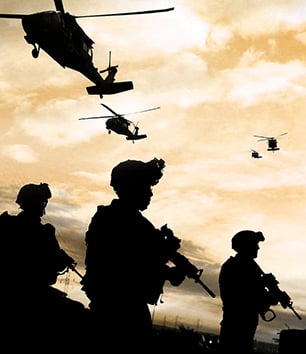
While NGOs aren’t combat forces, the U.S. and many other nations have undertaken efforts to incorporate them into broader military efforts. Former U.S. secretary of state and retired general Colin Powell, for example, has described NGOs that offer politically supportive aid as “force multipliers“ and an “essential part of the combat team.”
Distributing aid this way is an increasingly common approach. But it’s also a moral minefield.
The humanitarian organization Spirit of America (SoA), for example, provides strategic aid requested by U.S. troops and diplomats in volatile regions like Afghanistan, Ukraine, and Iraq to assist indigenous or displaced populations. During the wars in Afghanistan and Iraq, SoA gathered supplies — ranging from sewing machines to hand tools to children’s toys — to assist U.S. forces with stabilizing the region. The charity also funded various Iraqi television stations to help displaced and impoverished citizens stay informed about the conflict.
While SoA absolutely helped desperate Iraqis and Afghans, its aid was delivered under no pretense of neutrality. Other humanitarian organizations like the United States Agency for International Development focused on returning children to school with the goal of informing youth about the benefits of democracy.
The distribution of aid to Iraqis was a central tenet of U.S. foreign policy after Saddam Hussein’s flight from the nation in 2003: The goal was to show people how their quality of life would improve without the nation’s former dictator ruling them. This kind of cooperation can make life better for innocent people, but it raises ethical questions about cooperating with invading armies.
- Using military force to protect or distribute aid.
Using military force to ensure victims receive aid might seem like an appealing option in humanitarian quagmires like the civil wars in Iraq and Syria, but it should be done with extreme caution.
Indeed, this tactic runs counter to two fundamental tenets of humanitarian aid: impartiality and neutrality.
Military personnel engaged in humanitarian operations, after all, must make no distinction between conflict victims on the basis of their faith, their membership with a political group, or their race. The decision to use military methods to impose humanitarian aid is not one to be taken lightly, as it can turn aid workers — and even the very people who are served — into targets for belligerents.
Even worse, forcefully protecting aid can spur even wider violence — for example, when U.S. efforts in Somalia in 1991 to secure food convoys ended in a brief but violent conflict.
- Expanding aid with education and communication.
The humanitarian impulse is a part of our human nature. But in a complicated world where wars are no longer fought between nations with clear borders, we must work together to inform policymakers, donors, and the media — both in war zones and donor states — about the challenges of humanitarian work and aid manipulation.
Using historical context like the manipulation of Somali aid in the 1990s, policy leaders can understand the dangers of protecting aid via military force. With community education, civilians can spot and report manipulation without putting themselves in harm’s way. And local media can learn to avoid reporting on the positions of aid convoys that might leave aid workers and resources vulnerable to attack.
If 1 percent of the $10 billion used to fund global humanitarian and post-conflict efforts was used to educate the public about how aid impacts conflict zones, war economies, and negotiations, our investment could be returned many times over. The long-term costs of manipulated aid is much higher than the short-term costs of increased education about humanitarian aid and manipulation by NSAs.
At its core, humanitarian aid enables us to ease suffering and position ourselves as empathetic human beings. Helping those in need often comes with ugly costs, but providing humanitarian aid — supported by continued education and communication — to war zones is the only way we can fulfill our human obligation to assist the innocent and protect the oppressed.


No comments: