








Are US Pacific Bases Just Chinese Hostages?
Americans will not risk the incineration of Los Angeles for the rubble of Guam. Iran's attacks on US bases in the Middle East are a warning.
Here Comes China
Thanks to China’s rare earth restrictions, the US cannot replace the high-technology weapons it is using in Ukraine and the Middle East. Washington just announced that it cannot defend any of its allies in the area apart from Israel, yet will still exhaust its defensive missile inventory within a week. – Godfree.
In the annals of military history, bases have often been the linchpins of empire, the forward redoubts from which great powers projected force and deterred foes. Yet in our era of hypersonic missiles and precision-guided swarms, one must ask: have these bastions become mere hostages?
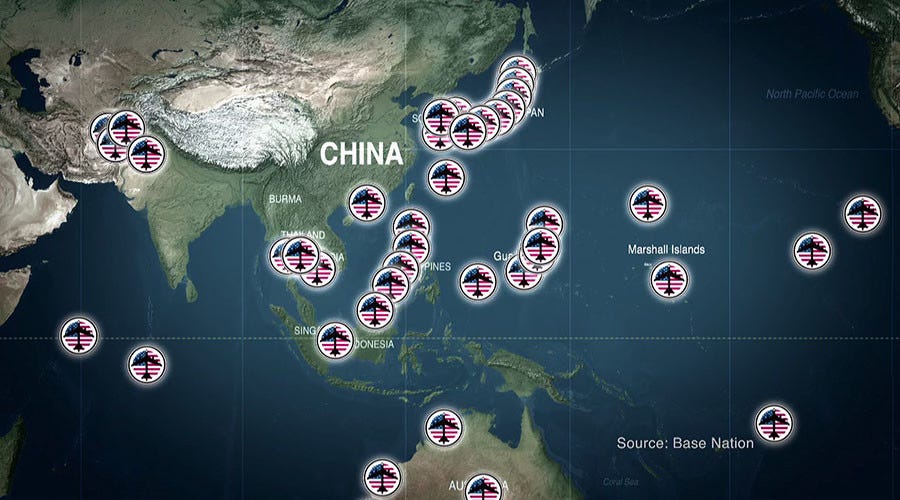
The United States’ network of 92 installations encircling China—Guam, Kadena in Okinawa, Yokosuka in Japan—stand as testaments to Cold War strategy, but historical precedent and immutable strategic principles suggest they are now liabilities, vulnerable pawns in a game where Beijing holds the initiative: the American public, ever pragmatic in its isolationism, will not trade the incineration of Los Angeles for the rubble of Guam. Nor should it.
Pearl of the Pacific
Consider the lessons of the Second World War, that cataclysmic forge of modern strategy. In December 1941, Japan’s audacious strike on Pearl Harbor demonstrated the peril of fixed naval bases in an age of carrier aviation. The US Pacific Fleet, moored in neat rows, was decimated not because of tactical ineptitude but because bases are inherently static targets, ripe for pre-emptive annihilation (the Navy’s main Middle East base at Erbil was annihilated by Iran yesterday).
Inverted calculus of deterrence
Fast forward to the missile age and China’s DF-21D ‘carrier killer’ and DF-26 ‘Guam killer’ ballistic missiles echo this logic. These weapons, capable of Mach 10 speeds and mid-course manoeuvres, render runways and fuel depots at Kadena or Andersen Air Force Base on Guam as exposed as those battleships at Pearl. Historical analogy is stark: just as Britain’s Singapore naval base, the “Gibraltar of the East,” fell to Japanese land assault in 1942 despite its vaunted guns, so too could US Pacific outposts succumb to a barrage of saturation strikes, without a single Chinese boot on the ground.
Strategic principles from Clausewitz to John Mearsheimer reinforce this vulnerability. War is politics by other means, and in the nuclear shadow, escalation ladders are perilously steep. The US bases serve as tripwires, ostensibly deterring Chinese aggression through their presence. But in truth, they invert the calculus of deterrence. During the Cuban Missile Crisis of 1962, Kennedy’s blockade and the removal of Soviet missiles from America’s doorstep underscored a fundamental truth: proximity breeds intolerable risk. Khrushchev backed down not from abstract moral suasion but from the spectre of mutual annihilation.
Today, China’s A2/AD (anti-access/area denial) strategy turns the tables. Beijing’s missile forces, numbering in the thousands, can overwhelm defences like Patriot batteries or Aegis systems in hours. A strike on Guam—2,000 miles from California—might flatten runways and sink docked vessels, but it stops short of homeland attack.
Would Washington really retaliate with strikes on the Chinese mainland, risking hypersonic reprisals against San Diego or Seattle? Precedent from the Cold War’s proxy wars—Korea in 1950, where MacArthur’s push to the Yalu invited Chinese intervention without nuclear exchange—suggests restraint. The US did not escalate to atomic weapons despite battlefield reverses; public opinion, scarred by Hiroshima’s legacy, recoiled at the thought.
Asymmetrical interests
The asymmetry of interests, moreover, amplifies this hostage dynamic. For China, Taiwan and the South China Sea are core national imperatives, a vital artery worth existential risk. For America, these are peripheral commitments, alliances forged in the anti-communist fervour of the 1950s but now strained by domestic priorities.
Historical echoes abound, even on the field of battle: in Vietnam, US forward bases like Da Nang became magnets for enemy fire, sapping morale without decisive advantage. The Tet Offensive of 1968 exposed the folly of fixed positions in guerrilla warfare; missiles merely accelerate this lesson. China’s hypersonics, with their ability to evade radar and strike with pinpoint accuracy, make any base a de facto hostage. Destroying Kadena might cost the US air superiority in a Taiwan strait crisis, but retaliating could invite a cascade: first conventional counterstrikes, then cyber assaults, and finally the nuclear threshold. As in the Falklands War of 1982, where Britain’s distant outpost compelled a risky expedition, the already-overstretched USA would face a similar dilemma—but with adversaries wielding far deadlier tools.
Coaling stations?
Strategic thinkers like Alfred Thayer Mahan, author of The Influence of Sea Power upon History, 1660–1783, analyzing the importance of naval power in the rise of the British Empire, once extolled bases as coaling stations for naval dominance, but that era has passed. The missile revolution, birthed in the V-2 rockets of Peenemünde and matured in ICBM silos, demands mobility over fixity. Submarines, stealth bombers, and drone swarms—dispersed, elusive—offer true power projection without the vulnerability of concrete revetments.
Win without fighting?
China’s doctrine, informed by Sun Tzu’s emphasis on indirect approach, exploits this. By holding US outposts at risk, Beijing deters without firing, much as the Royal Navy’s Grand Fleet deterred the Kaiser’s High Seas Fleet in World War I through mere existence, and Jutland showed how fleeting such equilibria can be.
The political dimension cannot be ignored. Strategic principle dictates that deterrents must be believable; hostages undermine this, inviting tests of will that favor the resolute. China and the Chinese people are resolute while America’s war-weary electorate is beginning to resemble Britain’s interwar aversion to continental entanglements. Public polls amid rising Sino-American tensions show scant appetite for sacrificing metropolises for atolls. The destruction of Guam—home to 170,000 souls, many American citizens—would evoke outrage, but not the Pearl Harbor resolve of 1941. Instead, it might fracture alliances: Japan, hosting Kadena, could sue for neutrality, recalling Italy’s waverings in 1914.
Shields or shackles?
Rome, bled by falling conscription rates and rising insurgencies, gradually abandoned frontier forts and garrisons, as have all empires. In the missile age, US bases around China are not shields but shackles, confining American power to vulnerable points while Beijing’s mobile arsenal grows. Washington must either sue for peace with China or invest in agile forces, strengthen alliances through shared technology rather than shared targets, and recognize that true security lies in domestic depth, not peripheral perimeters. Risk Los Angeles for Guam? No rational strategist, steeped in the bloody lessons of the past, would countenance it. The Pacific’s vastness once favored the bold; now, it demands the wise.


No comments: