Theme images by kelvinjay. Powered by Blogger.

This is war propaganda

This is war propaganda
A 2013 Mondoweiss article exposing how war propaganda gets a "makeover". The same military action is rebranded for media: "targeted operation" instead of "bombing", "self-defense" instead of "aggression". Goal: reshape public perception and sell the war.

COVERT WAR ON TERROR Yemen: reported US covert action 2012

COVERT WAR ON TERROR Yemen: reported US covert action 2012
2012 report on reported US covert operations in Yemen as part of the "War on Terror". The article discusses secret military actions, drone strikes, and how they were covered in media. Source: bladalarb.blogspot.com

CALL FOR INTERNATIONAL SOLIDARITY

CALL FOR INTERNATIONAL SOLIDARITY
CALL FOR INTERNATIONAL SOLIDARITY Article from Brussels Tribunal calling on global activists, intellectuals, and movements to unite in solidarity with Iraq and against occupation. Source: brussellstribunal.org

Saddam’s VP, Izzat ad-Douri: Maliki follows Iran’s agenda to divide Iraq /Video)

Saddam’s VP, Izzat ad-Douri: Maliki follows Iran’s agenda to divide Iraq /Video)
2013 video statement by Saddam's former VP Izzat ad-Douri. He accuses PM Maliki of following Iran's agenda to divide Iraq. Source: bladalarb.blogspot.com

BOOKS ON IRAQ

BOOKS ON IRAQ
click Pic.

The US War crimes on Iraq

The US War crimes on Iraq
How much they hate Iraq and why?

War in Mali : STOP THIS

War in Mali : STOP THIS
CLICK PHOTO

War in Syria : STOP THIS

War in Syria : STOP THIS
CLICK PHOTO

Welcome to Kuala Lumpur Foundation to Criminalise War

Welcome to Kuala Lumpur Foundation to Criminalise War
Kuala Lumpur Foundation to Criminalise War The Foundation promotes justice and accountability for war crimes. It seeks to bring political and military leaders responsible for aggression and crimes against humanity to an international tribunal.

Criminalize War - War is about killing, massive killing

Criminalize War - War is about killing, massive killing
A - List of killed Iraqi academics

"Kill Anything That Moves"

"Kill Anything That Moves"
Military Doctrine Began in Vietnam

How the Pentagon is hiding the dead The secret campaign to undercount the ‘war on terror’ death tol

How the Pentagon is hiding the dead The secret campaign to undercount the ‘war on terror’ death tol
CLICK The PIC

U.S. Officials Guilty of War Crimes

U.S. Officials Guilty of War Crimes
for the Iraq War

The Massacre of Al-Amiriyah Shelter Remembered – 2/10/13

The Massacre of Al-Amiriyah Shelter Remembered – 2/10/13
click Pic

PILOTS FOR 9/11 TRUTH

PILOTS FOR 9/11 TRUTH
Now available

US War Crimes

US War Crimes
Coverup of Extensive War Crimes

Barack Obama : A Gigantic Fraud upon the American People

Barack Obama : A Gigantic Fraud upon the American People
Clik Pict.

The victims of Fallujah's health crisis are stifled by western silence

The victims of Fallujah's health crisis are stifled by western silence
To research a possible link between US bombardment and rates of birth defects and pediatric cancer in Iraq is a moral imperative

If Americans Knew

If Americans Knew
UN Resolutions Targeting Israel and the Palestinians

40% of Palestinian Children Detained by Israel Sexually Abused; Virtually All Tortured

40% of Palestinian Children Detained by Israel Sexually Abused; Virtually All Tortured
Click Pict.

The Iraq War began when

The Iraq War began when
CLICK PC.

Israeli soldiers raid Al Aqsa courtyard, attack worshipers

Israeli soldiers raid Al Aqsa courtyard, attack worshipers
CLICK The PIC

#CrowdActivism 911 Mass Arrests!

#CrowdActivism 911 Mass Arrests!
Click for RAW Evidence DECIDE *now*!

War Crimes Are US

War Crimes Are US
Depleted Uranium weapons: Why shouldn’t it be a war crime to poison civilians with radiation?

The Iraqi weapons of mass destruction

The Iraqi weapons of mass destruction
Found at last! After searching for 10 years, the Iraqi weapons of mass destruction have finally been found – in Syria

The Mother of All Battles The Endless U.S.-Iraq War

The Mother of All Battles The Endless U.S.-Iraq War
Book by Jeff Archer

MASS Graves uncovered accidentally unveiling true dangers of iranian backed militias in iraq

MASS Graves uncovered accidentally unveiling true dangers of iranian backed militias in iraq
REPORT Foreign Relations Bureau - Iraq - United Kingdom

Get the REAL DEAL

CLICK TO VISIT

operation iraqi freedom

operation iraqi freedom
click PC

LIST OF KILLED IRAQI ACADEMICS

LIST OF KILLED IRAQI ACADEMICS
ASSASSINATED IRAQI MEDIA PROFESSIONALS

International Lawyers Seek Justice for Iraqis

International Lawyers Seek Justice for Iraqis
Sabah al-Mukhtar is the president of the Arab Lawyers Association and chair of the Iraq Commission

A World Appeal to Anti-war Forces: STAND WITH IRAQ!

A World Appeal to Anti-war Forces: STAND WITH IRAQ!
click the photo

Engineering solution for Radioactive Waste in IRAQ

Engineering solution for Radioactive Waste in IRAQ
Engineering Solution for Radioactive Waste in IRAQ

Wikileaks Iraq: data journalism maps every death

Wikileaks Iraq: data journalism maps every death
Iraq war logs release has dumped some 391,000 records

Report on Status of Iraq

Report on Status of Iraq
Government War Crimes in Anbar Province

Historical Analysis of the Global Elite: Ransacking the World Economy Until ‘You’ll Own Nothing.’

COVERT WAR ON TERROR Yemen: reported US covert action 2012

COVERT WAR ON TERROR Yemen: reported US covert action 2012

Sir Henry Kissinger: Midwife to New Babylon

Sir Henry Kissinger: Midwife to New Babylon
The moment Kissinger’s last breath left his corpse, media commentators lost no time running out the gates, either singing songs of slavish praise about the “great liberal statesman”clik Pict.

Action in Ghent 16 March. 7000 posters were distributed by 70 volunteers. A lot of "Justice For Ira

Beyond Torture U.S. Violations of Occupation Law in Iraq

Beyond Torture U.S. Violations of Occupation Law in Iraq
A report by the Center for Economic and Social Rights

Iraqi Children: Deprived Rights, Stolen future

Iraqi Children: Deprived Rights, Stolen future
click PIC

Syria News - August 16, 2013 (Warning: Graphic Videos)

Syria News - August 16, 2013 (Warning: Graphic Videos)
Local Coordination Committees of Syria + Videos

Letter From Yemen by Felicity Arbuthnot + Defining Drone Deaths in Yemen

Handwritten letter from President Saddam Hussein to the American people. 7 July 2006.

Handwritten letter from President Saddam Hussein to the American people. 7 July 2006.
To the American people:

Saddam Hussein refuses to sell out Iraq.

Saddam Hussein refuses to sell out Iraq.
Saddam Hussein refuses to sell out Iraq. Egyptian Magazine publishes transcript of meeting in prison between Saddam Hussein and Donald Rumsfeld.

Report On Israeli Human Rights Violations

Report On Israeli Human Rights Violations
Weekly Report On Israeli Human Rights Violations in the Occupied Palestinian Territory (23 - 29 May 2013)

Weekly Report On Israeli Human Rights Violations in the Occupied Palestinian Territory (05 - 12 Jun

Weekly Report On Israeli Human Rights Violations in the Occupied Palestinian Territory (05 - 12 Jun
The Palestinian Centre for Human Rights (PCHR)

IRAKDOSSIER in DE WERELD MORGEN: verschillende Engelstalige artikels die op deze website staan, wer

America’s Long History of Bloodletting

America’s Long History of Bloodletting

Lawrence Davidson

May 31, 2013

Americans like to think of themselves as peace-loving, but their history belies that self-image. From the genocidal wars against Native Americans through the current multi-front "war on terror," the United States has been fighting and killing for most of its history, as Lawrence Davidson notes.
There is an American tradition of frequent war. Indeed, over the course of the country’s history the United States has been at war almost constantly. Some of these have been relatively short conflicts like interventions in various Central American venues. Some have been much larger and longer affairs, like the Civil War, World War II and Vietnam.
The point to be drawn from this is that the people of the United States are (perhaps unconsciously) acclimated to always being in one sort of armed conflict or another. Unfortunately, this history renders a recent public statementby the Pentagon’s general counsel, Jeb Johnson, into just a bit of fanciful idealism. He insisted "war must be regarded as a finite, extraordinary and unnatural state of affairs." Certainly not for Americans.
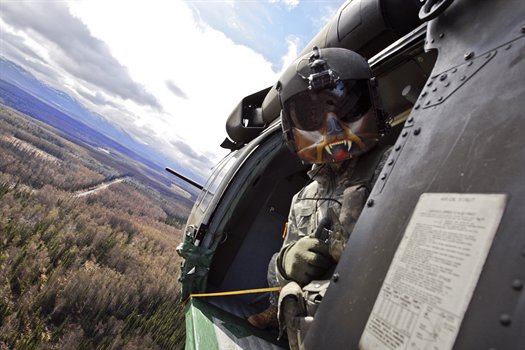
An Army sergeant peers out the door of a UH-60 Black Hawk helicopter on the way to pick up soldiers in a training operation at Joint Base Elmendorf-Richardson, Alaska, May 23, 2013. (U.S. Army photo by Percy Jones)
With their active assumption that the U.S. represents the world’s best chance for the victory of "good" against "evil," Americans seem willing to battle on as long as they are convinced they are winning and the casualties are low. That may be why there was no popular protest when Michael Sheehan, Obama’s assistant secretary of defense for "special operations," told a Senate hearingthat the country’s "war on terror" might last "at least 10 or 20 years" longer (it has already been going on 12 years). In the mainstream media, there was not even a noticeable raising of an anchorperson’s eyebrows!
The reason given for Sheehan’s prognosis was that al-Qaida, and its franchise allies, keep recreating themselves as fast as their alleged leaders can be droned into oblivion. Missing from the congressional and media reaction was the obvious question of "how come" such groups keep recreating themselves?
Many middle-echelon State Department analysts familiar with the Middle East know the answer has something to do with the fact that U.S. policies in the region have not significantly changed since the 9/11 attacks. Most of the personnel above the middle echelon are political appointees who keep asserting that what motivates the al-Qaida types is religious fanaticism.
Of course there are religious fanatics at work on both sides of the "war on terror," but those in the Middle East have grievances to focus on and U.S. policies are seen as one source of those. The fact that the "war on terror" is largely a consequence of American policies cemented into place by powerful special interests calls into question President Barack Obama’s recent assertion that "this is a just war, a war waged proportionally in last resort and in self-defense."
It also suggests that the struggle is likely to go on and on until its ruinous consequences become so obvious to the voting public that the politicians are forced to break with their special-interest supporters. This is the real criterion for change, for, under the present circumstances, there will always be "terrorists" out there who, to reword (and correct) an assertion by President George W. Bush, "hate our policies."
And what is there not to hate about draconian sanctions, the arming of dictators, and giving opened-ended support to the most racist state in the region?
Rules of Engagement
In the meantime, President Obama has been trying to create "rules of engagement" for the use of the government’s primary weapon in this endless war: those remote controlled bombs we call drones. These rules will, he says, provide "clear guidelines, oversight and accountability" and satisfy partisan congressional grumblings, if not the more pertinent questions of human rights advocates.
To this end the White House has issued guidelines concerning procedures for counterterrorism operations such as drone attacks. The guidelines tell us "there must be a legal basis for using lethal force" and decisions to use such "force against individual terrorists outside the United States and areas of active hostilities are made at the most senior levels of the U.S. Government." The document then lays out other specific preconditions for the use of lethal force, among which are:
1. "Near certainty" that the terrorist target is present.
2. "Near certainty" that noncombatants will not be injured or killed.
3. An assessment that "capture is not feasible at the time of the operation."
4. An assessment that the relevant governmental authorities in "the country where action is contemplated cannot or will not effectively address the threat to U.S. persons."
5. An assessment that "no other reasonable alternatives exist" to effectively address the threat to U.S. persons.
Finally, "International legal principles, including respect for sovereignty and the law of armed conflict, impose important constraints on the ability of the United States to act unilaterally – and on the way in which the United States can use force. The United States respects national sovereignty and international law."
The problem with these guidelines, beyond a number of undefined terms such as "near certainty," "reasonable" and "feasible," is that its criteria misrepresent reality or are utterly unreliable. For instance, under international law there is no "legal" basis for this sort of use of "lethal force."
What the Obama administration (and the Bush regime before it) has done is take up the illegal Israeli "targeted assassination" program, which constitutes the behavior of a rogue state. Even from a domestic legal prospective, Obama’s criteria for targeted assassination will be carried out behind closed doors. There will be no due process. And there will be no accountability for "mistakes."
Finally, nothing in the guidelines is enacted into legislation and therefore, assuming an effort to actually follow their criteria, they are specific to the Obama presidency and have no authority over his successors. As Kenneth Roth, director of Human Rights Watch, put it, "a mere promise that the U.S. will work within established guidelines . . . provides little confidence that the U.S. is complying with international law."
Throughout the country’s history of one war following another, there has been a parallel history of cyclical deterioration and recovery of constitutional rights.
However, with the government’s wholehearted embrace of targeted assassination, as well as modern surveillance technology and the precedent of offshore prisons for "enemy combatants," one wonders if, from now on, the recovery of rights will ever be fully equal to their loss. Maybe now it really will be all downhill for freedom in the "land of the free."

Lawrence Davidson is a history professor at West Chester University in Pennsylvania. He is the author of Foreign Policy Inc.: Privatizing America’s National Interest; America’s Palestine: Popular and Official Perceptions from Balfour to Israeli Statehood; and Islamic Fundamentalism.

Source 

A New Front in War on Wikileaks

A New Front in War on Wikileaks

By Danny Schechter

With Private Bradley Manning’s leak trial about to start and with Wikileaks founder Julian Assange still holed up in the Ecuador Embassy in London, "We Steal Secrets," a new big-budget documentary purports to explain the controversy but has more the look of a hit job, says Danny Schechter.


June 1, 2013
Every documentary filmmaker begins with deciding on the story to be told, and, then, how to sustain audience interest. If your goal is to inform the public or take a stand on an important issue by explaining its origins and exposing wrongdoers then you go one way. If your goal is to entertain and shroud your motives by exploring murky personality contradictions, you go another.
"We Steal Secrets," Alex Gibney’s latest documentary (or is it a docudrama?), skillfully made with the backing of a major media company tries to do both. Ironically, that company, Comcast-Universal, owners of NBC, is at the same time having a major success with another movie, "Fast and Furious6," glamorizing a criminal gang that relies on speedy cars.
You could say that Wikileaks, the subject of "We Steal Secrets" also began with a fury – a fury against war and secrecy, and was moving as fast as it could to challenge media complacency in the digital realm. Now,  it is being ganged up on by a media that invariably builds you up before tearing you down.
The docu-tract uses slick graphics to creatively report on the origins and impact of Wikileaks, the online whistleblower collective, but then, for "balance" and perhaps to pre-empt any criticisms of any bias, especially too much ideological sympathy, opened the tap on endless criticisms by Wiki-dissidents who have turned on founder Julian Assange, as well as the pathetic patriot hacker turned informant who ratted out Bradley Manning.
The movie revels in all the negatives that surround Assange and his chief and gutsy leaker, Private First Class Manning who is on the eve of a trial that could land him behind bars for life under the 1917 Espionage Act. On June 1, Manning supporters are rallying at Fort Meade, the Maryland military base where he is being held. His trial begins June 3.
Says Michael Ratner of the Center for Constitutional Rights: "The Manning trial is occurring in the context of perhaps the most repressive atmosphere for free press in recent memory. It was bad enough that the Obama administration prosecuted twice the number of whistleblowers than all prior administrations combined. Then it went after logs and records of journalists and publishers."
Manning’s recent and widely unreported statement in Court explaining his reasons for making the secret documents public is not in the film. The film mentions, but does not explore, Manning’s claim that he offered his data first to mainstream newspapers, including the Washington Post, which showed no interest. Their failure to publish the story was one of the reasons the soldier turned to Wikileaks.
And, also, one of the reasons that validates Wikileaks claim of having a journalistic mission. So, the stakes are high, and it’s surprising that the film’s very title, "We Steal Secrets," a statement that many might take as a Wiki-boast, was really an admission by former CIA and NSA director Michael Hayden about what the U.S. government, not Wikileaks, is all about.
It is very rare for an indy filmmaker to land interviews with top intelligence honchos. Who had the juice to get this "get" as major interviews are called in the news world? Supporters of Assange like civil libertarians, media freedom groups, Pentagon Papers leaker Daniel Ellsberg and Noam Chomsky are conspicuously absent. As a result, "We Are Secrets" seems more like a case for the prosecution than the defense, at least in the court of public opinion.
The film has had a big promotional push and is already playing in three theaters in New York, a success that masks some of its editorial failings including its in-your-face attempt at "fairness and balance," the pretext the one-siders at FOX use as their claim to credibility. The promotional hype for the film initially made it seem like an endorsement of Assange until you read it closely.
"Filmed with the startling immediacy of unfolding history, Academy Award®-winning director Alex Gibney’s 'We Steal Secrets: The Story of WikiLeaks’ details the creation of Julian Assange’s controversial website, which facilitated the largest security breach in U.S. history. Hailed by some as a free-speech hero and others as a traitor and terrorist…"
So, there you are: the movie’s real question: Is Assange a good guy or not? And what about Manning? Why did he do what he did? So, at the outset, Gibney leaves the political plane for a psychological, or even, a psychiatric one. He is out to personalize and in the process depoliticize a very political issue for what’s known in the news-biz as "character-based story telling."
The mantra: stick with people, not their passions, individuals not ideas.
Yes, there’s lots of information about the goals and methods of Wikileaks, but that becomes in this movie a subtext to a more Shakespearean tragedy:  the rise and fall of idealists who turn into their opposites, or are using politics to work out their twisted personal issues. Out goes more film time devoted to war crimes and information concealment; and, in comes juicy stories about sex without condoms, cross-dressing and gender conflicts to soften the brew.
The "worthy" appearance of investigation quickly turns into the nasty reality of exploitation with the focus on their subject’s flaws, not their bravery, a theme I am sure played well in the conservative board room at Comcast.
–The Village Voice asks in its review, "is a strong point of view really such a bad thing? The movie leaves you feeling lost and confused. Fix. Please."
–The Washington Post seemed to celebrate its exposé not of government  secrets — but of secret-hunter Assange, writing, "At best, Assange comes across as something of a noble jerk, a man who doesn’t care about embarrassing public figures who have done wrong.
"At worst, he comes across as a callous sociopath, someone who wouldn’t hesitate to publish unredacted details of military operations that might actually get people killed, only to lie about it after the fact by claiming that WikiLeaks had 'systems’ in place to prevent potentially harmful disclosures. There weren’t, according to several seemingly knowledgeable individuals, including Assange’s former WikiLeaks colleagues." (Doesn’t this reality show how bogus the oft-repeated fears of many in the media and government were?)
–The New York Times was also a bit perturbed – not too much, given the paper’s frequent trashing of Assange, (after milking the secrets he gave them) – describing the film as a "tale of absolutist ideals that seemed somehow to curdle and of private torment in search of an outlet with drastic results." Again, the theme is the personal more than the political, the message: You can’t trust anyone, much less anyone challenging power.
No wonder that Assange — who was not interviewed for this movie, perhaps sensing a hit job — has turned against the movie. Wikileaks even got its hands on a script before the film’s release and annotated it to challenge its veracity. You can read it on their website at Wikileaks.org.
Wikileaks says, "The film portrays Manning’s alleged acts as failure of character rather than a triumph of conscience. The portrayal of Manning’s alleged relationship to WikiLeaks and to Assange is grossly irresponsible and suggests – erroneously and when evidence is to the contrary – that Assange may be guilty of conspiring with Bradley Manning to commit espionage or similar offences. The film buys into the current US government position that journalists and publishers can be prosecuted as co-conspirators alongside their alleged sources.
"This is a dangerous proposition for all journalists and media organizations — not just WikiLeaks. In the context of the US government’s attempts to prosecute journalists who communicate with confidential sources, Gibney’s film could have been an important and timely project. The film barely touches on the US investigation against WikiLeaks, never mentions the words 'grand jury’, and trivializes the larger issues, perhaps because the film-maker could not secure an interview with Julian Assange?"
The film reports that Assange demanded millions of dollars for an interview — his way, no doubt, of mocking the big bucks behind the production. He knew they wanted the big confrontational Q&A and wouldn’t give it them! He says there are two more Wikleaks films on the way that he has cooperated with.
I have been impressed with Alex Gibney’s work. He is a talented pro, and this film is worth seeing (and dissecting). I also admire the daring of Manning and Assange who are faulted for being paranoid, but, given the propaganda and legal broadsides launched against them, you can understand why.
Remember when the U.S. government sent thugs to break into Vietnam whistleblower Daniel Ellsberg’s psychiatrist’s office looking for ways to discredit him? Making your whistleblowers appear weird and crazy is an old technique used by the powerful against those who question power.
Kafka couldn’t have come up with a more byzantine legal process than the one that Manning faces. (Military justice is said be for justice what military bands are for music.) There are, for example, no official transcripts of the legal proceedings available. Prominent journalists are calling for more access and transparency. And while having Assange taking refuge in the Ecuador Embassy in London seems absurd, it is also a sign that there are people worldwide who respect and admire the work that Wikileaks does!
"We Steal Secrets" is now a high-profile part of the media war that Wikileaks is fighting, a war that has often put whistleblower group at odds with the press whose freedom it champions. That press insists their way is the only way and is in the business of marginalizing dissidents.
So, first, there were the newspapers which initially rejected the secrets of government abuse and then used Wikileaks, before repudiating Assange as not a "real journalist," as they apparently believe themselves to be. Then, they collectively and arrogantly turned on him en masse. Now, documentaries have become part of this contested terrain.

News Dissector Danny Schechter edits Mediachannel.org and blogs at news dissector.net.  He is also an independent filmmaker.  Comments todissector@mediachannel.org. 

Source 

Emergency Alert: Lynne Stewart In Grave Danger

Emergency Alert: Lynne Stewart In Grave Danger

Lynne Stewart

1lynne_smiles.jpg
June 1, 2012

Just last week, the warden of Carswell FCI, the federal medical facility where Lynne is being held, agreed to forward her compassionate petition to the Department of Justice. Lynne is suffering Stage Four breast cancer. The time to increase the heat is now, as she explains, below.


Dear Friends and Supporters:

One month ago I made a request for compassionate release which was honored by the warden at Carswell Federal Medical Center. Today the papers are still on a desk in Washington, D.C. even though the terminal cancer that I have contracted requires expeditious action.

Although I requested immediate action by the Bureau of Prisons, I find it necessary to again request immediate action from you, my friends, comrades and supporters to call the three numbers listed below on Thursday, May 30 and request action on my behalf.

This could result in my being able to access medical treatment at Sloan Kettering so that I can face the rest of my life with dignity surrounded by those I love and who love me.

Please do this.

Yours truly

Lynne Stewart FMS CARSWELL-53504-054

& Ralph Poynter

Lynne Stewart Defense Organization

Attorney General Eric Holder - 1 202 514 2001

White House President Obama – 1 202 456 1414

B.O.P. – Director Charles Samuels – 1 202 307 3198 ext 3

For updates and more information, go to http://lynnestewart.org/

Violence Soars in Iraq: Over 1,000 Killed in Month of May

Violence Soars in Iraq: Over 1,000 Killed in Month of May

Jason Ditz

High Death Tolls Not Seen Since 2007

May 31, 2013

With the month of May coming to a close, the trend of worsening violence in Iraq became all the more apparent. After April being the highest death toll in years with several hundred deals, sectarian violence blew wide open in May.

Antiwar.com’s own daily round-ups from Margaret Griffis tracked Iraq violence counts, and came up with 1,077 dead in the month of May, and 2,258 others wounded. UN death tolls were roughly in line, putting the dead at 1,045. Such a level has not been seen since the last sectarian civil war in Iraq in summer 2007.
Perhaps most troubling is that the toll wasn’t a straight line throughout the month, and that much of the violence came in the second half of May. Signs are that the situation is still getting worse, and May could be the beginning of a trend toward even worse violence through the summer.
There seems to be no reason for things to get better any time soon, sectarian tensions are on the rise and Prime Minister Nouri al-Maliki is following the same strategy of crackdowns that didn’t work last time. The last sectarian blood-letting calmed down only when religiously mixed neighborhoods were eventually all re-segregated. That displacement hasn’t changed, and the new fighting is more regional than local, meaning that barring an actual settlement there is nothing to stop the attacks this time.

Source 

The Right to the City Movement and the Turkish Summer

The Right to the City Movement and the Turkish Summer

by Jay Cassano

1tu-fdfkksdkf.jpg
A protestor and police in Gezi Park. 31 May 2013. From Yücel Tunca via Nar Photos

June 1, 2013
As I write this, Istanbul is under siege. The might of Istanbul's entire police force—the largest city police force in Europe—is violently cracking down on peaceful occupiers in Gezi Park.
The protest, which began on 27 May, is ostensibly over a planned shopping center to be built over a park in Istanbul's central Taksim Square. Nevertheless, massive popular movements like this do not emerge out of nowhere. Typically, they are the result of the tireless groundwork of activists over the course of an extended period. And then, something happens: a spark sets off the lighter fluid accumulating unnoticed at everyone's feet.
The protests began with approximately seventy Right to the City protesters in Gezi Park on 27 May when demolition of the park was set to begin. These activists successfully stopped demolition and a little more than a dozen activists spent that night in the park. They erected two large tents, brought guitars, and made their opinions known to passersby. These activists were comprised of members of Taksim Solidarity and the Taksim Gezi Park Protection and Beautification Association as well as some unaffiliated but concerned individuals.  
On 28 May, a coalition of Right to the City associations presented a petition to Istanbul's Council to Protect Culture Heritage calling on it protect the park. At 1:30 in the afternoon on 28 May, bulldozers returned a second time. The protesters resisted and police used tear gas to clear the park. One activist climbed a tree and was unable to be dislodged, further stalling demolition. Demolition resumed and continued until pro-Kurdish rights Peace and Democracy Party (BDP) and secularist opposition Republican People's Party Members of Parliament Sırrı Süreyya ضnder and Gülseren Onanç blockaded bulldozers. This yet again stopped demolition and a protest was called for 7pm that night. Protesters slept in the park again.
The day of 29 May was more low-key as a few hundred people came out for protests in the park and created a festival-like atmosphere with films and concerts. Throughout the day, activists planted seedlings in the park as a token of resistance. Numbers swelled and 150 people slept in the park that night as the state regrouped.
On 30 May Turkish police, unwilling to allow a major tourist hub to be blighted in this fashion, gave the occupiers a five in the morning wake-up call in the form of tear gas. In case the message was not clear enough, they also set fire to occupiers' tents. With the park cleared and the state clear that it meant business, demolition resumed until at 7:50 in the morning, ضnder yet again blockaded the bulldozers with his own body. After news broke on social media of the early-morning raid and concomitant police violence, people accumulated throughout the day and slept over in the park en masse. 
The police tried the same tactics on the morning of 31 May, this time with several hundred people sleeping over in the park. The raid was more vicious than the day before and media was banned from the park. After this, Taksim Square officially became contested territory as police violence escalated and protesters clashed with police throughout the day. 
In the ensuing mayhem, famed freelance Turkish journalist, Ahmet Şık was hospitalized after being struck in the head by a teargas canister. Onlookers claimed that Şık, who in 2011 penned a book about police corruption in Turkey that was banned from publication, was fired on intentionally from a distance of about ten yards. ضnder himself was hospitalized after also being hit by a tear gas canister. 
What likely would have blown over with no lasting impact suddenly ignited into one of the biggest mobilizations in recent Turkish history. Estimates during the day of 31 May put the number of protesters between five thousand and ten thousand, and police have attempted mass arrests of anyone occupying the park. Police forces have been making liberal use of teargas, resulting in a flood ofinstantly iconic images that capture the spirit of dissent. There are in fact reports that the police have used so much tear gas that Istanbul's police force has had to ship in more from the nearby city of Bursa. On Friday, #DirenGeziParki [Resist Gezi Park] was, for most of the day, the number one worldwide trending hashtag on Twitter.  
Late in the night on 31 May, the police barricaded the park and closed all of the roads and public transportation leading to Taksim Square. This completed the square's transformation into a battleground as protesters attempted—and in some instance succeeded—to break the barricades. With news spreading that Taksim was barricaded, and growing outrage at the media blackout, residents of Istanbul began organizing in their own neighborhoods and marching together to Taksim. Unverified reports on Twitter estimated 40,000 people were on foot heading to Taksim, including thousands crossing the Bosphorus Bridge that connects the European and Asian sides of the city, which is normally closed to pedestrians.
Solidarity protests have spread organically to other cities, mostly as an expression of anger at police brutality. Protesters have taken to the streets in the cities of Ankara, Izmir, Izmit, Eskişehir, Kayseri, Antalya, Kutahya, and no doubt others. Radikal reports that protesters were tear gassed in Izmit and Eskişehir and dozens were detained in other cities. At the time of writing, it appears that numbers are only going to continue to grow and demonstrations will continue to escalate. 
The police violence has been nothing short of excessive. According to the Turkish alternative news site Bianet, at least one hundred protesters have been injured. But this was reported during the day on 31 May and so seems like a conservative estimate at this point, especially given the level of violence and the use of tear gas, which is widely considered a chemical weapon. The Turkish Radikal daily has a series of videos available putting police violence on display. According to a live blog on the leftist website Sendika.org, police have in multiple instances blocked ambulances from accessing the injured.
The reaction of the police prompted Emma Sinclair-Webb, senior Turkey researcher at Human Rights Watch, to declare Friday that "the display of extreme police violence yet again against peaceful demonstrators in the Taksim Park spells the government and local authorities' deep intolerance of the right to assembly and non-violent protest in Turkey today." 
The Origins of the Uprising 
The fact that the protests were not sponsored by a political party or related to the Kurdish conflict has led to comparisons with Occupy Wall Street (OWS) or even the Seattle World Trade Organization protests of 1999. OWS protesters in the United States, once inspired by tactics of the Arab uprisings, are now expressing solidarity with Turkish activists. Right now no party or group can claim ownership of the movement and the only sign of coalition is the information hub, DirenGeziParki.com. 
But this protest is the latest manifestation of a movement that has been stirring for some time now. The shopping mall is only one component of a plan to entirely redesign Taksim Square into a morecar-friendly, tourist-accommodating, and sanitized urban center. Mass protests have also taken place recently to stop the closure of the landmark Emek Cinema, located on İstiklal Avenue off Taksim Square, which is also being converted into (no surprise) a shopping mall. 
Taksim Square is the heart and soul of Istanbul. It is common sense to Istanbulites that if a revolution is to come to Turkey, it would begin in Taksim. Protests are regularly held in the square, and issues run the full gamut of concerns of Turkish citizens: LGBT equality, recognition of the Armenian Genocide, an end to the Kurdish conflict, an end to military conscription, economic justice, and more. In 2011, there was a massive one-day protest in support of a free and open internet that drew upwards of thirty thousand people.  
[Protesters flood Taksim Square for the "Internetime Doukunma" ("Don't Touch My Internet") protest in 2011. Gezi Park can be seen in the background. Photo by Jay Cassano.]
Taksim is also home to a massive May Day protest every year, in part a response to the Taksim Square Massacre on May Day 1977. On 1 May, Istanbul police violently cracked down on protesters, using over fourteen tons of water mixed with tear gas. As evidence of the link between current protests and those of May Day, the Confederation of Revolutionary Trade Unions (also known by the acronym DISK, and one of the largest union blocks in Turkey) officially called on its members to come out and support the occupation.
The new Taksim will eliminate mass pedestrian entrances from all sides in favor of car tunnels, making it an impractical site to protest and congregate. In short, it will be reduced to a photo-op for tourists who pass through for five minutes and then continue on with their tax-free shopping. 
Another key launching point was the planned construction of a third bridge crossing over the Bosphorus in Istanbul. Ground broke on construction of the third bridge on the first day of the protest and was one of the main concerns expressed by protesters, even though they were occupying Gezi Park and not the bridge construction site. If built, the third bridge is expected to complete Istanbul's deforestation by subjecting the northern Belgrade Forest to development. The third bridge is another example of the AKP's development-driven, car-oriented designs for Istanbul, with complete disregard for the viability of the city in ecological and social terms. These concerns were highlighted in a recent feature-length documentary, Ecumenopolis: City Without Limits, which sold out theaters in Taksim's İstiklal Avenue when it opened. 
Culture Wars or Economic Unrest? 
The entire plan for Taksim Square’s redesign is part of an overall neoliberal turn that Prime Minister Erdogan's Justice and Development Party (AKP) are central to. Istanbul's city center has been undergoing a rapid process of gentrification, especially in the historic neighborhoods of Sulukule,Tarlabaşı, Tophane, and Fener-Balat, which housed the poor, the immigrants, the Kurds, and the Roma. The goal of this so-called "urban renewal" is to make room for more tourist attractions, or to—at minimum—"clean up" the neighborhoods, removing working class urban dwellers who might scare off tourists. The idea is that this new and improved city center will attract foreign investment in Istanbul, which is to be further developed into a financial and cultural hub at the crossroads of Europe and the Middle East.  
Some outlets have linked the Gezi Park protests to the AKP's recent restrictions on the sale of alcohol.Journalists doing so are attempting to portray the Gezi Park occupation as a conflict between Erdoğan's Islamism and the country's secular ethos. The secularist opposition Republican People's Party (CHP) has also taken this stance, and has tried to coopt the uprising by turning the movement into a symbol of culture wars between a secular youth and an older Islamist generation.  Attractive as that framing may be to Western media, it could not be further from the truth. While many protesters are without a doubt staunch secularists who are motivated by opposition to the AKP's increasing social conservatism, there is no indication that this is what ultimately brought thousands of people out into the streets. In fact, when CHP leader Kemal Kılıçdaroğlu, came to Gezi Park to speak, protesters sang over him, preventing him from being heard. It is clear that the movement thus far is about a conflict in visions for urban space between ruling elites and the people who actually live, work, and play in the city. In this regard it is telling that #DirenGeziParkı emerged as the original hashtag on Twitter. This connects to protests held in 2009 in Istanbul against the International Monetary Fund and World Bank,which took place under the banner of "Diren Istanbul"—"Resist Istanbul"—cleverly shortened in translation to "ResIstanbul." 
At the same time, and as the protests appear to spread and take on a more generally anti-government tone, it is not unlikely that general dissatisfaction with Erdoğan will eventually win out as the primary message of the movement. In that case, we can expect to see a rift between the liberal secularist opposition who joined the protest on 31 May and after and the radical protesters who spawned the movement in the first place.  
Throughout the Arab uprisings, Turkey remained ostensibly stable. Some commentators proposed Turkey as a model for post-uprising Arab states, most especially Egypt. The mixture of a "moderate" Islamist prime minister and a "secular" constitution made NATO-member Turkey an attractive prototype for a new Middle East in the eyes of Western pundits.  Others, along with myself, have pointed out that Turkey is a poor choice of role model, given its ongoing conflict with its Kurdish minority population as well as myriad other dynamics. 
Today, it seems as though Turkey's internal divisions are surfacing in a way not seen for some time. What we are seeing in the Gezi Park occupation is the sudden explosion of this Right to the City movement, with some general anti-government sentiment mixed in. For now, an Istanbul court has temporarily suspended construction of the park, pending a hearing on the matter. As time goes on, and if this movement continues to grow, rifts are likely to occur and the meaning of the protests will become as contested as the physical space of Taksim Square. But for the time being, between the massive May Day protest and now this nationwide movement less than a month later, we may finally be in for a summer of uprising in Turkey. 

[Cihan Tekay contributed research to this story.]

Source 

If the Government Is Tracking Your Location or Reading Your Email, Would You Ever Know?

If the Government Is Tracking Your Location or Reading Your Email, Would You Ever Know?

By Patrick C. Toomey, Fellow, ACLU National Security Projec

31blog-geolocation-500x280.jpg
May 31, 2013

Court rulings unsealed last week in Washington show for the first time a behind-the-scenes legal battle over when the government should have to tell you that it's tracking your location and reading your email. These documents—which came to light only as the public learned more about the government's controversial investigation of Fox News journalist James Rosen—reveal significant new details about the government's obligation to provide notice, after the fact, when it obtains geolocation data or obtains stored email messages. Indeed, the court orders bring to light a striking contrast: federal prosecutors in Washington routinely provide notice to individuals they track using cell-phone geolocation data, even if that notice is delayed, yet the government strenuously resists giving any notice to individuals when searching and reading their emails.
The government is required to tell you when it listens in on your phone calls or searches your home. Now, it appears that at least some prosecutors provide delayed notice when they use cell-phone data to track your location in real-time. If prosecutors in Washington can provide such notice, then prosecutors elsewhere should be doing it too. Last year, the public learned that the phone companies receive a staggering 1.3 million surveillance requests per year, many of which are likely for geolocation data. Although notification is apparently the norm in Washington we're not aware of similar practices anywhere else in the country.
As for government searches of your personal email account, you will likely never know—unless you are ultimately charged with a crime or your email service provider voluntarily tells you about the search (something few do, often because the government obtains a gag order). The lack of notice for email searches appears to be a central question in court documents unsealed last week, which show the government trying to convince at least three judges that it has no duty to provide notice to email subscribers.
The new details emerged in a series of court opinions debating whether the government was ever required to tell Rosen that it had obtained a warrant to search his Gmail account. Relying on the convoluted and outdated federal statute governing email searches—the Electronic Communications Privacy Act (ECPA)—the government argued that it was excused from providing notice. U.S. Magistrate Judge John Facciola of the D.C. District Court rejected the government's argument and highlighted the perverse consequences of its position. Pointing out that federal prosecutors in Washington typically provide notice when tracking a person's movements using cell-phone data, Judge Facciola wrote:
[T]he user of a cell phone whose telecommunications data has been intercepted and captured pursuant to a warrant would ultimately learn that the government has been surveilling her, even though a portion of that surveillance may have occurred when she was in a public place. The e-mail account holder, on the other hand, would never learn of the search of the entire contents of her email account. Thus, as the government would have it, while it would have to tell a person that it followed his movements one day as he walked from K Street to Connecticut Avenue, it would never have to tell him that it has read and copied the entire contents of the e-mail account that he opened when he arrived at his office on K Street.
While the government was unable to convince Magistrate Judge Facciola, it appealed and ultimately persuaded Chief Judge Royce Lamberth that it had no obligation to notify Rosen of the email search. In particular, Chief Judge Lamberth held that the government's duty to provide notice was satisfied when investigators presented the warrant to the email service provider—in this case, Google. Magistrate Judge Facciola had previously rejected the government's interpretation of the notification statute, describing it as a "meaningless act of telling the ISP what it already knows." Facciola also observed that "[i]t is irrational to think that Congress would . . . grant the government a perpetual dispensation from ever notifying a person of the remarkable intrusion that a search of his email account creates."
These court opinions and filings tell us a great deal about how the government interprets its authority to obtain highly personal information, and the extent to which it interprets the law to avoid informing individuals when they have been spied upon. The documents also prompt further questions and significant concerns. For instance, we learned for the first time that federal prosecutors in Washington generally give delayed notice to the targets of cell-phone geolocation tracking—but what about prosecutors in other parts of the country, at the federal, state, and local level? Is this practice the result of a specific court ruling confined to our nation's capital, or does it reflect a national policy adopted nation-wide by the Department of Justice?
Even more, the documents show that the government seeks to access ever-greater quantities of our personal information with even less protection for individuals. Our email accounts contain vast amounts of private information, including personal communications, financial records, and other sensitive material. Yet courts do not even mandate the kind of notice that would be required if the government wanted to rifle through the letters we keep at home. Our laws have not caught up to the reality of today's electronic communications. The government should be required to notify individuals it targets for searches, whether electronic or physical, even if that notice is delayed for a time. Currently, individuals will only learn of these electronic searches if and when they are charged with a crime. The strange result of this policy: innocent people who are never charged will never learn that they were the subject of government surveillance and this type of intrusive search.
The Department of Justice has long kept the public in the dark about the scale of its surveillance activities. Such secrecy over surveillance powers is simply not appropriate in a democracy.

Source 


An appeal from Daniel Ellsberg

An appeal from Daniel Ellsberg

by Daniel Ellsberg


30ellsberg0a.jpg
May 30, 2013

During the Vietnam War I worked in the Pentagon under Robert McNamara. In Vietnam, my background as a Marine officer allowed me to walk with the troops in combat and see the war up close. What I found was a costly, immoral war that could not be allowed to continue.
My decision to reveal the top secret Pentagon Papers to the American public was an act of conscience. These documents showed that we were in a destructive, wrongful war, and that we had entered that war under false pretenses. My hope was that, armed with this truth, the American people could act to end that war.
Today, a young soldier named Bradley Manning faces trial for a similar act of conscience, and he needs our help. In releasing documents and videos to the anti-secrecy website WikiLeaks, PFC Manning made an enormously positive impact on world events. He revealed the terrifying misdeeds by American and coalition forces, such as the 2007 Baghdad airstrike that targeted and killed at least 12 Iraqi civilians. He opened a new pathway for truth and justice to reach the world, perhaps preventing the next unjust war from ever beginning. He even helped inspire a new, global movement for openness and democracy, ringing out from Tahrir Square to Wall Street. To me, and many others, Bradley is a hero.
Yet, for his courage, Bradley faces life in prison — much like I did 40 years ago. And just as I was arrested and called a "traitor" by President Nixon, Bradley’s charges include an accusation of "aiding the enemy," even though there is no evidence that any individual was endangered by his disclosures. Bradley, now 25 years old, is far too young, and has too much to offer this country to spend the rest of his life in prison. He needs our support.
That support has worked already. In March of 2011, I proudly got arrested along with 35 others at the Quantico Marine Base while Bradley was being held there in solitary confinement. Bradley had spent nine months in conditions considered torture by the UN. However, shortly after our protest, with your help, Bradley was transferred to much more humane conditions in Fort Leavenworth, Kansas.
Americans who care about the future of our country need to be involved in Bradley’s defense. The defining issues of the 21st century, including the transparency and accountability of our government, are at stake. I believe history is on the side of those who seek to reveal the truth, not on the side of those who seek to conceal it. But, as my example shows, there are those in government who rely on crimes and secrets, who will seek to punish him and dissuade others from offering truth to the American people. Mercifully, the Vietnam War did end, and many consider the release of the Pentagon Papers to have helped. With your assistance, Bradley’s impact can be even greater.

Help us continue to cover 100%
of Bradley’s legal fees! Donate today.

The Bradley Manning Support Network has been key in coordinating nationwide support efforts for Bradley’s defense, raising hundreds of thousands of dollars from thousands of people. We need money to support ongoing grassroots efforts—including rallies, petitions, and ads. Most importantly, however, we need to continue fully funding Bradley’s legal defense efforts—including possible appeals, all the way up to the US Supreme Court, if need be.
The future of truth-telling is at stake, and a young man’s selfless, heroic act of patriotism deserves our support.


P.S. If you are one of the 18,000 friends who have already given to Bradley’s Defense Fund, thank you. On the eve of this historic trial, I’m asking you now to please give once more, and to give whatever you can. Your commitment, your creativity, and your energy remain vital, but right now, we need money as well. This is a crucial time in shaping support and public discourse in favor of Bradley.
The Bradley Manning Defense Fund, hosted by Courage to Resist in collaboration with the Bradley Manning Support Network, is responsible for 100% of Bradley’s legal expenses. Courage to Resist is a program of the Alliance for Global Justice (AfGJ), a non-profi t organization under Section 501(c)(3) of the IRS Code. Donations are tax-deductible. For more information, contact Courage to Resist at 510-488-3559.

Help us continue to cover 100%
of Bradley’s legal fees! Donate today.


Source 

Naming Our Nameless War How Many Years Will It Be?

Naming Our Nameless War 
How Many Years Will It Be?

By Andrew J. Bacevich

May 30, 2013
For well over a decade now the United States has been "a nation at war." Does that war have a name?
It did at the outset.  After 9/11, George W. Bush's administration wasted no time in announcing that the U.S. was engaged in a Global War on Terrorism, or GWOT.  With few dissenters, the media quickly embraced the term. The GWOT promised to be a gargantuan, transformative enterprise. The conflict begun on 9/11 would define the age. In neoconservative circles, it was known as World War IV.
Upon succeeding to the presidency in 2009, however, Barack Obama without fanfare junked Bush’s formulation (as he did again in a speech at the National Defense University last week).  Yet if the appellation went away, the conflict itself, shorn of identifying marks, continued.
Does it matter that ours has become and remains a nameless war? Very much so.

Names bestow meaning.  When it comes to war, a name attached to a date can shape our understanding of what the conflict was all about.  To specify when a war began and when it ended is to privilege certain explanations of its significance while discrediting others. Let me provide a few illustrations.
With rare exceptions, Americans today characterize the horrendous fraternal bloodletting of 1861-1865 as the Civil War.  Yet not many decades ago, diehard supporters of the Lost Cause insisted on referring to that conflict as the War Between the States or the War for Southern Independence (or even the War of Northern Aggression).  The South may have gone down in defeat, but the purposes for which Southerners had fought -- preserving a distinctive way of life and the principle of states’ rights -- had been worthy, even noble.  So at least they professed to believe, with their preferred names for the war reflecting that belief.
Schoolbooks tell us that the Spanish-American War began in April 1898 and ended in August of that same year.  The name and dates fit nicely with a widespread inclination from President William McKinley’s day to our own to frame U.S. intervention in Cuba as an altruistic effort to liberate that island from Spanish oppression.
Yet the Cubans were not exactly bystanders in that drama.  By 1898, they had been fighting for years to oust their colonial overlords.  And although hostilities in Cuba itself ended on August 12th, they dragged on in the Philippines, another Spanish colony that the United States had seized for reasons only remotely related to liberating Cubans.  Notably, U.S. troops occupying the Philippines waged a brutal war not against Spaniards but against Filipino nationalists no more inclined to accept colonial rule by Washington than by Madrid.  So widen the aperture to include this Cuban prelude and the Filipino postlude and you end up with something like this:  The Spanish-American-Cuban-Philippines War of 1895-1902.  Too clunky?  How about the War for the American Empire?  This much is for sure: rather than illuminating, the commonplace textbook descriptor serves chiefly to conceal.
Strange as it may seem, Europeans once referred to the calamitous events of 1914-1918 as the Great War.  When Woodrow Wilson decided in 1917 to send an army of doughboys to fight alongside the Allies, he went beyond Great.  According to the president, the Great War was going to be the War To End All Wars.  Alas, things did not pan out as he expected.  Perhaps anticipating the demise of his vision of permanent peace, War Department General Order 115, issued on October 7, 1919, formally declared that, at least as far as the United States was concerned, the recently concluded hostilities would be known simply as theWorld War.
In September 1939 -- presto chango! -- the World War suddenly became the First World War, the Nazi invasion of Poland having inaugurated a Second World War, also known as World War II or more cryptically WWII.  To be sure, Soviet dictator Josef Stalin preferred the Great Patriotic War.  Although this found instant -- almost unanimous -- favor among Soviet citizens, it did not catch on elsewhere.
Does World War II accurately capture the events it purports to encompass?  With the crusade against the Axis now ranking alongside the crusade against slavery as a myth-enshrouded chapter in U.S. history to which all must pay homage, Americans are no more inclined to consider that question than to consider why a playoff to determine the professional baseball championship of North America constitutes a "World Series."
In fact, however convenient and familiar, World War II is misleading and not especially useful.  The period in question saw at least two wars, each only tenuously connected to the other, each having distinctive origins, each yielding a different outcome.  To separate them is to transform the historical landscape.
On the one hand, there was the Pacific War, pitting the United States against Japan.  Formally initiated by the December 7, 1941, attack on Pearl Harbor, it had in fact begun a decade earlier when Japan embarked upon a policy of armed conquest in Manchuria.  At stake was the question of who would dominate East Asia.  Japan’s crushing defeat at the hands of the United States, sealed by two atomic bombs in 1945, answered that question (at least for a time).
Then there was the European War, pitting Nazi Germany first against Great Britain and France, but ultimately against a grand alliance led by the United States, the Soviet Union, and a fast fading British Empire.  At stake was the question of who would dominate Europe.  Germany’s defeat resolved that issue (at least for a time): no one would.  To prevent any single power from controlling Europe, two outside powers divided it.
This division served as the basis for the ensuing Cold War, which wasn’t actually cold, but also (thankfully) wasn’t World War III,the retrospective insistence of bellicose neoconservatives notwithstanding.  But when did the Cold War begin?  Was it in early 1947, when President Harry Truman decided that Stalin’s Russia posed a looming threat and committed the United States to a strategy of containment?  Or was it in 1919, when Vladimir Lenin decided that Winston Churchill’s vow to "strangle Bolshevism in its cradle" posed a looming threat to the Russian Revolution, with an ongoing Anglo-American military intervention evincing a determination to make good on that vow?
Separating the war against Nazi Germany from the war against Imperial Japan opens up another interpretive possibility.  If you incorporate the European conflict of 1914-1918 and the European conflict of 1939-1945 into a single narrative, you get a Second Thirty Years War (the first having occurred from 1618-1648) -- not so much a contest of good against evil, as a mindless exercise in self-destruction that represented the ultimate expression of European folly.
So, yes, it matters what we choose to call the military enterprise we’ve been waging not only in Iraq and Afghanistan, but also in any number of other countries scattered hither and yon across the Islamic world.  Although the Obama administration appears no more interested than the Bush administration in saying when that enterprise will actually end, the date we choose as its starting point also matters.
Although Washington seems in no hurry to name its nameless war -- and will no doubt settle on something self-serving or anodyne if it ever finally addresses the issue -- perhaps we should jump-start the process.  Let’s consider some possible options, names that might actually explain what’s going on.
The Long War: Coined not long after 9/11 by senior officers in the Pentagon, this formulation never gained traction with either civilian officials or the general public.  Yet the Long War deserves consideration, even though -- or perhaps because -- it has lost its luster with the passage of time.
At the outset, it connoted grand ambitions buoyed by extreme confidence in the efficacy of American military might.  This was going to be one for the ages, a multi-generational conflict yielding sweeping results.
The Long War did begin on a hopeful note.  The initial entry into Afghanistan and then into Iraq seemed to herald "home by Christmas" triumphal parades.  Yet this soon proved an illusion as victory slipped from Washington’s grasp.  By 2005 at the latest, events in the field had dashed the neo-Wilsonian expectations nurtured back home.
With the conflicts in Iraq and Afghanistan dragging on, "long" lost its original connotation.  Instead of "really important," it became a synonym for "interminable."  Today, the Long War does succinctly capture the experience of American soldiers who have endured multiple combat deployments to Iraq and Afghanistan.
For Long War combatants, the object of the exercise has become to persist.  As for winning, it’s not in the cards. The Long War just might conclude by the end of 2014 if President Obama keeps his pledge to end the U.S. combat role in Afghanistan and if he avoids getting sucked into Syria’s civil war.  So the troops may hope.
The War Against Al-Qaeda: It began in August 1996 when Osama bin Laden issued a "Declaration of War against the Americans Occupying the Land of the Two Holy Places," i.e., Saudi Arabia.  In February 1998, a second bin Laden manifesto announced that killing Americans, military and civilian alike, had become "an individual duty for every Muslim who can do it in any country in which it is possible to do it."
Although President Bill Clinton took notice, the U.S. response to bin Laden’s provocations was limited and ineffectual.  Only after 9/11 did Washington take this threat seriously.  Since then, apart from a pointless excursion into Iraq (where, in Saddam Hussein’s day, al-Qaeda did not exist), U.S. attention has been focused on Afghanistan, where U.S. troops have waged the longest war in American history, and on Pakistan’s tribal borderlands, where a CIA drone campaign is ongoing.  By the end of President Obama’s first term, U.S. intelligence agencies were reporting that a combined CIA/military campaign had largely destroyed bin Laden’s organization.  Bin Laden himself, of course, was dead.
Could the United States have declared victory in its unnamed war at this point?  Perhaps, but it gave little thought to doing so.  Instead, the national security apparatus had already trained its sights on various al-Qaeda "franchises" and wannabes, militant groups claiming the bin Laden brand and waging their own version of jihad.  These offshoots emerged in the Maghreb, Yemen, Somalia, Nigeria, and -- wouldn’t you know it -- post-Saddam Iraq, among other places.  The question as to whether they actually posed a danger to the United States got, at best, passing attention -- the label "al-Qaeda" eliciting the same sort of Pavlovian response that the word "communist" once did.
Americans should not expect this war to end anytime soon.  Indeed, the Pentagon’s impresario of special operations recently speculated -- by no means unhappily -- that it would continue globally for "at least 10 to 20 years."   Freely translated, his statement undoubtedly means: "No one really knows, but we’re planning to keep at it for one helluva long time."
The War For/Against/About Israel: It began in 1948.  For many Jews, the founding of the state of Israel signified an ancient hope fulfilled.  For many Christians, conscious of the sin of anti-Semitism that had culminated in the Holocaust, it offered a way to ease guilty consciences, albeit mostly at others’ expense.  For many Muslims, especially Arabs, and most acutely Arabs who had been living in Palestine, the founding of the Jewish state represented a grave injustice.  It was yet another unwelcome intrusion engineered by the West -- colonialism by another name.
Recounting the ensuing struggle without appearing to take sides is almost impossible.  Yet one thing seems clear: in terms of military involvement, the United States attempted in the late 1940s and 1950s to keep its distance.  Over the course of the 1960s, this changed.  The U.S. became Israel’s principal patron, committed to maintaining (and indeed increasing) its military superiority over its neighbors.
In the decades that followed, the two countries forged a multifaceted "strategic relationship."  A compliant Congress provided Israel with weapons and other assistance worth many billions of dollars, testifying to what has become an unambiguous and irrevocable U.S. commitment to the safety and well-being of the Jewish state.  The two countries share technology and intelligence.  Meanwhile, just as Israel had disregarded U.S. concerns when it came to developing nuclear weapons, it ignored persistent U.S. requests that it refrain from colonizing territory that it has conquered.
When it comes to identifying the minimal essential requirements of Israeli security and the terms that will define any Palestinian-Israeli peace deal, the United States defers to Israel.  That may qualify as an overstatement, but only slightly.  Given the Israeli perspective on those requirements and those terms -- permanent military supremacy and a permanently demilitarized Palestine allowed limited sovereignty -- the War For/Against/About Israel is unlikely to end anytime soon either.  Whether the United States benefits from the perpetuation of this war is difficult to say, but we are in it for the long haul.
The War for the Greater Middle East: I confess that this is the name I would choose for Washington’s unnamed war and is, in fact, the title of a course I teach.  (A tempting alternative is the Second Hundred Years War, the "first" having begun in 1337 and ended in 1453.)
This war is about to hit the century mark, its opening chapter coinciding with the onset of World War I.  Not long after the fighting on the Western Front in Europe had settled into a stalemate, the British government, looking for ways to gain the upper hand, set out to dismantle the Ottoman Empire whose rulers had foolishly thrown in their lot with the German Reich against the Allies.
By the time the war ended with Germany and the Turks on the losing side, Great Britain had already begun to draw up new boundaries, invent states, and install rulers to suit its predilections, while also issuing mutually contradictory promises to groups inhabiting these new precincts of its empire.  Toward what end?  Simply put, the British were intent on calling the shots from Egypt to India, whether by governing through intermediaries or ruling directly.  The result was a new Middle East and a total mess.
London presided over this mess, albeit with considerable difficulty, until the end of World War II.  At this point, by abandoning efforts to keep Arabs and Zionists from one another's throats in Palestine and by accepting the partition of India, they signaled their intention to throw in the towel. Alas, Washington proved more than willing to assume Britain’s role.  The lure of oil was strong.  So too were the fears, however overwrought, of the Soviets extending their influence into the region.
Unfortunately, the Americans enjoyed no more success in promoting long-term, pro-Western stability than had the British.  In some respects, they only made things worse, with the joint CIA-MI6 overthrow of a democratically elected government in Iran in 1953 offering a prime example of a "success" that, to this day, has never stopped breeding disaster.
Only after 1980 did things get really interesting, however.  The Carter Doctrine promulgated that year designated the Persian Gulf a vital national security interest and opened the door to greatly increased U.S. military activity not just in the Gulf, but also throughout the Greater Middle East (GME).  Between 1945 and 1980, considerable numbers of American soldiers lost their lives fighting in Asia and elsewhere.  During that period, virtually none were killed fighting in the GME.  Since 1990, in contrast, virtually none have been killed fighting anywhere except in the GME.
What does the United States hope to achieve in its inherited and unending War for the Greater Middle East?  To pacify the region?  To remake it in our image?  To drain its stocks of petroleum?  Or just keeping the lid on?  However you define the war’s aims, things have not gone well, which once again suggests that, in some form, it will continue for some time to come.  If there’s any good news here, it’s the prospect of having ever more material for my seminar, which may soon expand into a two-semester course.
The War Against Islam: This war began nearly 1,000 years ago and continued for centuries, a storied collision between Christendom and the Muslim ummah.  For a couple of hundred years, periodic eruptions of large-scale violence occurred until the conflict finally petered out with the last crusade sometime in the fourteenth century.
In those days, many people had deemed religion something worth fighting for, a proposition to which the more sophisticated present-day inhabitants of Christendom no longer subscribe.  Yet could that religious war have resumed in our own day?  Professor Samuel Huntington thought so, although he styled the conflict a "clash of civilizations."  Some militant radical Islamists agree with Professor Huntington, citing as evidence the unwelcome meddling of "infidels," mostly wearing American uniforms, in various parts of the Muslim world.  Some militant evangelical Christians endorse this proposition, even if they take a more favorable view of U.S. troops occupying and drones targeting Muslim countries.
In explaining the position of the United States government, religious scholars like George W. Bush and Barack (Hussein!) Obama have consistently expressed a contrary view.  Islam is a religion of peace, they declare, part of the great Abrahamic triad.  That the other elements of that triad are likewise committed to peace is a proposition that Bush, Obama, and most Americans take for granted, evidence not required.  There should be no reason why Christians, Jews, and Muslims can’t live together in harmony.
Still, remember back in 2001 when, in an unscripted moment, President Bush described the war barely begun as a "crusade"?  That was just a slip of the tongue, right?  If not, we just might end up calling this one the Eternal War.
Andrew J. Bacevich is a professor of history and international relations at Boston University and a TomDispatch regular. His next book, Breach of Trust: How Americans Failed Their Soldiers and Their Country, will appear in September.
Follow TomDispatch on Twitter and join us on Facebook or Tumblr. Check out the newest Dispatch book, Nick Turse’s The Changing Face of Empire: Special Ops, Drones, Proxy Fighters, Secret Bases, and Cyberwarfare.
Copyright 2013 Andrew J. Bacevich


Source