









America's new wars, and militarised diplomacy
 |
| Donald Rumsfeld (Pic. from BBC) |
The experience of Afghanistan and Iraq compels Washington to rethink its model of 21st-century warfare. Its evolving focus, already visible in the widespread use of drones and special forces, also has profound political implications.
The appointment of Donald Rumsfeld as defence secretary in 2001 by the incoming United States president George W Bush represented the promotion of a figure who was convinced of the value of new military technologies. In future, believed Rumsfeld, military campaigns would be fought largely with stand-off weapons; there were few areas where "boots on the ground" would be necessary; and there was every prospect that the US army could be cut right back without diminishing the country's security.
It appeared to work in Afghanistan at the end of 2001 when the Taliban regime was easily terminated by a combination of airpower, special forces and the militias of the Northern Alliance warlords. Rumsfeld saw this very much as a vindication of his concept, and his attitude was further bolstered when the first three weeks of the Iraq war culminated in the toppling of Saddam Hussein's regime. The widepread looting in Baghdad could be dismissed in the notoriously offhand remark, "stuff happens". But with the escalation of the insurgency in Iraq and the regroupment of the Taliban in Afghanistan, the gap between thinking and practice grew into a chasm.
The new model
Now, long after Rumsfeld's departure, the Pentagon is seeking to move beyond a "boots-on-the-ground" era unseen since the Vietnam war, and reach for a new concept. The politicians also feel the need to respond to a situation where the massive troop deployments in Iraq and Afghanistan over these grinding years have incurred such an enormous cost, both financial and human (tens of thousands of soldiers were killed and injured) and where such wars have proved so unpopular at home. Thus, amid conflicting views within the administration and military, President Obama has overseen a remarkably quick withdrawal from Iraq and set a timetable for rapid downsizing in Afghanistan.
The collapse of a military model based on large force-deployment has forced a rethink about how the United States can maintain control in a country such as Afghanistan, and how it may learn to handle other risks. Some of the thinking was already being done in the early period of Rumsfeld's tenure, but the accumulated experience of these two disastrous wars has sharpened its urgency - and offered lessons and possibilities unimaginable even a decade ago.
For the Pentagon, the most tempting response has been to embrace the high-tech option of "wars by remote" - evident in the rapid increase in the use of armed drones, whether or not the authorities in a given country acquiesce to their use, (see "Drone warfare: cost and challenge" [23 June 2011], and "The drone-war blowback" [29 September 2011]). Just as significant, however, is the greatly increased focus on special forces.
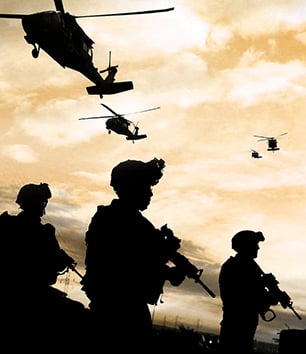
While most countries with a substantial military capacity have special forces of one sort or another, the size of the United States's commitment far exceeds that of any rival. Its special-operations command (Socom) oversees forces that are larger than many conventional armies. Socom currently has 66,000 personnel, with 12,000 deployed outside the homeland, three-quarters of them in Afghanistan (see David Isenberg, "The Globalisation of U.S. Special Operations Forces", IPS/TerraViva, 27 May 2012). A 12% increase is planned over the next four years, though a period of increasing budget pressures means that Socom wants to forge far greater cooperation with supportive allies.
It envisages a series of regional centres that concentrates the training and coordination of special forces from a number of countries (see Barbara Opall-Rome, "U.S. Seeks Global Spec Ops Network", Defense News, 14 May 2012). These would be modelled on Nato's special-operations forces HQ at Mons in Belgium. The latter has been instrumental in the rapid expansion of such forces in Afghanistan, where the US has worked closely with the British SAS, Australian units, and contingents of other coalition states (see Andrew Bacevich, "The Golden Age of Special Operations", TomDispatch, 29 May 2012).
Socom is already planning to set up the first such centre to cover central and south America (based, however, in Miami). The current leadership is also looking to establish another centre in the the middle east, though major political differences between allies will make this hard.
Instead, a likely candidate region is sub-Saharan Africa, where US forces are reported to be widely engaged in seeking to control a number of conflicts. A current example is the hundred Socom personnel now aidingoperations against Jospeh Kony and the remnants of the Lord's Resistance Army (LRA) in Uganda, South Sudan, the Central African Republic and the Democratic Republic of Congo (see John Ryan, "The Search for Joseph Kony", Defense News, 21 May 2012). A probable future focus is backing for the Nigerian authorities in countering the Boko Haram rebellion (see "Al-Qaida franchise: the Nigerian case", 25 August 2011).
The future war
The overarching assumption guiding military planners in this switch of emphasis to drones and special forces concerns the future of warfare. In particular, that there will be more "small wars in far-off places"; that these, despite their modest size and distance, might threaten US and western interests; and that they must be controlled without huge military commitments. Thus, the planners see drones and special forces as central to the challenge (see "America's global shift: drone wars, base politics", 3 May 2012).
But in the case of Washington's shift of emphasis there is a further, intriguing twist: the ever-closer linkage of this evolving approach not just with the US security posture but more generally with the country's foreign policy.
Two examples illustrate the trend. The first is the unexpected address by secretary of state Hillary Clinton at the special-operations forces industry conference in Tampa, Florida (see Paul McLeary, "U.S. State Department, SOCOM forge unlikely partnership", Defense News, 28 May 2012). This focused on the need to connect the state department and its diplomatic missions much more closely with Socom; as a case-study, Clinton cited the work of an inter-agency team, the Center for Strategic Counterterrorism Communications, in countering al-Qaida propaganda in Yemen. This team was housed in the state department, but it included Pentagon and intelligence-agency staff along with Socom personnel.
The second example relates to the aforementioned Socom operations in eastern Africa. Before Socom's involvement, the state department's new bureau of conflict and stabilisation operations (CSO) was working across the region. As Clinton put it: "{You) can begin to see the potential when soldiers and diplomats live in the same camps and eat the same MREs [meals read to eat]. This is smart power in action."
None of this is new. Diplomats and the military of many countries have invariably worked together, a reality especially pervasive when American and Soviet missions were engaging in numerous "proxy wars" during the cold-war era. In some ways, then, the trend represents "back to the future" - even if it flows directly from the experience of the post-9/11 wars.
What is different is the context: not of an ideological conflict between rival superpowers but of a constrainedenvironment filled with ever more individual "revolts from the margins". In this 21st-century world, the closer integration of military and diplomatic missions may lean more in the direction of a militarisation of diplomacy than the other way round. That certainly is significant.


No comments: