








Are the Venezuelan People’s Gains `Solely Because of Oil’?
Global Research, November 30, 2012
Links 1 November 2012
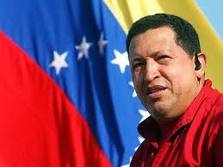
While most eyes in North America have been on the presidential election in the United States, for people in the South another election last month was actually of more interest. In the Bolivarian Republic of Venezuela, incumbent president Hugo Chávez was up against a strong challenge, from a – for once – united opposition. Gwynne Dyer (2012) was not alone when he speculated, days before the vote, that this could be “Hugo Chávez’s swan song”. However, when the vote came, it wasn’t really close, Chávez winning a third term as president with 55.08% of the vote, far ahead of the 44.3% obtained by his challenger Henrique Capriles Radonski (CNE 2012). Neither candidate in that other presidential election in the Americas can even dream about this kind of a victory margin.
There was good reason for huge interest “South of the Border” in the results of the election. The Chávez presidency has been at the centre of an assertion of sovereignty in Latin America and the Caribbean, an assertion of sovereignty that has put up a wall against economic, political and military encroachments by the Global North. To take one example from each of the spheres of economics, politics and the military, this wall of resistance has seen:
- the 2005 collapse of the Free Trade Area of the Americas (FTAA), scheduled to be implemented that year, but which is now completely moribund;
- the 2009 decision by the Organization of American States (OAS) to end its exclusion of Cuba from the organization (OAS 2012);
- the 2009 suspension of Honduras from OAS membership because of a right-wing coup against President José Manuel Zelaya (OAS 2010).
None of these would have been conceivable just a few years previous. The fact of a growing group of states willing to defy the U.S. is a huge change from the 1990s. None of it would have been possible without the accession to office by Chávez in 1999, the first government in some years in the region (except for, of course, the one in Cuba) to openly oppose U.S. hegemony.
The accomplishments of the Chávez presidency are almost always minimized in the Global North press. Dyer is typical, acknowledging that “Chávez’s rule has benefited the poor in many ways” but saying that this is solely because of oil. Chávez, he says, “has enjoyed the advantages of big oil exports and a tenfold increase in the world oil price” so that “almost all the growth in Venezuela’s economy since Chávez took power is due to higher oil prices” (Dyer 2012).
This is quite misleading. Alberta in Canada has oil, and is one of the most developed areas of the world. By contrast, Nigeria in Africa has oil, and is mired in deep, debilitating poverty and underdevelopment. Using a resource like oil for national development, or alleviating poverty, is not an inevitable question, but a political question, and the situation Chávez inherited when he took office in 1999 was politically retrograde.
Since 1976, oil extraction, refining and distribution in Venezuela, has been under the umbrella of a state-owned oil corporation, Petróleos de Venezuela, S.A. (PDVSA). But PDVSA did not operate in the interests of either the Venezuelan economy or the Venezuelan poor. It was, in effect, a front for Global North oil corporations, which maintained most of their privileges, paying exceedingly low royalties and taxes. In the Orinoco tar sands area, for instance, “the PDVSA capped the royalties to be paid by these projects at 1 percent” (McNew 2008, 153). An elite in PDVSA and the Venezuelan government became wealthy, but the economy remained in bad shape, poverty grew, and the oil wealth flowed out of the country.
Changing this situation proved extraordinarily difficult. In 2006 Chávez would call his plan for the oil industry “Full Sovereignty Over Oil” with the aim of gaining majority control of the 32 joint ventures with foreign companies, raising income taxes to 50% and increasing “royalties payable to the government from as low as 1 percent to 33 percent” (Carreño 2006; Collier 2006; McNew 2008; O’Grady 2005). In 2000, the objectives were much more modest. In November 2001, he passed the Hydrocarbons Law, whose key provision was to introduce royalties on a sliding scale from 20% to 30%.
The source for the details about the Hydrocarbons Law is an otherwise dry as dust publication called “The Oil Daily”. Interestingly, in the same issue of that publication, the authors highlight another aspect of the Chávez reforms that they consider problematic. “Also controversial is new land reform legislation that allows the expropriation of areas deemed unproductive by the government” (The Oil Daily 2011). There is a fascinating consistency to these spokespeople for big business, concerned to protect the interests of Global North corporate profits, and the Global South privileged, landed elite.
It was this modest attempt to push back against the privileges of the oil industry, which provoked the social crises of 2002 and 2003. The corruption in Venezuelan society was not limited to the corporations. The leaders of the main trade union central, the Workers’ Confederation of Venezuela (CTV) – including its most important section, the oil workers of Fedepetro – joined with the main bosses’ organization, Fedecamaras, to oppose Chávez. This perverse united front of privileged managers and corrupt union leaders, bent every effort to roll back the reforms.
The highlights of this struggle are well known. April 2002, there was an attempted coup against Chávez, stopped by massive mobilization of the poorest sections of Caracas, and a split in the armed forces. In the winter of 2002-2003, there was a strike (really a lockout) centred in the oil industry which brought the economy to its knees. This was only ended when the blue-collar workers who supported Chávez, pushed aside the white-collar workers who supported the opposition, and began to restart production. In the end, 18,000 PDVSA employees – half of the PDVSA workforce, but fully “90 percent of PDVSA’s white-collar workforce” were dismissed (Collier 2006; Clough 2008).
It is only after this massive social upheaval lasting almost two years, that Chávez was able to assert the very basic right to increase royalties on oil production in the country. The point is, there is nothing automatic about being able to direct profits from the extractive industries towards national economic development, let alone social assistance for the poor. There were very serious class forces opposed to these steps being taken, and two years of intense class struggle before these very modest reforms could be implemented.
None of this history matters for commentators like Dyer. He berates Chávez for overseeing a rate of economic growth that has been slower than in Brazil or Colombia. Of course economic growth in Venezuela has been slower. First, Brazil is the biggest economy on the South American continent, with a domestic market many times the size of that in Venezuela. Second, Colombia’s growth has been as a virtual client state of the U.S., and the price of its growth has been the displacement of millions from their land, and the death of thousands at the hands of right-wing death squads. Third, while Venezuela was able to assert control over oil by 2003, the oil industry in the country has never fully recovered from the loss of the 18,000 white-collar professionals. It is absolutely understandable why they were fired – their alliance with the bosses’ federation pushed the country to the brink of chaos. But the modern oil industry is extraordinarily complex, and their skill and expertise has yet to be replaced in the oil fields and refineries.
Veteran Latin American Commentator Mike Gonzalez in his analysis of the election, identifies some real problems in contemporary Venezuela. “[W]hoever travels to Venezuela with open eyes cannot fail to notice the conspicuous consumption of the bourgeoisie with its shopping centres, restaurants, the permanently guarded houses and estates, and the fourwheel drives with tinted windows that speed through the streets” (González 2012). He is right. There is a new elite developing around the state apparatus. The privileges of the old elite are still remarkably intact.
But Gonzalez makes his critique less persuasive by offering a confusing assessment of the election results. “Although official spokespeople of the government insist that the vote for Chávez grew, in reality, despite a large campaign backed up by immense resources, the vote he received was much lower than any since 1998” (González 2012).
In fact, the exact opposite is true. This is not the lowest vote total for Chávez since 1998. It is his highest vote total ever. The chart on this page makes this very clear. It shows the total votes counted in the last three presidential elections, the total vote for Chávez, and the total vote for his chief opposition candidate (CNE 2006; CNE 2012; IFES 1998).

There are several remarkable aspects to this chart. First – voter participation has exploded. The total votes cast in 1998 were just under 7 million. This jumped to almost 12 million in 2006 and more than 15 million in 2012. More than twice as many people cast ballots in 2012 compared to 1998.
This can only partly be accounted for by population increase. The other key factor has been the increase in overall participation. In 1998 63.76% of the eligible population cast a ballot. In 2006 that figure jumped to 74.69%. This year it reached the astonishing figure of 80.52%. These levels of voter participation are higher than in Canada, and far higher than in the United States. Perhaps we need editorials in the Globe and Mail and the New York Times, bemoaning the lack of democracy in the Global North, and praising Venezuela for high levels of citizen involvement in elections.
Then look at the vote totals for Chávez. He was first elected, in 1998, with 3.7 million votes. He almost doubled this in 2006, to a total of 7.3 million. This year he received almost 8.2 million votes, an increase of more than 800,000 from the total of 2006.
The 2012 elections did see a narrower margin of victory for Chávez, in the context of a massive voter turnout. Clearly what was going on was a serious mobilization by the right wing to oust Chávez. That his vote increased in the face of this tidal wave of right wing organizing, is impressive.
It was the fact of this right wing surge which shaped political attitudes in Venezuela. The only position to take in the 2012 election, with whatever criticisms, was to support Chávez, something that, as Jeffrey Webber points out, “was recognized by close to the entirety of the Venezuelan left over the last several months, including those sectors especially critical of the limits to the political economic program of the government and the lingering influence of an important conservative bureaucratic layer within the ruling party” (Webber 2012).
Outside of Venezuela, we face a different challenge. Chávez’ great crime in the eyes of the leaders of the United States, Britain and Canada, is that he has presided over a movement which has restricted their ability to drain oil profits out of the country, a movement which has instead diverted those profits towards social programs. As a result, the transnational oil companies, and the Global North governments will be only too ready to support any mobilization of the right-wing against Chávez, and we have to be ready to do our bit to oppose them, if and when they embark upon such a course of action.
References
Carreño, Rafael Ramírez. 2006. “Full Sovereignty Over Oil.” Sitio Web PDVSA.
Clough, Langdon D. 2008. “Energy Profile of Venezuela.” The Encyclopedia of Earth.
CNE. 2006. “Elección Presidencial – 3 De Diciembre De 2006.” Poder Electoral.
———. 2012. “Divulgación Elección Presidencial – 07 De Octubre De 2012.” Poder Electoral.
Collier, Robert. 2006. “Chavez Drives a Hard Bargain, but Big Oil’s Options Are Limited.” San Francisco Chronicle, September 24.
Dyer, Gwynne. 2012. “Hugo Chavez’s Swan Song in Venezuela?: He Could Lose; He Could Die. But What He Has Built Will Survive Him.” The Spectator, October 2.
González, Mike. 2012. “Venezuela: El Chavismo Contra Un Candidato No Tan Nuevo.” En Lucha, October.
IFES. 1998. “Election Profile for Venezuela – Results.” Election Guide.
McNew, B. Seth. 2008. “Full Sovereignty over Oil: A Discussion of Venezuelan Oil Policy and Possible Consequences of Recent Changes.” Law and Business Review of the Americas 14: 149–158.
O’Grady, Mary Anastasia. 2005. “Americas: Oil Wells Refuse to Obey Chavez Commands.” Wall Street Journal, May 20, sec. A.
OAS. 2010. “Member States.” OAS – Organization of American States: Democracy for Peace, Security, and Development.
———. 2012. “Member States.” OAS – Organization of American States: Democracy for Peace, Security, and Development.
The Oil Daily. 2011. “Venezuelan Strike Poses Big Challenge.” The Oil Daily, December 10.
Webber, Jeffrey R. 2012. “Latest Step in a Long Road: The Venezuelan Elections.” The Bullet, October 12.


No comments: