








'Zero Dark Thirty' Is Osama bin Laden's Last Victory Over America
Matt Taibbi

January 16, 2013
I went to see Zero Dark Thirty this weekend with great anticipation. I've always loved Kathryn Bigelow's movies – I'm a fan to an almost embarrassing degree. Like most people I liked the Busey-Keanu surf-and-bromance film Point Break, but I also loved the The Weight of Water, as well as Strange Days, The Widowmaker… Bigelow's movies are visually engrossing, innovative and smart, and I couldn't wait to see what she did with a real-life subject matter that had the potential to be both the greatest detective story and the greatest action-movie plot of all time.
So I went to see the movie and like most people I know who watched it, I was blown away. On a pure whodunit level, the bulk of the film was an unbelievably compelling thriller, and purely on the level of action cinematography, the final scene – with all its real-world drama and consequence, plus the unique fact the movie revealed secrets about one of the shadowiest, most highly-classified operations ever – was about as pulse-pounding and exciting as movies get.
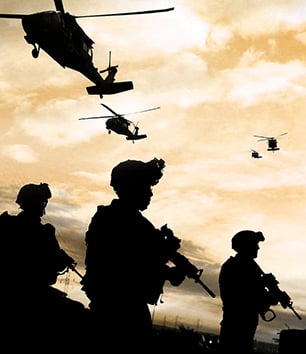
The way Bigelow shot that last sequence in Abbotabad, constantly declining to Michael-Bay-ize the action sequences with goofball explosions and kung-fu battles, and not glossing over the brutality or the mission's mistakes (God, what a screw-up to crash that helicopter!), it was ingenious. For however long it lasted, you felt exactly how long 14 or 15 minutes can be, with so much on the line, crowds beginning to form, Pakistani jets on the way.
And when they dragged the big prize with its blood-soaked beard back into the copter and flew off, well – the triumph the characters felt at that moment exploded into the theater, there were gasps and patriotic applause, and even I got caught up in it. The only thing I can compare it to was seeing Rocky or Star Wars in theaters as a kid, the way the crowds went wild over the ass-kicking ending.
On the way home I felt buzzed and high, like one always does after seeing a great film, but then various things that had bothered me about the movie started to float to the surface.
Apart from the queasiness from the opening "enhanced interrogation" scene (more on that in a minute), there was the letdown purely on the detective-movie fanboy level I got from the fact that the "heroes" got their key information from torture. It was like watching a fishing show where the host throws dynamite in the lake to get the bass. In all the detective films and books I grew up watching and reading, the meathead cop who uses the third degree is always the villain – or if not the bad guy exactly, the sap, the klutz, who screws things up by swinging a fist when just talking would have worked fine.
In classic detective tales, the thug interrogator is even sometimes introduced as a parallel character to the hero, to show how things aren't done – think the Victory Motel scenes inL.A. Confidential, or the cops in Raymond Chandler's novels. Take the character of Captain Gregorius in The Long Goodbye, who gets tough with Marlowe when he didn't need to, trying to get him to fink on his friend in a murder investigation. Chandler couldn't have known how much a passage from his great P.I. novel would have relevance to the War on Terror decades later:
Gregorius bared his teeth at me. They needed cleaning – badly. "Let's have the exit line, chum.""Yes, sir," I said politely. "You probably didn't intend it, but you've done me a favor. With an assist from Detective Dayton. You've solved a problem for me. No man likes to betray a friend but I wouldn't betray an enemy into your hands. You're not only a gorilla, you're an incompetent. You don't know how to operate a simple investigation. I was balanced on a knife edge and you could have swung me either way. But you had to abuse me, throw coffee in my face, and use your fists on me when I was in a spot where all I could do was take it. From now on I wouldn't tell you the time by the clock on your own wall."For some strange reason he sat there perfectly still and let me say it. Then he grinned. "You're just a little old cop-hater, friend. That's all you are, shamus, just a little old cop-hater.""There are places where cops are not hated, Captain. But in those places you wouldn't be a cop."
Back to the "enhanced interrogation" in the first scene: conducted by chameleonic Australian actor Jason Clarke's "Dan" character while Oscar nominee Jessica Chastain's Maya character looks on, it's shocking, horrific, disgusting, and it was obviously supposed to be all of those things.
By graphically depicting the sexual humiliation ("You don't mind if my female colleague sees your junk?" Clarke says, ripping the suspect's pants down as he hangs by his wrists), the walking around of suspects in dog-collars Lynndie-England-style, the putting of people in boxes, the waterboarding and the flat-out punching in the face (which Maya resorts to later, with help from another interrogator), Bigelow made it clear that she wasn't making any half-assed Rumsfeldian claim that what went on after 9/11, in thousands of grimy rooms around the world with thousands if not tens of thousands of people, somehow wasn't torture.
No, Bigelow wrapped her arms all the way around that subject, which makes sense now. She has since been praised, almost excessively, for being brave enough to "tell the truth" about torture in Zero Dark Thirty. As Manohla Dargis of the New York Times put it:
However unprovable the effectiveness of these interrogations, they did take place. To omit them from "Zero Dark Thirty" would have been a reprehensible act of moral cowardice.
Here's my question: if it would have been dishonest to leave torture out of the film entirely, how is it not dishonest to leave out how generally ineffective it was, how morally corrupting, how totally it enraged the entire Arab world, how often we used it on people we knew little to nothing about, how often it resulted in deaths, or a hundred other facts? Bigelow put it in, which was "honest," but it seems an eerie coincidence that she was "honest" about torture in pretty much exactly the way a CIA interrogator would have told the story, without including much else.
There's no way to watch Zero Dark Thirty without seeing it as a movie about how torture helped us catch Osama bin Laden. That's why I was blown away when I read this morning that Bigelow is now going with a line that "depiction is not endorsement," that simply showing torture does not amount to publicly approving of it.
If Bigelow really means that, I have a rhetorical question for her: Are audiences not supposed to cheer at the end of the film, when we get bin Laden? They cheered in the theater where I watched it. And is Maya a good character or a bad character? Did she cross some dark line in victory like Michael Corrleone, did she lose her moral self and her humanity chasing her goal like Captain Ahab, or is she just a modern-day Sherlock Holmes (or, hell, John McClane) getting his man in the end?
It seemed to me more the latter than anything else. I barely caught a whiff of a "moral journey/descent" storyline in this film – the closest they came to that was in the first scene, where Maya looks a little grossed out by Clarke's methods. A few minutes later, though, she's all street and everything, wearing a hijab and getting some henchman to throw fists at her suspects on command. She went from queasy to hardass in about ten seconds and we didn't linger on the transformation at all.
Bigelow is such a great storyteller that she has to know, deep inside, that the "depiction is not endorsement" line doesn't wash. You want audiences gripped to the screen, you've gotta give them something to root for, or against. This was definitely not a movie about two vicious and murderous groups of people killing and torturing each other in an endless cycle of increasingly brainless revenge. And this was not a movie about how America lost its values en route to a great strategic victory.
No, this was a straight-up "hero catches bad guys" movie, and the idea that audiences weren't supposed to identify with Maya the torturer is ludicrous. Are we really to believe that viewers aren't supposed to be shimmering in anticipation for her at the end, as she paces back and forth with set-fans whooshing back her beautiful red hair, waiting for her copter to come in? They might as well have put a cape and a Wonder Woman costume on her, that's how subtle that was.
Bigelow and screenwriter Mark Boal clearly spent a lot of time with sources in the CIA who were peddling a version of history where the "Enhanced Interrogation Techniques" program, though distasteful, scored us the big prize in the end.
In Oscar-winning director Alex Gibney's agonizing and affecting documentary about EIT called Taxi to the Dark Side, he talks about the phenomenon of "force drift" in torture, when interrogators start using harsher methods when the permitted ones don't work. Well, in journalism, what happened with Boal and Bigelow is what you might call "access drift" – when you really, really love the drama of the story you're hearing, you start leaning in the direction of your sources even if the truth doesn't quite cooperate.
Obviously, torture does produce some information, maybe even some good information. If you really squint hard, it may very well be that, technically speaking, there's a lot of truth in the plot of Zero Dark Thirty. It may be that we wouldn't have found bin Laden without torture. And as such, any movie about the hunt for bin Laden that excluded scenes of torture would have been dishonest.
But that's not what's messed up about this movie. The problem had nothing to do with the fact that Bigelow showed torture. It was the way she depicted it – without perspective, and in the context of a pulse-pounding thriller where the audience is clearly supposed to root for the big treasure find.
For one thing, Gibney put out a compelling argument in a Huffington Post piece that theZD30 storyline is not accurate in the sense that it excluded crucial information. He points to several facts that Bigelow and Boal chose to ignore (and remember, this was supposed to be a "journalistic account," according to Bigelow), like for instance:
1) Mohammed Al-Qatani, the so-called "20th hijacker," who may have been some part of the inspiration for the "Ammar" character who was tortured in the opening scene, might have been the first detainee to mention the name of bin Laden's courier. But as Gibney points out, al-Qatani gave that information up to the FBI, in legit, torture-free interrogations, before he was whisked away to Gitmo for 49 days of torture that included such insanities as forcing him to urinate on himself (by force-feeding him liquids while in restraints), making him watch a puppet show of him and bin Laden having sex, making him take dance lessons, making him wear panties on his head, and making him wear a "smiley-face" mask, along with the usual sleep and sensory deprivation, arm-hanging, etc. In other words, the key info may have come before they chucked our supposed standards for human decency.
2) The CIA waterboarded Khalid Sheikh Mohammed 183 times, and throughout this "enhanced interrogation," the former al-Qaeda mastermind continually played down the importance of Abu Ahmed al-Kuwaiti, the man who led the CIA to bin Laden. But the CIA was so sure KSM was telling the truth under torture – so sure waterboarding was a "magic bullet," as Gibney put it to me – that they discounted the lead. So torture may have actually delayed bin Laden's capture.
3) The CIA took another detainee, Ibn al-Sheik al Libi, and duct-taped his head, put him in a wooden box, shipped him off to Cairo to be waterboarded, and got him to admit under torture that there were links between Saddam Hussein and bin Laden. This "intel" became part of Colin Powell's presentation to the U.N. on the need to invade Iraq. So while torture might have found us bin Laden, maybe, it also very well might have sent us on one of history's all-time pointlessly bloody wild goose chases, invading Iraq in search of WMDs.
A more accurate movie about the torture program would have been a grotesque comedy that showed grown men resorting to puppet shows and dance routines and fourth-rate sexual indignities dreamed up after spending too much time reading spank mags and BDSM sites – and doing this thousands of times to thousands of people, all over the world, "accidentally" murdering hundreds of people in the process, going to war by mistake at least once as a result of it, and having no clue half the time who they're interrogating (less than 10 percent of "terror suspects" at places like Bagram were arrested by American forces; most of the rest were brought in by Afghanis or other foreigners in exchange for bounties).
I mean, this is real Keystone Kops stuff, on a grand scale, only it had the minor side effect of destroying everything America purports to stand for, in addition to being comically stupid and ineffective.
Zero Dark Thirty is like a gorgeously-rendered monument to the fatal political miscalculation we made during the Bush years. It's a cliché but it's true: Bin Laden wanted us to make this mistake. He wanted America to respond to him by throwing off our carefully-crafted blanket of global respectability to reveal a brutal, repressive hypocrite underneath. He wanted us to stop pretending that we're the country that handcuffs you and reads you your rights instead of extralegally drone-bombing you from the stratosphere, or putting one in your brain in an Egyptian basement somewhere.
The only way we were ever going to win the War on Terror was to win a long, slow, political battle, in which we proved bin Laden wrong, where we allowed people in the Middle East to assess us as a nation and decide we didn't deserve to be mass-murdered. To use another cliché, we needed to win hearts and minds. We had to make lunatics like bin Laden pariahs among their own people, which in turn would make genuine terrorists easier to catch with the aid of genuinely sympathetic local populations.
Instead, we turned people like bin Laden into heroes. Just like Marlowe in The Long Goodbye, there were a lot of people in the Middle East who were on the knife-edge about America after 9/11. Yes, we were hated for supporting Israel, but the number of people willing to suicide-bomb us was still a tiny minority.
The EIT program changed that. We tortured and humiliated thousands of people across the world. We did it on camera, in pictures that everyone in the Middle East can watch over and over again on the Internet. We became notorious for a vast kidnapping program we called by the harmless-sounding term "rendition," and more lately for an endless campaign of extralegal drone attacks, through which 800 innocent people have died in Afghanistan alone in the last four years (the Guardian claims we've killed 168 children in that country in the last seven years).
Now we have this movie out that seems to celebrate the use of torture against Arabs, and we're nominating it for Oscars. Bigelow can say that "depiction is not endorsement," but how does she think audiences will receive it in the Middle East? Are they going to sell lots of popcorn in Riyadh and Kabul during the waterboarding scenes?
This film got nominated for Best Picture – it could even win. Has anyone thought about howZero Dark Thirty winning Best Picture will be received in places like Kashmir and Waziristan and Saudi Arabia?
But forget about all of that. The real problem is what this movie says about us. When those Abu Ghraib pictures came out years ago, at least half of America was horrified. The national consensus (albeit by a frighteningly slim margin) was that this wasn't who we, as a people, wanted to be. But now, four years later, Zero Dark Thirty comes out, and it seems that that we've become so blunted to the horror of what we did and/or are doing at Abu Ghraib and Guantanamo and Bagram and other places that we can accept it, provided we get a boffo movie out of it.
That's pathetic. Bin Laden was maybe the most humorless person who ever lived, but he has to be laughing from the afterlife. We make an incredible movie that celebrates his death – a movie so good it'll be seen everywhere in the world – and all it does is prove him right about us.
Editor's Note: Since I seem to be taking a lot of heat for this one, a few notes. Many emailers are telling me this was a movie that "examined the moral costs of victory" and showed many scenes of regret and internal conflict. One pointed to the fact that "Dan" went home, another pointed to Maya's tears at the end as being "symbolic" of America's ambivalence about all that messy torture stuff.
First of all, Dan went home because he was tired. If you want to argue that he really went home because he was sick of torturing people, good luck with that one, because he went home to stay in the CIA and oversee the same goddamned torture programs! How's that for moral disgust! Forget John Paul Vann, dude is practically Gandhi. There's no actual evidence for any kind of moral wrangling in Dan's case – it's much more likely that he just felt like wearing a tie for a while.
As for Maya's tears, anyone who reads in regret or ambivalence there is doing just that: reading in. I saw that scene as being identical to the ending of The Princess Bride, when Inigo Montoya says, "I've been in the revenge business for so long, now that it's over, I don't know what to do with the rest of my life."
All the "examining the moral cost" stuff people seem to be seeing is, by an amazing coincidence, unspoken and implied in this movie. All the stuff about how torture helped us catch bin Laden is, by yet another, equally amazing coincidence, explicit and shown quite graphically.
Some wrote in and said that all Bigelow was doing was telling an "objective" story and leaving it to us to sort it out. That's bullshit. All storytelling is a series of editorial decisions. You decide what to leave in, what to leave out. In doing so you reveal a point of view. They kept to a very narrow storyline that ended in the triumphant capture of bin Laden. The posters don't say, "WE SOLD OUR SOULS TO GET HIM," they read, "THE GREATEST MANHUNT IN HISTORY." There's no Das Boot-style shock-bummer ending where Maya steps off her transport plane and gets blown to hell.
My last comment is going to be this: To all the people defending the movie, what do you think Dick Cheney's review is going to be? Isn't it just a crazy coincidence that he's probably going to love it?


No comments: